Download
1 / 3
0 likes | 0 Vues
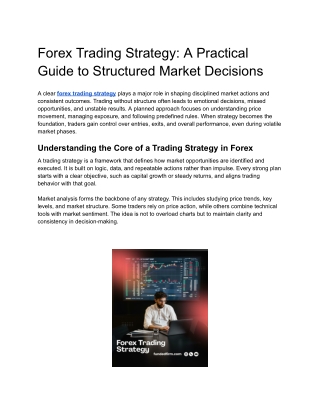
A clear forex trading strategy plays a major role in shaping disciplined market actions and consistent outcomes. Trading without structure often leads to emotional decisions, missed opportunities, and unstable results. A planned approach focuses on understanding price movement, managing exposure, and following predefined rules. When strategy becomes the foundation, traders gain control over entries, exits, and overall performance, even during volatile market phases.<br>

E N D
Forex Trading Strategy: A Practical Guide to Structured Market Decisions A clear forex trading strategy plays a major role in shaping disciplined market actions and consistent outcomes. Trading without structure often leads to emotional decisions, missed opportunities, and unstable results. A planned approach focuses on understanding price movement, managing exposure, and following predefined rules. When strategy becomes the foundation, traders gain control over entries, exits, and overall performance, even during volatile market phases. Understanding the Core of a Trading Strategy in Forex A trading strategy is a framework that defines how market opportunities are identified and executed. It is built on logic, data, and repeatable actions rather than impulse. Every strong plan starts with a clear objective, such as capital growth or steady returns, and aligns trading behavior with that goal. Market analysis forms the backbone of any strategy. This includes studying price trends, key levels, and market structure. Some traders rely on price action, while others combine technical tools with market sentiment. The idea is not to overload charts but to maintain clarity and consistency in decision-making.
Risk management is another essential pillar. Position sizing, stop placement, and risk limits protect capital during unfavorable moves. A strategy without defined risk rules often fails, regardless of how accurate the analysis appears. Importance of Market Timing and Trade Execution Timing influences the quality of trades. Markets move differently during various sessions, and liquidity plays a major role in price behavior. A structured approach considers active trading hours, volatility ranges, and economic events. Execution discipline separates planned trades from random ones. Entering a position only when conditions align with predefined rules helps reduce unnecessary losses. The same discipline applies to exits. Clear profit targets and exit conditions prevent emotional decisions driven by short-term price fluctuations. Consistency in execution builds confidence. Over time, this allows traders to review performance objectively and make data-based improvements instead of reacting emotionally to single outcomes. Role of Analysis and Trade Management Analysis is not limited to finding entry points. Ongoing evaluation of open positions helps traders adapt to changing market conditions. Trade management techniques such as trailing stops or partial exits can protect profits while allowing room for growth. Keeping a trading journal strengthens this process. Recording reasons for entry, exit decisions, and emotional state during trades reveals patterns that often go unnoticed. This habit supports long-term improvement and sharper discipline. Strategy refinement is a continuous process. Markets evolve, and strategies must adapt through testing and review. Adjustments based on performance data maintain relevance and effectiveness without compromising core rules. Psychology and Discipline in Strategic Trading Mental discipline plays a key role in executing any plan successfully. Even a well-designed strategy can fail if emotions take control. Fear and overconfidence often lead to early exits or unnecessary trades. A structured routine helps maintain focus. Reviewing charts, setting alerts, and planning trades in advance reduce impulsive behavior. Accepting losses as part of the process also strengthens emotional stability and decision-making clarity. Patience is another vital trait. Waiting for high-quality setups instead of forcing trades improves accuracy and long-term results. Strategic trading values quality over quantity.
Long-Term Growth Through Structured Planning Sustainable trading success comes from repetition and review. A strategy provides measurable results that can be tracked over time. This allows traders to understand strengths, identify weaknesses, and refine execution methods. Markets reward discipline and preparation. A structured plan removes uncertainty and creates a clear roadmap for action. Over time, this approach supports steady growth and controlled exposure to risk. Final Thoughts on Building Consistency A reliable forex trading strategy brings structure, discipline, and clarity to market participation. It transforms trading into a planned process rather than a reaction to price movement. By focusing on analysis, execution, and risk control, traders develop confidence and consistency. In the long run, a well-defined strategy supports stable performance and informed decisions across changing market conditions.
















![[PDF] DOWNLOAD Options Trading Psychology: The Art of Mastering Your Trading Mindset for Financial Freedom (How To Trade](https://cdn7.slideserve.com/12580025/slide1-dt.jpg)
![[READ DOWNLOAD] FOREX TRADING: The Basics Explained in Simple Terms (Forex, Forex Trading System, Forex Trading Strategy](https://cdn7.slideserve.com/12667090/slide1-dt.jpg)

![Ebook❤️(download)⚡️ OPTIONS TRADING: A Beginners Crash Course [7 BOOKS in 1] with Best Strategies and 1 # Guide to Becom](https://cdn7.slideserve.com/12682550/slide1-dt.jpg)
![[READ DOWNLOAD] FOREX TRADING: The Basics Explained in Simple Terms (Forex, Forex Trading System, Forex Trading Strategy](https://cdn7.slideserve.com/12693050/slide1-dt.jpg)