ASTM A334 Grade 1 Pipes
0 likes | 0 Vues
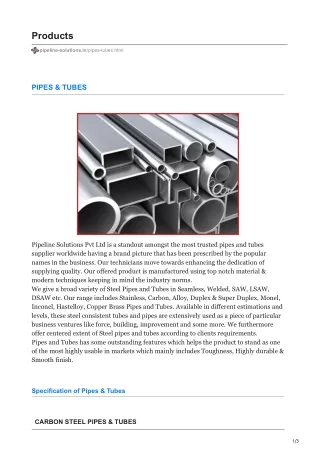
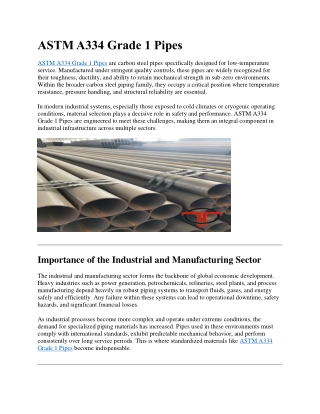
What are ASTM A334 Grade 1 Pipes? These are seamless carbon steel pipes engineered for low-temperature services. The specification covers pipes with excellent notch toughness and mechanical strength at sub-zero temperatures. ASTM A334 Grade 1 has a nominal composition of carbon, manganese, phosphorus, and sulfur, making it a highly durable material that resists brittleness in cold environments. It conforms to ASTM standards and is frequently used in demanding conditions where normal piping materials fail. Tricon Steel & Alloys supplies these pipes in various sizes and wall thicknesses as a dep


ASTM A334 Grade 1 Pipes
E N D
Presentation Transcript
ASTM A334 Grade 1 Pipes ASTM A334 Grade 1 Pipes are carbon steel pipes specifically designed for low-temperature service. Manufactured under stringent quality controls, these pipes are widely recognized for their toughness, ductility, and ability to retain mechanical strength in sub-zero environments. Within the broader carbon steel piping family, they occupy a critical position where temperature resistance, pressure handling, and structural reliability are essential. In modern industrial systems, especially those exposed to cold climates or cryogenic operating conditions, material selection plays a decisive role in safety and performance. ASTM A334 Grade 1 Pipes are engineered to meet these challenges, making them an integral component in industrial infrastructure across multiple sectors. Importance of the Industrial and Manufacturing Sector The industrial and manufacturing sector forms the backbone of global economic development. Heavy industries such as power generation, petrochemicals, refineries, steel plants, and process manufacturing depend heavily on robust piping systems to transport fluids, gases, and energy safely and efficiently. Any failure within these systems can lead to operational downtime, safety hazards, and significant financial losses. As industrial processes become more complex and operate under extreme conditions, the demand for specialized piping materials has increased. Pipes used in these environments must comply with international standards, exhibit predictable mechanical behavior, and perform consistently over long service periods. This is where standardized materials like ASTM A334 Grade 1 Pipes become indispensable.
Role of Key Industries Using Carbon Steel Piping Energy and Power Generation Thermal and nuclear power plants rely on extensive piping networks to carry steam, feedwater, and condensate. Low-temperature zones, particularly during startup or shutdown cycles, demand pipes that can withstand thermal stress without cracking. Oil and Gas Processing Upstream, midstream, and downstream oil and gas facilities operate in varied temperature ranges, including cold offshore environments. Piping systems must maintain integrity while handling hydrocarbons under pressure. Chemical and Petrochemical Manufacturing Chemical processing plants often handle volatile fluids at fluctuating temperatures. Materials used in pipelines must ensure chemical compatibility and mechanical stability. Industrial Fabrication and Engineering Fabrication units and EPC contractors require standardized pipes for large-scale projects, ensuring consistency, traceability, and regulatory compliance. Connection Between Industries and ASTM A334 Grade 1 Pipes The industries mentioned above demand materials that can perform reliably in low-temperature conditions without compromising safety. ASTM A334 Grade 1 Pipes are specifically developed for such applications. Their chemical composition and controlled heat treatment ensure enhanced notch toughness, making them suitable for environments where brittle fracture is a risk. These pipes also integrate seamlessly into systems that may include other alloy and carbon steel products, such as ASTM A335 Pipes, which are typically used for high-temperature and high- pressure services. Together, these materials allow engineers to design piping systems capable of handling wide thermal ranges within the same facility. Benefits of ASTM A334 Grade 1 Pipes Across Industries Mechanical Reliability and Safety
ASTM A334 Grade 1 Pipes are known for their excellent impact resistance at low temperatures. This property significantly reduces the risk of sudden material failure, enhancing operational safety. Compliance with International Standards These pipes are manufactured in accordance with ASTM specifications and are often aligned with ASME Boiler and Pressure Vessel Code requirements for piping systems. Equivalent references and material acceptance are recognized across global projects, ensuring ease of approval. Chemical and Dimensional Consistency The controlled carbon and manganese content ensures good weldability and formability. Dimensional tolerances meet stringent industrial requirements, supporting precision installation. Quality and Certification Pipes are typically supplied with mill test certificates, including chemical analysis, mechanical test results, and impact testing. Compliance with standards such as ASTM, ASME, DIN, and JIS enhances global usability. Long-Term Efficiency By minimizing maintenance needs and reducing the likelihood of replacement due to material degradation, ASTM A334 Grade 1 Pipes contribute to long-term operational efficiency and cost control. Industry Applications ASTM A334 Grade 1 Pipes are widely used in applications where low-temperature performance is critical: Low-temperature fluid transportation pipelines Heat exchangers and condenser systems Power plant auxiliary piping Oil and gas transmission in cold regions Industrial refrigeration and cooling systems Structural piping exposed to variable climates In global supply chains, a certified ASTM A334 Grade 1 Pipes Exporter plays an important role by ensuring consistent quality, proper documentation, and adherence to international shipping
and compliance norms. This reliability supports large-scale industrial projects that depend on uninterrupted material supply. Conclusion: Future Relevance of ASTM A334 Grade 1 Pipes As industrial operations expand into harsher environments and demand higher safety margins, the importance of low-temperature carbon steel piping will continue to grow. ASTM A334 Grade 1 Pipes address a critical niche within the industrial ecosystem by offering dependable performance, standardized quality, and compatibility with complex piping systems. Their integration alongside other specialized materials enables engineers to design safer and more efficient plants capable of operating across wide temperature ranges. With ongoing advancements in industrial manufacturing and global infrastructure development, ASTM A334 Grade 1 Pipes are set to remain a vital material choice for industries focused on durability, compliance, and long-term performance.