Benefits of Preschool Education
Benefits of Preschool Education. W. Steven Barnett, Director National Institute for Early Education Research Rutgers—The State University of New Jersey For further information go to our website: www.nieer.org. Preschool’s Benefits. Increased Achievement Test Scores


Benefits of Preschool Education
E N D
Presentation Transcript
Benefits of Preschool Education W. Steven Barnett, Director National Institute for Early Education Research Rutgers—The State University of New Jersey For further information go to our website: www.nieer.org
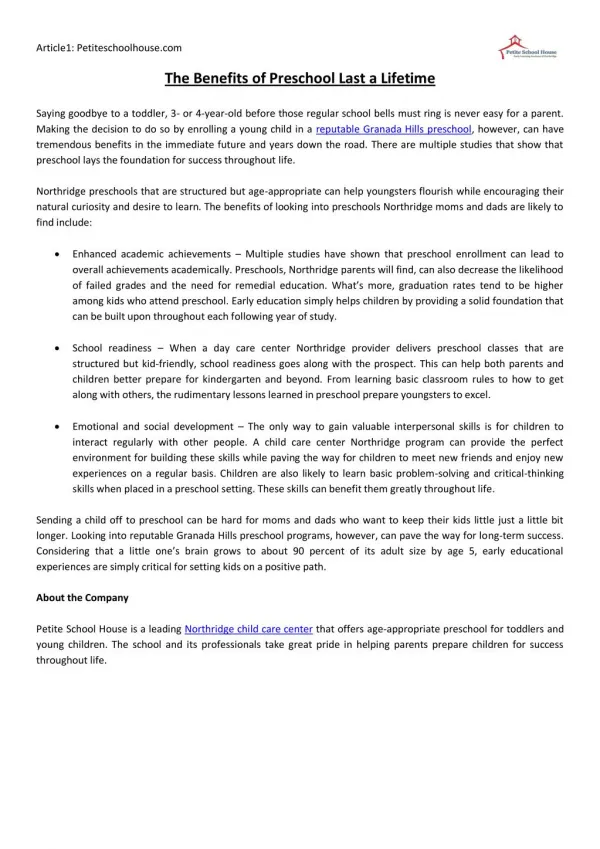
Preschool’s Benefits • Increased Achievement Test Scores • Improved Behavior and Attitudes • Decreased Grade Retention • Decreased Special Education • Decreased Crime & Delinquency • Increased High School Graduation
Three Exemplary Studies High/Scope Perry Preschool– a half-day program on a small scale in the Ypsilanti, MI public schools True Experiment, n=123, follow-up to age 27 Abecedarian educational child care– a full-day year-round program in Chapel Hill, NC True Experiment, n=111, follow-up to age 21 Chicago-Child Parent Centers (CPC)– a half-day program on a large scale in the Chicago public schools Quasi-Experimental, n=1286, follow-up to age 18-21
Perry: Economic Return to the Public(excludes $20,000 in economic benefits to participants)
Cost – Benefit Analysis of Preschool for Disadvantaged Children Cost Benefit to Society • Perry Preschool: $12,000 $108,000 • Abecedarian: $35,864 $136,000 • CPC: $7,000 $ 48,000 All three studies find that economic benefits from intensive, high-quality programs to taxpayers and participants combined far exceed the cost of high-quality programs (comparable to the cost of public education generally).
Education Challenges • Many Children Start School with Significant Academic Disadvantages • Many Social and Emotional Problems Are Evident Prior to School Entry • High School Graduation Declined 40 Years • College Graduation Rate Flat for 25 Years
Middle Class Children At Risk Too Middle class children have fairly high rates of academic problems preschool reduces for low-income children. Reducing these problems could generate large benefits. IncomeRetention Dropout Lowest 20% 17% 23% 20-80% 12% 11% Highest 20% 8% 3% Source:US Department of Education, NCES (1997). Dropout rates in the United States: 1995. Figures are multi-year averages.
Preschool Classroom Quality is Too Low Excellent Good Minimal
Conclusions • Preschool produces cognitive and social emotional gains for children (at least disadvantaged) • Quality preschool education can be a good economic investment • Most 3-4 year old children already attend some type of classroom • Access and quality must be improved if society is to obtain the returns