Avoiding Common Pitfalls When Outsourcing Accounting and Finance Support
0 likes | 0 Vues
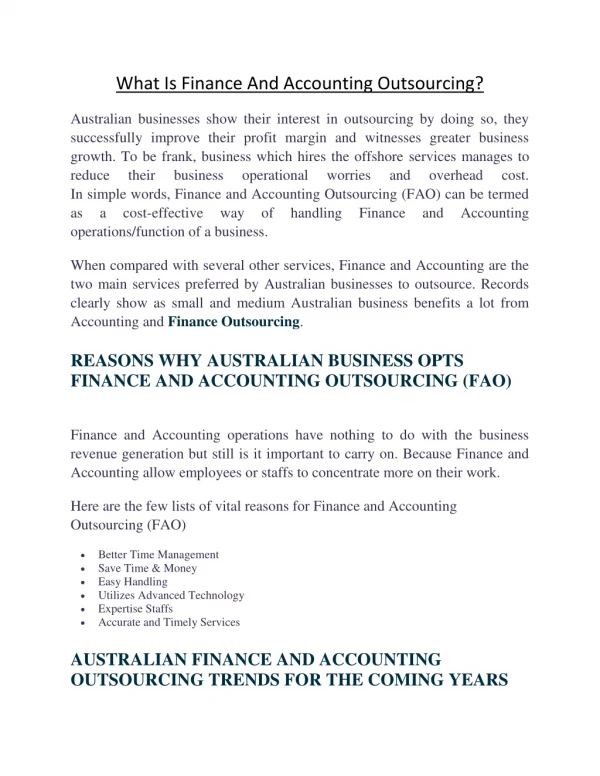
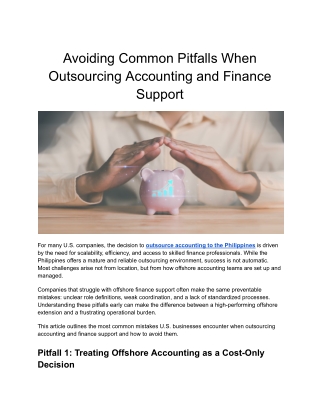
For many U.S. companies, the decision to outsource accounting to the Philippines is driven by the need for scalability, efficiency, and access to skilled finance professionals. While the Philippines offers a mature and reliable outsourcing environment, success is not automatic. Most challenges arise not from location, but from how offshore accounting teams are set up and managed.


Avoiding Common Pitfalls When Outsourcing Accounting and Finance Support
E N D
Presentation Transcript
Avoiding Common Pitfalls When Outsourcing Accounting and Finance Support For many U.S. companies, the decision to outsource accounting to the Philippines is driven by the need for scalability, efficiency, and access to skilled finance professionals. While the Philippines offers a mature and reliable outsourcing environment, success is not automatic. Most challenges arise not from location, but from how offshore accounting teams are set up and managed. Companies that struggle with offshore finance support often make the same preventable mistakes: unclear role definitions, weak coordination, and a lack of standardized processes. Understanding these pitfalls early can make the difference between a high-performing offshore extension and a frustrating operational burden. This article outlines the most common mistakes U.S. businesses encounter when outsourcing accounting and finance support and how to avoid them. Pitfall 1: Treating Offshore Accounting as a Cost-Only Decision
One of the most common mistakes is approaching offshore accounting purely as a cost-reduction exercise. While cost efficiency is a benefit, focusing only on savings often leads to underinvestment in onboarding, documentation, and management structures. When companies outsource without clearly defining outcomes, offshore teams are left executing tasks without context. This increases errors, rework, and frustration on both sides. To avoid this, finance leaders should treat offshore accounting as a capability extension, not a transactional expense. Clear performance expectations, role scopes, and integration into existing workflows are essential for long-term success. Pitfall 2: Weak Coordination Between Onshore and Offshore Teams Many issues arise when coordination between U.S.-based finance teams and offshore staff is inconsistent or informal. Relying on ad-hoc instructions or last-minute requests creates confusion and undermines accountability. When companies outsource work to the Philippines, time zone differences can either be an advantage or a liability. Without structured handovers and communication rhythms, tasks can stall or be duplicated. Strong coordination requires: ● Clearly defined handoff points between teams ● Regular check-ins aligned to U.S. business hours ● Shared tools for task tracking and documentation With the right structure, offshore teams enhance speed and continuity rather than complicating workflows.
Pitfall 3: Lack of Standard Operating Procedures (SOPs) A frequent and costly mistake is outsourcing accounting tasks before processes are properly documented. Many companies assume offshore teams will “figure it out” based on informal knowledge held by internal staff. In practice, undocumented workflows lead to inconsistencies, errors, and dependency on specific individuals. This defeats the purpose of building scalable finance operations. Before transitioning work offshore, companies should document: ● Step-by-step workflows for recurring tasks ● Approval paths and escalation rules ● Reporting formats and deadlines Clear SOPs reduce onboarding time, improve accuracy, and allow offshore teams to operate with confidence and consistency. Pitfall 4: Unclear Role Ownership and Accountability
Another common issue is failing to define where responsibilities begin and end. When tasks are shared loosely between onshore and offshore teams, accountability becomes blurred. This often results in: ● Duplicate work ● Missed deadlines ● Finger-pointing when issues arise To prevent this, roles should be defined with precision. Offshore accountants should know exactly which tasks they own, which require review, and where decision authority sits. Clear role ownership improves efficiency and builds trust between teams. Pitfall 5: Choosing the Wrong Outsourcing Partner Not all providers offer the same level of maturity, especially for accounting and finance functions. Selecting an outsourcing company in the Philippines based solely on price increases operational and compliance risk. For U.S. companies, the right partner should demonstrate experience supporting:
● U.S. accounting standards and reporting expectations ● Secure data handling and internal controls ● Structured onboarding and performance management A strong outsourcing partner provides governance, not just staffing. This support layer is critical for finance roles where accuracy and compliance are non-negotiable. Pitfall 6: Underestimating Change Management Outsourcing accounting changes how work gets done, and internal teams are often slow to adapt. Resistance can emerge when onshore staff are unclear about how offshore teams fit into existing processes. Without proper change management, offshore teams may be underutilized or treated as temporary help rather than long-term contributors. Successful companies address this by: ● Communicating the purpose of offshore roles ● Training onshore teams to collaborate effectively ● Positioning offshore staff as partners, not replacements This cultural alignment is essential for sustained performance. Pitfall 7: Expecting Immediate Perfection
Some companies expect offshore accounting teams to deliver flawless results immediately. In reality, there is always a transition period as systems, processes, and expectations are aligned. When early challenges are viewed as failures rather than part of onboarding, companies risk abandoning a model that could deliver long-term value. The most successful offshore finance programs allow time for: ● Knowledge transfer ● Process refinement ● Performance calibration With patience and structure, offshore teams consistently improve and often exceed initial expectations. Why These Pitfalls Don’t Outweigh the Benefits Understanding these challenges does not negate the reasons to outsource to the Philippines. Instead, it highlights why preparation and execution matter. Companies that invest in clarity, documentation, and the right partnerships consistently achieve strong results. When done correctly, offshore accounting teams deliver: ● Reliable execution ● Improved efficiency ● Strong business continuity ● Long-term scalability The difference lies in how the offshore model is implemented not in the destination itself. Final Thoughts Outsourcing accounting and finance support to the Philippines can be a powerful strategic move for U.S. companies, but success depends on avoiding common operational pitfalls. Weak coordination, unclear roles, and missing processes are preventable issues that stem from poor planning rather than offshore capability.
By approaching offshore accounting with structure, intention, and the right partner, companies can build resilient finance operations that support growth not complexity.