BUILDING A MINIMUM VIABLE PRODUCT
E N D
Presentation Transcript
BUILDING A MINIMUM VIABLE PRODUCT (MVP): Introduction to MVP development for startups,Advantages,Building the MVP,B.M.L.Approach, Mistakes to Avoid,Metrics for Measuring Success A Step-by-Step Guide for Startups
1- INTRODUCTION TO MVP DEVELOPMENT FOR STARTUPS: Definition of MVP: A simplified version of a software product with essential features. Purpose: Test product viability and gather real user feedback for improvement. Importance: Cost-effective, faster time-to-market, learning and improvement during development.
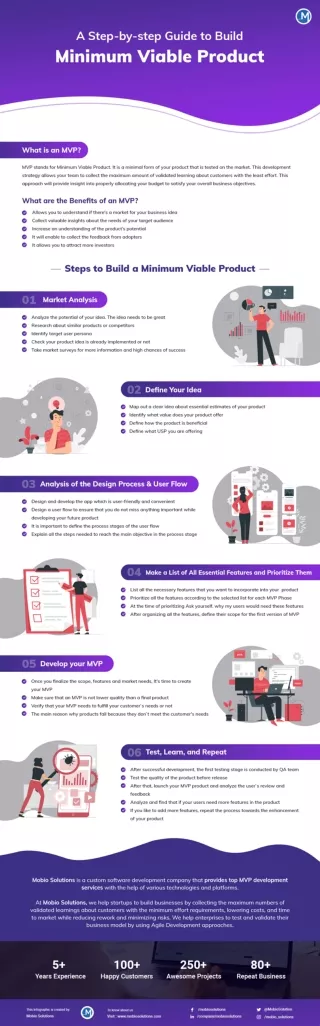
2- How to Develop an MVP for Startups: Identify User Flow: Determine Value Proposition: Analyze the Market and Target Audience: Design a user- friendly navigation. Outline stages of user interaction. Prioritize simplicity over complexity. Define the problem the product solves. Highlight differentiation from competitors. Focus on delivering basic value to users. Research competitors and market trends. Understand global market potential. Identify target audience needs and preferences. Determine the Problem: Identify existing or artificially- modeled problems. Ensure the product solves a genuine issue or offers value. Prioritize MVP Features: Selecting an MVP Development Company: Evaluate options based on needs and budget. Gather input from stakeholders. Finalize agreement through negotiations and contract signing. Brainstorm all features and categorize by impact. Focus on features that create value. Keep the MVP lean and efficient.
Proof of Concept (PoC) 01 Earliest stage of product development. Determines feasibility and viability of the project. Conducted before significant investment. 3- MVP vs Proof of Concept vs Prototype Prototype: 02 Provides a tangible representation of the product. Helps visualize the product's design and functionality. Can range from simple sketches to more advanced wireframes using tools like Figma. Minimum Viable Product (MVP): Let’s break down the difference between MVP, Proof of Concept (PoC), and Prototype. These are important stages in creating a product. 03 Basic version with essential features. Aimed at real customers for validation and feedback. Serves as a foundation for iterative development and improvement.
4- 'B.M.L.' - Build, Measure, Learn: Embrace the iterative process of building, measuring, and learning from user feedback. Continuous improvement based on real-world data ensures the product remains relevant and valuable.
Quick market penetration and feedback collection. Reduced development costs and time-to-market. Learning and iterative improvement throughout the development process. Attraction of potential investors through demonstrated product viability. Advantages of Building an MVP: Feature overload, ignoring user feedback, rushing development, neglecting scalability, inadequate testing, lack of clear value proposition, inadequate market research, poor communication, ignoring competitors, overlooking security. Common Development Mistakes to Avoid: Number of downloads/signups, percentage of active users, percentage of paying users, average revenue per user (ARPU), churn rate, user ratings, customer acquisition cost (CAC), customer lifetime value (CLV). Essential Metrics for Measuring Success:
Factors influencing costs include the development team, features and complexity, technology stack, design and user experience, testing and quality assurance, infrastructure and hosting, iterative development, market research and validation. Cost Consideration s for MVP Development:
Conclusion Building an MVP is a strategic approach for startups to validate their ideas, gather feedback, and iterate towards a successful product launch. By following a systematic approach, avoiding common pitfalls, and leveraging key metrics, startups can increase their chances of building a compelling MVP and achieving market success.
Thank you! Let's embark on this journey of MVP development and turn your startup idea into a reality!