
conventional machining processes
manufacturing process

conventional machining processes
E N D
Presentation Transcript
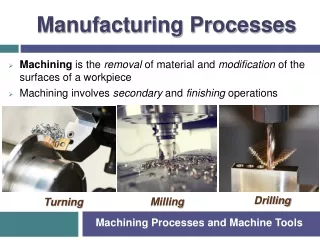
Manufacturing Processes ➢ Machining is the removal of material and modification of the surfaces of a workpiece ➢ Machining involves secondary and finishing operations Drilling Milling Turning Machining Processes and Machine Tools
Manufacturing Technology 2 Broad classification of Engineering Manufacturing Processes. It is extremely difficult to tell the exact number of various manufacturing processes existing and are being practiced presently because very large number of processes have been developed till now and the number is still increasing exponentially with the growing demands and rapid progress in science and technology. ➢ However, all such manufacturing processes can be broadly classified in four major groups as follows ➢ Shaping or forming ➢ Manufacturing a solid product of definite size and shape from a given material taken in three possible states: in liquid or semi-liquid state – e.g., casting, injection moulding etc. ➢ in solid state – e.g., forging rolling, extrusion, drawing etc. ➢ in powder form – e.g., powder metallurgical process. ➢
Manufacturing Technology 3 Joining process ➢ Welding, brazing, soldering etc. Removal or Cutting process ➢ Machining (Traditional or Non-traditional), Grinding etc. Regenerative manufacturing Process ➢ Production of solid products in layer by layer from raw materials in different form: ➢ liquid – e.g., stereo lithography ➢ powder – e.g., selective sintering ➢ sheet – e.g., LOM (laminated object manufacturing) ➢ wire – e.g., FDM. (Fused Deposition Modeling) Out of the fore said groups, Regenerative Manufacturing is the latest one which is generally accomplished very rapidly and quite accurately using CAD and CAM for Rapid Prototyping and Tooling.
Manufacturing Technology 4 Material Removal Processes – Metal Cutting Process ➢ A family of shaping operations, the common feature of which is removal of material from a starting work part so the remaining part has the desired geometry ➢ Traditional Process (Machining) – Material removal by a sharp cutting tool, e.g., turning, milling, drilling ➢ Nontraditional processes - Various energy forms other than sharp cutting tool to remove material. e.g., Laser and Electron Beam machining ➢ Abrasive processes – Material removal by hard, abrasive particles, e.g., grinding
Manufacturing Technology 5 Why Machining is Important ➢ Variety of work materials can be machined ➢ Most frequently used to cut metals ➢ Variety of part shapes and special geometric features possible, such as: ➢ Screw threads ➢ Accurate round holes ➢ Very straight edges and surfaces ➢ Good dimensional accuracy and surface finish
Manufacturing Technology 6 Disadvantages with Machining ➢ Wasteful of material ➢ Chips generated in machining are wasted material, at least in the unit operation ➢ Time consuming ➢ A machining operation generally takes more time to shape a given part than alternative shaping processes, such as casting, powder metallurgy, or forming ➢ Machining in Manufacturing Sequence ➢ Generally performed processes, such as casting, forging, and bar drawing after other manufacturing
Machining Processes and Machine Tools 7 ➢ Parts can be manufactured by casting, forming and shaping processes ➢ They often require further operations before the product is ready for use
Classifications Cutting Machining
Machining Processes and Machine Tools 9 Major types of material removal processes: ➢ Cutting ➢ Abrasive processes ➢ Advanced machining processes Machining operations is a system consisting of: ➢ Workpiece ➢ Cutting tool ➢ Machine tool ➢ Production personnel
Introduction 10 Cutting processes remove material from the surface of a workpiece by producing chips Common cutting processes: ➢ Turning (workpiece rotates; tool moves left, removes layer of material) ➢ Cutting off (cutting tool moves radially inward) ➢ Slab milling (rotating cutting tool removes material from workpiece) ➢ End milling (rotating cutter; produces cavity)
Introduction 11 ➢ In the turning process, the cutting tool is set at a certain depth of cut [mm] and travels to the left (with a certain velocity) as the workpiece rotates ➢ Feed, or feed rate, is the distance the tool travels horizontally per unit revolution of the workpiece [mm/rev] This tool movement produces chips, which move up the face of the tool ➢ Tool holder
Introduction 12 ➢ In idealized model, a cutting tool moves to the left along the workpiece at a constant velocity, V, and a depth of cut, to ➢ Chip thickness, tc Idealized model; Orthogonal; 2-D cutting with a well-defined shear plane; also called M.E. Merchant model Orthogonal (2-D) cutting without a well-defined shear plane: “shear zone”; why rough surface?
Mechanics of Cutting 14 ➢ Major independent variables in the cutting process: ➢ Tool material and coatings ➢ Tool shape, surface finish, and sharpness ➢ Workpiece material and condition ➢ Cutting speed, feed, and depth of cut ➢ Cutting fluids ➢ Characteristics of the machine tool ➢ Work holding and fixturing
Mechanics of Cutting 15 ➢ Dependent variables in cutting (influenced by changes in independent variables): ➢ Type of chip produced (studied since early 1940’s) ➢ Force and energy dissipated during cutting ➢ Temperature rise in the workpiece, the tool and the chip ➢ Tool wear and failure ➢ Surface finish and surface integrity of the workpiece
Mechanics of Cutting 16 ➢ Merchant model is known as orthogonal cutting (?) ➢ It is two dimensional and the forces involved are perpendicular to each other ➢ Cutting tool has a rake angle () and a relief or clearance angle ➢ Shearing takes place in a shear zone at shear angle () Velocity diagram showing angular relationship among 3 speeds in cutting zone: V: cutting speed Vs: shearing speed Vc: chip velocity Basic mechanism of chip formation by shearing
Mechanics of Cutting 17 ➢ Imagine shearing: “deck of cards” sliding along each other ➢ Below shear plane, workpiece: undeformed ➢ Above shear plane: chip moves up rake face (tool) ➢ Dimension d (distance between shear planes, OC) highly exaggerated to show mechanism It is only in order of 10-2to 10-3mm ➢ Some materials shear in a zone (not plane) e.g. cast iron this leads to surface defects in workpiece ➢ ➢ ➢ ➢
Mechanics of Cutting 18 Cutting Ratio (or chip-thickness ratio, r ) ➢ The ratio is related to the two angles shear angle, rake angle, r ➢ ➢ − cos r sin t = = = 0 tan r ( ) − 1 sin cos ct ➢ Chip thickness tcis always > than the depth of cut, to ➢ ⇒ the value of r is always less than unity (i.e. <1) ➢ Reciprocal of r (i.e. 1/r ) is known as the chip-compression ratio or chip-compression factor It’s a measure of how thick the chip has become Always > 1 ➢ ➢
Mechanics of Cutting 19 ➢ Making use of cutting ratio in evaluating cutting conditions: ➢ depth of cut, to: machine setting (i.e. indep. variable) ➢ chip thickness, tccan be measured using micrometer ➢ cutting ratio, r can then easily be calculated ➢ rake angle, is also known for cutting operation It is function of tool and workpiece geometry ➢ Cutting ratio and rake angle can be used to find shear angle, (equation in previous slide) ➢
Mechanics of Cutting 20 Shear Strain ➢ The shear strain (i.e. deformation relative to original size) that the material undergoes can be expressed as OB OC OC AB AO ( ) = = + = + − cot tan OC ➢ Large shear strains (≥5) are associated with low shear angles or with low or negative rake angles ➢ Based on the assumption that the shear angle adjusts itself to minimize the cutting force, − + = μ = tanβ ➔ coefficient of –dynamic – friction μ usually: 0.5 – 2 Note, first form is more generally used β = friction angle, related to μ : 45 2 2 = + − 45
Mechanics of Cutting 21 ➢ Chip encounters friction as it moves up the rake face ➢ Large variations in contact pressure and temperature are encountered at the tool-chip interface (rake face) ➢ This causes big changes in μ and it is thus called “apparent mean coefficient of friction” ➢ Equation (second set in previous slide) thus indicates: As rake angle ↓ or friction at rake face ↑ ⇒ shear angle ↓ and chip becomes thicker Thicker chip ⇒ more energy lost because shear strain is higher Because work done during cutting is converted into heat ⇒ temperature rise is higher ➢ ➢ ➢
Mechanics of Cutting 22 Velocities in the Cutting Zone ➢ Since tc> to⇒ Vc(velocity of chip) < V (cutting speed) ➢ Since mass continuity is maintained, − sin V = = = or Vt V t V Vr V ( ) 0 c c c c cos ➢ From Velocity diagram, obtain equations from trigonometric relationships (Vsvelocity at shearing plane): ( ) cos − V V V = = s c cos sin t V ➢ Note also that = = 0 c r t V c
Mechanics of Cutting: Types of Chips Produced in Metal Cutting 23 ➢ Types of metal chips commonly observed in practice (orthogonal metal cutting) ➢ There are 4 main types: ➢ } a) Continuous chip (with narrow, straight, primary shear zone) b) Continuous chip with secondary shear zone at the tool-chip interface c) Built-up edge, BUE chip d) Serrated or segmented or non-homogenous chip e) Discontinuous chip
Mechanics of Cutting: Types of Chips Produced in Metal Cutting 24 All Chips ➢ Chip has two surfaces: ➢ Surface in contact with rake face Shiny and polished Caused by rubbing of the chip on the tool surface ➢ Outer surface from the original surface of the workpiece Jagged, rough appearance Caused by shearing mechanism Note, this surface remains exposed to the environment, and does not come into contact with any other surface ➢ ➢ ➢ ➢ ➢
Mechanics of Cutting: Types of Chips Produced in Metal Cutting 25 Continuous Chips ➢ Formed with ductile materials machined at high cutting speeds and/or high rake angles ➢ Deformation takes place along a narrow shear zone called the (primary shear zone) ➢ Continuous chips may develop a secondary shear zone due to high friction at the tool–chip interface This zone becomes thicker as friction increases ➢ ➢ Continuous chips may also occur with wide primary shear zone with curved boundaries. ➢ Note, lower boundary of deformation zone drops below machined surface ⇒ distortion in workpiece, poor finish Occurs: machining soft metals at low speeds, low rake angles ➢
Mechanics of Cutting: Types of Chips Produced in Metal Cutting 26 Built-up Edge (BUE) Chips ➢ Consists of layers of material from the workpiece that are deposited on the tool tip ➢ As it grows larger, the BUE becomes unstable and eventually breaks apart BUE: partly removed by tool, partly deposited on workpiece ➢ BUE can be reduced by: ➢ Increase the cutting speeds ➢ Decrease the depth of cut ➢ Increase the rake angle ➢ Use a sharp tool ➢ Use an effective cutting fluid ➢ Use cutting tool with lower chemical affinity for workpiece material ➢ BUE: turning Hardness distribution with BUE chip note BUE chip much harder than chip BUE: milling
Mechanics of Cutting: Types of Chips Produced in Metal Cutting 27 Serrated Chips ➢ Also called segmented or nonhomogeneous chips ➢ They are semicontinuous chips with large zones of low shear strain and small zones of high shear strain (shear localization) ➢ Example: metals with low thermal conductivity and strength that decreases sharply with temperature, i.e. thermal softening (e.g. titanium) ➢ Chips have a sawtooth-like appearance Note, do not confuse this with dimension d. ➢ ➢ ➢
Mechanics of Cutting: Types of Chips Produced in Metal Cutting 28 Discontinuous Chips ➢ Consist of segments that are attached firmly or loosely to each other ➢ Form under the following conditions: ➢ Brittle workpiece materials ➢ Materials with hard inclusions and impurities ➢ Very low or very high cutting speeds ➢ Large depths of cut ➢ Low rake angles ➢ Lack of an effective cutting fluid ➢ Low stiffness of the machine tool (⇒ vibration, chatter)
Mechanics of Cutting: Types of Chips Produced in Metal Cutting 29 Chip Curl ➢ Chips will develop a curvature (chip curl) as they leave the workpiece surface ➢ Factors affecting the chip curl conditions are: Distribution of stresses in the primary and secondary shear zones. Thermal effects. Work-hardening characteristics of the workpiece material Geometry of the cutting tool Cutting fluids Note, as cutting depth ↓, chip radius ↓ (i.e. curlier) ➢ ➢ ➢ ➢ ➢ ➢
Mechanics of Cutting: Types of Chips Produced in Metal Cutting 30 Chip Breakers ➢ Long, continuous chips are undesirable since: become entangled and greatly interfere with machining potential safety hazard ➢ ➢ action of chip breaker ➢ chip-breaker: breaks chips intermittently with cutting tools clamped chip breaker ➢ Traditionally are clamped to rake face: bend and break the chip Grooves in tools act as chip breakers ➢ Modern tools: built-in chip breakers ➢ Ideal chip: “C” or “9” shape
Mechanics of Cutting: Types of Chips Produced in Metal Cutting 31 Chip Breakers ➢ Chips can also be broken by changing the tool geometry to control chip flow Chips produced in turning Chips hits workpiece and breaks Continuous chip moving radially away from the workpiece Chip hits tool shank (body) and breaks off Tightly curled chip
Mechanics of Cutting: Oblique Cutting 32 Majority of machining operations involve tool shapes that are 3-D where the cutting is said to be oblique Difference between oblique and orthogonal cutting can be seen in chip movement and shape Top view, showing inclination angle, i Cutting with an Oblique Tool (note the direction of chip movement) Types of chips produced with tools at increasing inclination angles
Mechanics of Cutting: Oblique Cutting 33 ➢ Orthogonal cutting: chip slides directly up face of tool ➢ Oblique cutting: chip is helical, at an inclination angle Chip movement is like snow from snowplow blade: sideways i.e. helical chip don’t interfere with cutting zone, unlike orthogonal cutting ➢ The effective rake angle is Note i, ncan be measured directly to find e ➢ As i ↑ ⇒ e↑ ⇒ chip becomes thinner and longer (see last slide) ⇒ cutting force ↓ (very important finding!) ➢ ➢ ( ) − = + 1 2 2 sin sin cos sin i i e n ➢
Mechanics of Cutting: Oblique Cutting 34 Shaving and Skiving ➢ Thin layers of material can be removed from straight or curved surfaces (similar to shaving wood with a plane) ➢ Shaving can improve the surface finish and dimensional accuracy ➢ Parts that are long or combination of shapes are shaved by skiving A specially shaped cutting tool is moved tangentially across the length of the workpiece ➢
Cutting Forces and Power 35 Knowledge of cutting forces and power involves: ➢ Data on cutting forces important to minimize distortions, maintain required dimensional accuracy, help select appropriate toolholders ➢ ➢ Power requirements enables appropriate tool selection Force circle to determine various forces in cutting zone ➢ Forces acting in the cutting zone during 2-D (orthogonal) cutting
Cutting Forces and Power 36 ➢ Forces considered in orthogonal cutting include Cutting, friction (tool face), and shear forces ➢ ➢ Cutting force,Fcacts in the direction of the cutting speed V, and supplies the energy required for cutting Ratio of Fcto cross-sectional area being cut (i.e. product of width and depth of cut, t0) is called: specific cutting force ➢ Thrust force,Ftacts in a direction normal to the cutting force ➢ ➢ These two forces produces the resultant force, R see force circle (last slide) ➢ ➢ On tool face, resultant force can be resolved into: Friction force, F along the tool-chip interface Normal force, N to ⊥ to friction force ➢ ➢
Cutting Forces and Power 37 ➢ It can also be shown that ( is friction angle) = = sin cos F R N R ➢ Resultant force, R is balanced by an equal and opposite force along the shear plane ➢ It is resolved into shear force, Fsand normal force, Fn ➢ Thus, sin c n F F = = − cos sin F F F s c t + cos F t ➢ The magnitude of coefficient of friction, is F = + tan F F = t c − tan N F F c t
Cutting Forces and Power 38 ➢ Thrust Force ➢ The toolholder, work-holding devices, and machine tool must be stiff to support thrust force with minimal deflections If Ftis too high ⇒ tool will be pushed away from workpiece this will reduce depth of cut and dimensional accuracy ➢ ➢ ➢ The effect of rake angle and friction angle on the direction of thrust force is ( ) − = or sin t R F ( ) = − tan F F t c ➢ Magnitude of the cutting force, Fcis always positive as the force that supplies the work is required in cutting ➢ However, Ftcan be +ve or –ve; i.e. Ftcan be upward with a) high rake angle, b) low tool-chip friction, or c) both
Cutting Forces and Power 39 Power ➢ The power input in cutting is = Power F V c ➢ Power is dissipated in shear plane/zone (due to energy required to shear material) Rake face (due to tool-chip interface friction) ➢ ➢ ➢ Power dissipated in shearing is = Power shearing for F sV s ➢ Denoting the width of cut as w, (i.e. area of cut: wt0), the specific energy for shearing, is F V s = s u s wt V 0
Cutting Forces and Power 40 Power ➢ The power dissipated in friction is = Power friction for FV c ➢ The specific energy for friction, ufis FV Fr = = c u f wt V wt 0 0 ➢ Total specific energy, utis = + u u u t s f
Cutting Forces and Power 41 Power Prediction of forces is based largely on experimental data (right) Wide ranges of values is due to differences in material strengths Sharpness of the tool tip also influences forces and power Duller tools require higher forces and power ➢ ➢ ➢ ➢
Cutting Forces and Power 42 Measuring Cutting Forces and Power ➢ Cutting forces can be measured using a force transducer, a dynamometer or a load cell mounted on the cutting-tool holder ➢ It is also possible to calculate the cutting force from the power consumption during cutting (provided mechanical efficiency of the tool can be determined) ➢ The specific energy (u, last slide) in cutting can be used to calculate cutting forces
Cutting Forces and Power 43 EXAMPLE 21.1 Relative Energies in Cutting In an orthogonal cutting operation, to=0.13 mm, V=120 m/min, α=10° and the width of cut 6 mm. It is observed that tc=0.23 mm, Fc=500 N and Ft=200 N. Calculate the percentage of the total energy that goes into overcoming friction at the tool–chip interface.
Cutting Forces and Power 44 Solution Relative Energies in Cutting The percentage of the energy can be expressed as Energy Friction FV Fr = = c Total Energy F V F c c where . 0 13 t = = = 0 . 0 565 r . 0 23 ct We have ( ) = , = − sin cos and F R F R c ( ) = + = + = 2 2 2 2 200 500 539 N R F F t c
Cutting Forces and Power 45 Solution Relative Energies in Cutting Thus, 500 = F ( ) = − = 539 cos 10 32 = 539 sin 32 286 N Hence ( )( 500 ) 286 . 0 565 = = Percentage . 0 32 or 32 %
Temperatures in Cutting 46 Temperature rise (due to heat lost in cutting ⇒ raising temp. in cutting zone) - its major adverse effects: ➢ Lowers the strength, hardness, stiffness and wear resistance of the cutting tool (i.e. alters tool shape) ➢ Causes uneven dimensional changes (machined parts) ➢ Induce thermal damage and metallurgical changes in the machined surface (⇒ properties adversely affected) Sources of heat in machining: Work done in shearing (primary shear zone) Energy lost due to friction (tool-chip interface) Heat generated due to tool rubbing on machined surface (especially dull or worn tools) ➢ ➢ ➢
Temperatures in Cutting 47 Expression: mean temperature in orthogonal cutting: 000665 . 0 T Y Vt f = 0 3 c K where, T: (aka Tmean) mean temperature in [K] Yf: flow stress in [MPa] ρc: volumetric specific heat in [kJ/m3·K] K: thermal diffusivity (ratio of thermal conductivity to volumetric specific heat) in [m2/s] Equation shows that T: increases with material strength, cutting speed (V), depth of cut (t0); decreases with ρc and K ➢ ➢ ➢ ➢ ➢ ➢ ➢
Temperatures in Cutting 48 Mean temperature in turning on a lathe is given by a b mean T V f where, V : cutting speed f : feed of the tool Approximate values of the exponents a,b: Carbide tools: a = 0.2, b = 0.125 High-speed steel tools: a = 0.5, b = 0.375 Also note how this relation shows the increase in temperature with increased cutting speed and feed ➢ ➢ ➢ ➢ ➢ ➢
Temperatures in Cutting 49 Temperature Distribution ➢ Sources of heat generation are concentrated in primary shear zone, and At tool–chip interface ⇒ v. large temp. gradients in the cutting zone (right) ➢ ➢ ➢ ➢ Note max. temp is about halfway up tool-chip interface (why?)
Temperatures in Cutting 50 Temperature Distribution Temperatures developed in turning 52100 steel ➢ Note: b) tool-chip interface temp. distribution (note, abscissa: 0: tool tip; 1: end of tool- chip contact) Highest temp.: 1100ºC High temp. appear as dark- color on chips (by oxidation at high V ) Reason: as V ↑ ⇒ time for heat dissipation ↓ ⇒ temp. ↑ a) flank temperature distribution ➢ ➢ ➢