
joint & mechanical assembly
joint & mechanical assembly

joint & mechanical assembly
E N D
Presentation Transcript
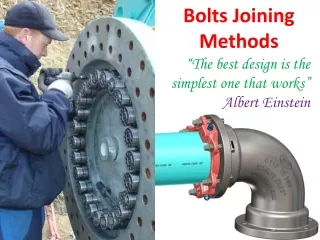
Bolts Joining Methods “The best design is the simplest one that works” Albert Einstein
Introduction & Overview every joining technique has particular design requirements. It is uneconomical to produce the part as a single shape. Easer to manufacture as pieces Easy for repair and maintenance Different properties are needed in different pieces mechanical joining (e.g., use of bolt, screws, nails) is a common fastening method, for example, but welding may reduce the weight of an assembly. all joint designs must consider characteristics such as load conditions, assembly efficiency, operating environment, overhaul and maintenance, and the materials used. design for assembly, automation, and fastener selection imposes their own requirements.
Joining is divided into three categories Mix Tape Zip Ties Hook And Loop (Velcro)
Thermal Joining Processes a joining process where the work pieces are melted and a filler material is added to form a pool of molten material that cools to become a strong joint a metal-joining process whereby a filler metal is heated above melting point and distributed between two or more close-fitting parts the filler metal is brought slightly above its melting temperature and flows over the base metal and is then cooled to join the work pieces together. It is similar to soldering, except the temperatures used to melt the filler metal are higher for brazing. is a joining process that's similar to brazing, except that it is performed at much lower temperatures than brazing process of joining two work pieces together with a filler metal, such that only this filler metal undergoes melting, i.e., the work pieces do not experience any melting Welding Brazing Soldering
Chemical Joining Processes Adhesive Bonding process for joining parts using bonding chemicals or materials known as adhesives. typically used to join polymers and composites, as well as polymers to metals, metals to metals, and ceramics to metals. adhesive-bonded joints can withstand shear, tensile, and compressive stresses, but they do not exhibit good resistance against peeling The most common adhesives are: wood glue (a.k.a. yellow glue, carpenter's wood glue, aliphatic resin) Elmer's glue (a.k.a. white glue, PVA) Plastic resin glue Epoxy Cyanoacrylate (a.k.a. super glue) Construction adhesive Contact cement
Mechanical Joining Processes is a process for joining parts through mechanical methods, which often involve threaded holes joining parts using screws or nuts and bolts are common examples of mechanical joining Source: https://worldofndt.com/metal-joining-technology/
Introductıon to Joining Processes Manufacturing processes discussed so far include operations for producing of a single product, i.e., product that consists of a single piece of metal. But in the real life very few of the manufactured products consist of a single part. Most common situation is when a commercial product is an assembly, a composition of single parts, or single parts subassemblies, which are groups of single parts combined to serve certain purpose and forming part of a larger assembly. and so called
Introductıon to Joining Processes For example, a simple ballpoint pen an assembly composed of three single parts, a plastic tube and two caps, and one subassembly, a cartridge. The cartridge itself can be considered as an assembly of few more single parts, in which a fine metallic or ceramic ball rotates against a supply of semisolid ink.
Introductıon to Joining Processes Manufacturing processes, in which single parts are combined to form an assembly are referred to as manufacturing processes for joining and assembling. These processes can be divided into two major classes, 1. Processes for non-permanent combining, which allow for multiple disassembly and assembly of single parts and/or subassemblies, and 2. Processes for permanent combining of single parts and/or subassemblies. Eventual disassembly would result in severe damages to the components in the assembly and the subsequent assembly if attempted would not be possible any more.
Introductıon to Joining Processes Further classification is possible with respect to the operational methods used as follows: mechanical assembly, which involves the use of various fastening methods to mechanically attach two (or more) parts and/or subassemblies together. This group includes processes for permanent (riveting, press or shrink fitting) or non-permanent (assembly with threaded fasteners) assembly; joining processes, in which two (or more) parts and/or subassemblies are jointed together to form a permanent assembly. Examples: welding, adhesive bonding, brazing and soldering.
Mechanıcal Assembly For purpose of organization, we divide processes for mechanical assembly into the following categories; processes for non-permanent assembly with threaded fasteners - screws, bolts, studs, and nuts processes for permanent assembly, which include assembly with rivets, and press and shrink fits.
Processes for non-permanent assembly Threaded fasteners are components that have external or internal threads for assembly of parts. The common threaded fastener types are screws, bolts, studs and nuts. bolt is an externally threaded fastener that is inserted through holes in the parts and screwed into a nut on the opposite side; screwis an externally threaded fastener that is generally assembled into a blind threaded hole and no nut is required; stud is an externally threaded fastener, but without the usual head possessed by a bolt. Studs can also be used to assemble two parts using a nut. They are available with threads on one end or both; nutis an internally threaded fastener having standard threads.
Processes for non-permanent assembly The typical assemblies that result from the use of screws, bolts, studs and nuts are shown in the figure: Typical assemblies using (a) bolt and nut, (b) screw and (c) stud and nut. Ease of assembly & disassembly
Processes for non-permanent assembly Source: https://www.youtube.com/watch?v=H-oa4MjyasM
Processes for non-permanent assembly Threaded fasteners come in a variety of sizes, threads, and shapes. Also, numerous head styles are available on bolts and screws, some of which are illustrated in the figure. The geometries of these heads, as well as the variety of sizes available, require different hand tools for the operator. Various head styles available on screws and bolts. There are additional head styles not shown.
Processes for non-permanent assembly Typical stresses acting on a bolted joint Two measures: Tensile strength, which has the traditional definition Proof strength - roughly equivalent to yield strength Maximum tensile stress without permanent deformation
Processes for non-permanent assembly Tightening of threaded fasteners Whether a threaded fastener serves its purpose depends to a large degree of the amount of torque applied to tighten it. Once the threaded fastener has been rotated until it is seated against the part surface, additional tightening will increase the amount of tension in the fastener (and simultaneously the amount of compression in the parts being held together) and an increasing torque will resist the tightening.
Processes for non-permanent assembly Typical stresses acting on a bolted joint Over-tightening in Bolted Joints Potential problem in assembly, causing stresses that exceed strength of fastener or nut Failure can occur in one of the following ways: Stripping of external threads Stripping of internal threads Bolt fails due to excessive tensile stresses on cross-sectional area Tensile failure is most common problem Apply Required Torque 1. 2. 3. Operator feel - not very accurate, but adequate for most assemblies Torque wrench – indicates amount of torque during tightening Stall-motor - motorized wrench is set to stall when required torque is reached Torque-turn tightening - fastener is initially tightened to a low torque level and then rotated a specified additional amount 4.
Processes for non-permanent assembly Types of Screws Machine screws - generic type, generally designed for assembly into tapped holes Capscrews - same geometry as machine screws but made of higher strength metals and to closer tolerances Setscrews Hardened and designed for assembly functions such as fastening collars, gears, and pulleys to shafts
Processes for non-permanent assembly Self-Tapping Screws Designed to form or cut threads in a pre-existing hole into which it is being turned; also called a tapping screw
Processes for non-permanent assembly Screw Thread Inserts Internally threaded plugs or wire coils designed to be inserted into an unthreaded hole and accept an externally threaded fastener Assembled into weaker materials to provide strong threads Upon assembly of screw into insert, insert barrel expands into hole to secure the assembly
Processes for non-permanent assembly Washer Hardware component often used with threaded fasteners to ensure tightness of the mechanical joint; Simplest form = flat thin ring of sheet metal Distribute stresses Provide support for large clearance holes Protect part surfaces and seal the joint Increase spring tension Resist inadvertent unfastening Types of washers: (a) plain (flat) washers; (b) spring washers, used to dampen vibration or compensate for wear; (c) lockwasher designed to resist loosening of the bolt or screw
Processes for permanent assembly Riveting A rivet is an unthreaded, headed pin used to join two (or more) parts by passing the pin through holes in the parts and then forming (upsetting) a second head in the pin on the opposite side. The deforming operation can be performed hot or cold and by hammering or steady pressing. Once the rivet has been deformed, it cannot be removed except by breaking one of the heads. Rivet type refers to five basic geometries that affect how the rivet will be upset to form the second head. The five basic types are illustrated in the figure. In addition, there are special rivets for special applications.
Processes for permanent assembly Riveting
Processes for permanent assembly Source: https://www.youtube.com/watch?v=4GXt02w66Tg&t=79s
Processes for permanent assembly Riveting Riveting is a fastening method that offers high production rates, simplicity, dependability and low cost. Despite these apparent advantages, its applications have declined in recent decades in favor of threaded fasteners, welding, and adhesive bonding. Riveting is used as one of the primary fastening processes in the aircraft and aerospace industries for joining skins to channels and other structural members. Much of the equipment used in riveting is portable and manually operated. Automatic drilling and riveting machines are available for drilling the holes and then inserting and upsetting the rivets.
Processes for permanent assembly Press and shrink fits There are several assembly methods that are based on mechanical interference between the two mating parts being joined. The methods discussed here include press fitting and shrink fitting. A press fit assembly is one in which the two components have an interference fit between them. The typical case is when a pin of a diameter Dp is pressed into a hole of a slightly smaller diameter Dc: Press fitting Applications of press fitting include locating and locking the components such as the assembly of collars, gears, pulleys, and similar components onto shafts. The major limitations of press fitting include the necessity of a substantial press force, and the possible damage to the surfaces of components during the process of press fitting. This limitations are overcame in the process of shrink fitting.
Processes for permanent assembly Press and shrink fits To assemble by shrink fitting, the external part is heated to enlarge by thermal expansion, and the internal part either remains at room temperature or is cooled to contract its size. The parts are then assembled and brought back to room temperature so that the external part shrinks and, if previously cooled, the internal part expands to form a strong interference fit. A modification of the shrink fitting method is so called expansion fit, which occurs when only the internal part is cooled to contract it for assembly. Once inserted into the mating component, it warms to room temperature, expanding to create the interference assembly.
Processes for permanent assembly Press and shrink fits Various methods are used to accomplish the heating and/or cooling of the workparts. Heating equipment includes torches, furnaces, electric resistance heaters, and electric induction heaters. Cooling methods include conventional refrigeration, packing in dry ice, and immersion in cold liquids, including liquid nitrogen. The change in diameter that results from heating or cooling a cylindrical workpiece depends on the coefficient of thermal expansion and the temperature difference that is applied to the parts. The shrink fitting method is used to fit gears, pulleys, sleeves, and other components onto solid and hollow shafts but the most popular application is to fit bearing onto shafts.
Processes for permanent assembly Retaining Ring Fastener that snaps into a circumferential groove on a shaft or tube to form a shoulder Used to locate or restrict movement of parts on a shaft Retaining ring assembled into a groove on a shaft
Processes for permanent assembly Stitching and/or Stapling Fastening operation in which U-shaped stitches are formed one-at-a-time from steel wire and immediately driven through the two parts to be joined Applications: sheetmetal assembly, metal hinges, magazine binding, corrugated boxes Common types of wire stitches: (a) unclinched, (b) standard loop, (c) bypass loop, and (d) flat clinch
Processes for permanent assembly Seaming Components are deformed as Integral Fasteners; so they interlock as a mechanically fastened joint Edges of two separate sheet-metal parts or the opposite edges of the same part are bent over to form the fastening seam single-lock seaming Lanced Tabs To attach wires or shafts to sheet-metal parts
References • https://www.mcmaster.com/products/fastene rs/products/fasteners/ • https://allpointsfasteners.com • https://www.fusiondesigninc.com/blog/2019/ 10/29/fasteners • http://www.engineeringslidechart.com