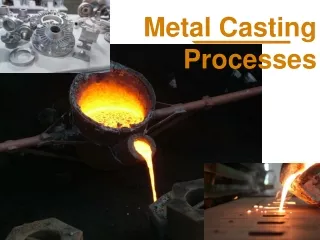

metal casting
E N D
Presentation Transcript
Metal Casting Processes
METAL CASTING PROCESSES 1. Sand Casting 2. Other Expendable Mold Casting Processes 3. Permanent Mold Casting Processes 4. Foundry Practice 5. Casting Quality 6. Metals for Casting 7. Product Design Considerations
Metal Casting Processes Categories 1. Expendable mold processes - mold is sacrificed to remove part ▪ Advantage: more complex shapes possible ▪ Disadvantage: production rates often limited by time to make mold rather than casting itself 2. Permanent mold processes - mold is made of metal and can be used to make many castings ▪ Advantage: higher production rates ▪ Disadvantage: geometries limited by need to open mold
Expendable Mold Processes ➢ Sand Casting ➢ Shell Molding ➢ Vacuum Molding ➢ Expanded Polystyrene Process ➢ Evaporative Pattern Casting (EPC) ➢ Investment Casting ➢ Plaster Mold and Ceramic Mold Casting
Overview of Sand Casting ➢ Most widely used casting process, accounting for a significant majority of total tonnage cast ➢ Nearly all alloys can be sand casted, including metals with high melting temperatures, such as steel, nickel, and titanium ➢ Castings range in size from small to very large ➢ Production quantities from one to millions Source: https://www.reliance-foundry.com/blog/sand-casting
A large sand casting weighing over 680 kg (1500 lb) for an air compressor frame (photo courtesy of Elkhart Foundry).
Steps in Sand Casting 1. Pour the molten metal into sand mold 2. Allow time for metal to solidify 3. Break up the mold to remove casting 4. Clean and inspect casting ▪ Separate gating and riser system 5. Heat treatment of casting is sometimes required to improve metallurgical properties
Manual Sand Casting Process Source: https://www.youtube.com/watch?v=szOwGvYO_Tc&ab
Steps in Sand Casting in detail Place pattern on molding board. Place drag parting surface down on molding board. Riddle sand over pattern until covered. Press sand around pattern with fingers. Completely fill drag with sand. Use a ram to pack sand. Remove excess sand with strike rod. Make vent holes for gases to escape. Place bottom board on drag. 10. Turn over drag and remove molding board. 11. Smooth molding sand. 12. Add fine coat of parting sand. 13. Place the cope on the drag. 14. Add sprue pin ~ 1” to side of pattern. 15. Fill, ram, & vent cope as done. 16. Withdraw sprue pin. 17. Create a funnel opening. 18. Separate cope from drag. 19. Moisten drag mold edges with swab. 20. Use draw spike to loosen pattern. 21. Remove the pattern. 22. Cut gate from sprue to pattern cavity. 23. Cut riser in cope to channel hot metal. 24. Spray, swab, or dust the mold surfaces with coating material. 25. Re-assemble cope and drag to prepare for pouring. 26. Weight cope to prevent seepage at parting line. 27. Pour the metal. 28. Allow to cool. 29. Separate and clean casting. 30. Reclaim the sand & clean the flask. 1. 2. 3. 4. 5. 6. 7. 8. 9. Source: https://foundry101.com/
Making the Sand Mold ➢ The cavity in the sand mold is formed by packing sand around a pattern, then separating the mold into two halves and removing the pattern ➢ The mold must also contain gating and riser system ➢ If casting is to have internal surfaces, a core must be included in mold ➢ A new sand mold must be made for each part produced
Overview of Sand Casting Sand casting for an industrial pump. Holes and surfaces have been machined (courtesy of George E. Kane Manufacturing Technology Laboratory, Lehigh University)
Steps in Sand Casting 1. Pour the molten metal into sand mold 2. Allow time for metal to solidify 3. Break up the mold to remove casting 4. Clean and inspect casting ▪ Separate gating and riser system 5. Heat treatment of casting is sometimes required to improve metallurgical properties
Making the Sand Mold ➢ The cavity in the sand mold is formed by packing sand around a pattern, then separating the mold into two halves and removing the pattern ➢ The mold must also contain gating and riser system ➢ If casting is to have internal surfaces, a core must be included in mold ➢ A new sand mold must be made for each part produced
Sand Casting Production Sequence Production sequence in sand casting, including pattern-making and mold-making
The Pattern ⚫ A full-sized model of the part, slightly enlarged to account for shrinkage and machining allowances in the casting ⚫ Pattern materials: ▪ Wood - common material because it is easy to work, but it warps ▪ Metal - more expensive to make, but lasts much longer ▪ Plastic - compromise between wood and metal
Types of Patterns Types of patterns used in sand casting: (a) solid pattern (b) split pattern (c) match-plate pattern (d) cope and drag pattern
Core ⚫ Full-scale model of interior surfaces of part ▪ Inserted into mold cavity prior to pouring ▪ The molten metal flows and solidifies between the mold cavity and the core to form the casting's external and internal surfaces ▪ May require supports to hold it in position in the mold cavity during pouring, called chaplets
Core in mold ➢ Full-scale model of interior surfaces of part ➢ It is inserted into the mold cavity prior to pouring ➢ The molten metal flows and solidifies between the mold cavity and the core to form the casting's external and internal surfaces. May require supports to hold it in position in the mold cavity during pouring, called chaplets (c) casting with internal cavity. (b) possible chaplet design, (a) Core held in place in the mold cavity by chaplets,
Desirable Mold Properties ➢ Strength - to maintain shape and resist erosion ➢ Permeability - to allow hot air and gases to pass through voids in sand ➢ Thermal stability - to resist cracking on contact with molten metal ➢ Collapsibility - ability to give way and allow casting to shrink without cracking the casting ➢ Reusability - can sand from broken mold be reused to make other molds? Erosion: to eat into or away by slow destruction of substance Permeability: capable of being penetrable
Foundry Sands ➢ Silica (SiO2) or silica mixed with other minerals ➢ Good refractory properties - capacity to endure high temperatures Small grain size yields better surface finish on the cast part Large grain size is more permeable, allowing gases to escape during pouring Irregular grain shapes strengthen molds due to interlocking, compared to round grains Disadvantage: interlocking tends to reduce permeability
Binders Used with Foundry Sand ➢ Sand is held together by a mixture of water and bonding clay ➢Typical mix: 90% sand, 3% water, and 7% clay ➢ Other bonding agents also used in sand molds: ➢Organic resins (e g , phenolic resins) ➢Inorganic binders (e g , sodium silicate and phosphate) ➢ Additives are sometimes combined with the mixture to increase strength and/or permeability Phenol = a corrosive poisonous crystalline acidic compound C6H5OH present in the tars of coal and wood that in dilute solution is used as a disinfectant
Types of Sand Mold ⚫ Green-sand molds - mixture of sand, clay, and water; ▪ “Green" means mold contains moisture at time of pouring ⚫ Dry-sand mold - organic binders rather than clay ▪ And mold is baked to improve strength ⚫ Skin-dried mold - drying mold cavity surface of a green-sand mold to a depth of 10 to 25 mm, using torches or heating lamps
Other Expendable Mold Processes ➢ Shell Molding ➢ Vacuum Molding ➢ Expanded Polystyrene Process ➢ Investment Casting ➢ Plaster Mold and Ceramic Mold Casting
Shell Molding Casting process in which the mold is a thin shell of sand held together by resin binder
Shell Molding Process Source: https://youtube.com/watch?v=OtG-ox3i0kQ
Advantages and Disadvantages of Shell Molding ⚫ Advantages: ▪ Smoother cavity surface permits easier flow of molten metal and better surface finish on casting ▪ Good dimensional accuracy ▪ Machining often not required ▪ Mold collapsibility usually avoids cracks in casting ▪ Can be mechanized for mass production ⚫ Disadvantages: ▪ More expensive metal pattern ▪ Difficult to justify for small quantities
Expanded Polystyrene Process Uses a mold of sand packed around a polystyrene foam pattern which vaporizes when molten metal is poured into mold ⚫ Other names: lost-foam process, lost pattern process, evaporative-foam process, and full-mold process ⚫ Polystyrene foam pattern includes sprue, risers, gating system, and internal cores (if needed) ⚫ Mass production of castings for automobile engines
Expanded Polystyrene Process Source: https://youtube.com/watch?v=n1l-nhRijSU
Expanded Polystyrene Process Aluminum engine head produced by expanded polystyrene casting process
Advantages & Disadvantages of EPC ⚫ Advantages: ▪ Pattern need not be removed from the mold ▪ Simplifies and expedites mold-making, since two mold halves (cope and drag) are not required as in a conventional green-sand mold ⚫ Disadvantages: ▪ A new pattern is needed for every casting ▪ Economic justification of the process is highly dependent on cost of producing patterns
Investment Casting (Lost Wax) A pattern made of wax is coated with a refractory material to make mold, after which wax is melted away prior to pouring molten metal ⚫ "Investment" comes from one of the less familiar definitions of "invest" - "to cover completely," which refers to coating of refractory material around wax pattern ⚫ It is a precision casting process - capable of castings of high accuracy and intricate detail
Investment Casting (Lost Wax) Source: https://youtube.com/watch?v=S4WuKJF_76c
Advantages and Disadvantages of Investment Casting ⚫ Advantages: ▪ Parts of great complexity and intricacy can be cast ▪ Close dimensional control and good surface finish ▪ Wax can usually be recovered for reuse ▪ Additional machining is not normally required - this is a net shape process ⚫ Disadvantages: ▪ Many processing steps are required ▪ Relatively expensive process
Permanent Mold Casting Processes ⚫ Economic disadvantage of expendable mold casting: a new mold is required for every casting ⚫ In permanent mold casting, the mold is reused many times ⚫ The major processes include: ▪ Basic permanent mold casting ▪ Die casting ▪ Centrifugal casting
The Basic Permanent Mold Process Uses a metal mold constructed of two sections designed for easy, precise opening and closing ⚫ Molds used for casting lower melting point alloys are commonly made of steel or cast iron ⚫ Molds used for casting steel must be made of refractory material, due to the very high pouring temperatures ⚫ Due to high mold cost, process is best suited to high volume production and can be automated accordingly
The Basic Permanent Mold Process Source: https://youtube.com/watch?v=cwT4U-qvJ-s
Advantages and Limitations of Permanent Mold Casting ⚫ Advantages: ▪ Good dimensional control and surface finish ▪ More rapid solidification caused by the cold metal mold results in a finer grain structure, so stronger castings are produced ⚫ Limitations: ▪ Generally limited to metals of lower melting point ▪ Simple part geometries compared to sand casting because of the need to open the mold ▪ High cost of mold
Die Casting A permanent mold casting process in which molten metal is injected into mold cavity under high pressure ⚫ Pressure is maintained during solidification, then mold is opened and part is removed ⚫ Molds in this casting operation are called dies; hence the name die casting ⚫ Use of high pressure to force metal into die cavity is what distinguishes this from other permanent mold processes
Die Casting Machines ⚫ Designed to hold and accurately close two mold halves and keep them closed while liquid metal is forced into cavity ⚫ Two main types: 1. Hot-chamber machine 2. Cold-chamber machine Source: https://www.ryobi-group.co.jp/en/glance/02.html
Hot-Chamber Die Casting (2) plunger forces metal in chamber to flow into die, maintaining pressure during cooling and solidification. (1) with die closed and plunger withdrawn, molten metal flows into the chamber
Hot-Chamber Die Casting (3) Plunger is withdrawn, die is opened, and casting is ejected
Hot-Chamber Die Casting Metal is melted in a container, and a piston injects liquid metal under high pressure into the die ⚫ High production rates - 500 parts per hour not uncommon ⚫ Applications limited to low melting-point metals that do not chemically attack plunger and other mechanical components ⚫ Casting metals: zinc, tin, lead, and magnesium
Cold-Chamber Die Casting Machine ⚫ Molten metal is poured into unheated chamber from external melting container, and a piston injects metal under high pressure into die cavity ▪ High production but not usually as fast as hot-chamber machines because of pouring step ▪ Casting metals: aluminum, brass, and magnesium alloys ▪ Advantages of hot-chamber process favor its use on low melting-point alloys (zinc, tin, lead)
Cold-Chamber Die Casting Cycle (1) With die closed and ram withdrawn, molten metal is poured into the chamber
Cold-Chamber Die Casting Cycle (2) Ram forces metal to flow into die, maintaining pressure during cooling and solidification
Cold-Chamber Die Casting Cycle (3) Ram is withdrawn, die is opened, and part is ejected
Cold-Chamber Die Casting Cycle Source: https://www.ryobi-group.co.jp/en/glance/02.html