

microfluids
E N D
Presentation Transcript
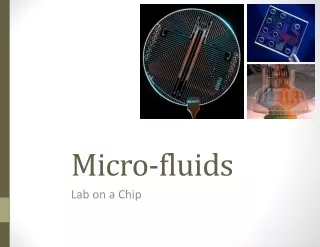
Micro-fluids Lab on a Chip
Outline • Introduction and motivation • Physics at the micro-scale -Liquid flows -Surface forces • Fabrication of microfluidic devices -Optical lithography -Soft lithography • Transport of liquids -Micro-scale pumps made with colloidal particles • Summary
Introduction • Microfluidics: manipulation of liquids in small quantities. • Aim: laboratories-on-chips, miniaturization of chemical and biological processes • Possible uses: -analysis (biology: DNA, cell...), -diagnostic and screening tests (medicine), -sensors (chemicals, bio, environment, weapons…), -synthesis • Advantages: small size, portability, lower costs, fewer inputs, less waste, precise reaction control (quick response), miniaturization of large-scale robotized systems, robust simple tasks (field hospitals).
Introduction • Typical microfluidic device, circuit: -~1 cm2 topological structure of channels (1 – 100 m) -micro-scale components: reaction chambers, pumps, valves… -other elements: electrodes… • Limited use despite ongoing research (20 years). Challenges: fabrication methods, liquids transport, commercialization (ink-jet printers)
Applications Biochemical assays: real-time PCR, immunoassay, dielectrophoresis for detecting cancer cells and bacteria, etc. Chemical application: separating molecules from mixtures, chemical reactors, chemical detections. etc. Biological application: cell coculture, biosensor, drug screening, single-cell analysis, etc.
Physics at the micro-scale Laminar flow: Fluid particles move along smooth paths in layers Most of energy losses are due to viscous effects Viscous forces are the key players and inertial forces are negligible Turbulent flow: An unsteady flow where fluid particles move along irregular paths Inertial forces are the key players and viscous forces are negligible Reynolds number: Measure of flow turbulence Re < 2000 for laminar Due to small dimensions Re < 1 in microfluidic systems where 6 diffusive (low Re) chaotic advection (Re < 100)
Physics at the micro-scale • Surface-to-volume ratio (S/V) increases with smaller volumes -7 surface forces become important (1 gram of silica, 1012 spheres, 2R ≈ 1 m: • Sticking: to channel walls, aggregation of particles etc. -7 requires complicated treament of surfaces • Surface tension may deform surfaces, cause bulk liquid motion • Capillary effect - capillary water level rise,10 m microchannel: ~ meters Surface area ≈ 3 m2)
Basic Properties Types of fluid flow: Laminar Turbulent Types of fluids: Newtonian fluids Non-Newtonian fluids
Newtonian Fluids Linear relationship between stress and strain, i.e. viscosity is independent of stress and velocity Shearing stress, v + dv v Rate of shearing strain, dv/dy 9
Viscosity Viscosity is a measure of internal friction (resistance) to flow Substance Air Acetone Water Mercury Olive oil Honey Viscosity (mPa·s) 0.017 0.3 0.9 1.5 80 2,000 – 10,000 10
Fabrication of microfluidic circuits L-Edit, AutoCAD Print Photolithography or etching Soft embossing
Fabrication of microfluidic circuits • A microchannel structure needed • UV optical lithography (= 350-400 nm) in photoresist films: • Mercury arc lamp • Mask aligners: clean rooms, flat surfaces, close mask-film contact • Other methods exist: Deep UV (< 300 nm), Extreme UV (= 13.5 nm), E-beam (15 nm): - time-consuming, more complicated, resolution may not be needed
Fabrication of microfluidic circuits • Direct structuring with UV lasers: -laser beam illumination -beam steering • Acousto-optic deflector (AOD) -acoustic wave -7 diffraction grating -tunable deflection (sin= /2) -tunable beam intensity (I/I0 α sin2Pac.) -7 2D patterning • Advantages: -simple device -no masks -no contact with photoresist films
Fabrication of microfluidic circuits • Soft lithography: PDMS elastomer replication process • PDMS (Polydimethylsiloxane): -viscous, molds to structures -hardens after curing -structure is imprinted -PDMS stamp bonded to a substrate • PDMS is inert, transparent, bonds well, non-toxic, bio-compatible • Several layers possible, micro contact printing
UV System • Structure size: ~ 1 cm2 • Resolution: better than 1 m • Max. beam intensity: 7 mW Schematic diagram Photo: UV laser system,
Transport of liquids • Usually by external vacuum pumps: -large -limited portability and precision • More practical - micro-scale pumps: -difficult assembly -transfer of energy
Generating Biochemical Gradients N.L. Jeon et al. (2000). Langmuir 16: 8311–16.
Transport of liquids: Peristaltic pumps and rotors • Peristaltic motion drives liquid currents. Image1: 3 m silica spheres, optical trapping • Rotating colloidal particles or multi-particle clusters as micro- rotors. Image1: 3 m silica spheres, optical trapping [1] A. Terray, J. Oakey and D. D. Marr, Science 296, 1841 (2002). Optically driven systems impractical (laser tweezers needed).
Transport of liquids: Biomimetic pumps Artificial flagellum2: particle chain pinned to surface • Artificial cilium2: particle chain magnetically attached to a nickel island • [2] Experimental Soft Matter Group, FMF, Ljubljana
Transport of liquids: Micro- scale rotors • Planar system, magnetic field rotating in plane – isotropic attraction -7 particle aggregation • Particle magnetization lagging – magnetic torque -7 clusters rotate • Magnetic fields: magnetic tweezers
Droplet-Based Microfluidics A.S. Utada et al. (2005). Science 22: 537-41.
Microfluidic and Lab-on-a- Chip Devices Microfluidic Devices Open Chips Closed chips Microfluidic probes (MFP) Droplet-based Continuous flow Micro-arrays External pressure Ink-jet printing Digital microfluidics Capillary effect Electrowetting-on- dielectirc Pin-printing technology Electrokinetic mechanisms Surface acoustic waves Microcontact printing Optoelectrowetting
Organ Function on a Chip D. Huh et al. (2010). Science 25: 1662-68.
Microfluidics advantages Parallelization and high throughout experimentation Source: The National Institute of Standards and T echnology (NIST)
Summary • Microfluidics promises miniaturization of liquid- manipulation processes • Problematic scaling effects at micro-scale and device fabrication issues • Micro-scale pumps demonstrated • Era of microfluidics will come...
References & Credits • Mathies Lab, UC-Berkeley, Quake Lab, Stanford • Micro & Nanobioengineering Lab Biomedical Engineering Department McGill University • National Center for Nanoscience and Technology, China • Biomedical engenierring, University of Minnesota .