Modern manufacturing processes
procesos de manufactura
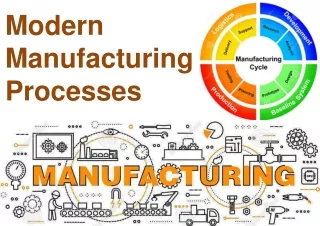

Modern manufacturing processes
E N D
Presentation Transcript
Modern Manufacturing Processes
Introduction of Manufacturing What is Manufacturing? Materials in Manufacturing Manufacturing Processes Production Systems Trends in Manufacturing
Microfabrication and Nanotechnology Microfabrication Processes that make parts and products whose feature sizes are in the micron range (10-6 m) Examples: Ink-jet printing heads, compact disks, microsensors used in automobiles Nanotechnology Materials and products whose feature sizes are in the nanometer range (10-9 m) Examples: Coatings for catalytic converters, flat screen TV monitors
Manufacturing is Important Making things has been an essential human activity since before recorded history Today, the term manufacturing is used for this activity Manufacturing is important to all nations (developed and developing countries) Technologically Economically
Technological Importance Technology - the application of science to provide society and its members with those things that are needed or desired Technology provides the products that help our society and its members live better What do these products have in common? They are all manufactured Manufacturing is the essential factor that makes technology possible
Economic Importance Economy of any country Sector: Agriculture and natural resources Construction and public utilities Manufacturing Service industries* %GDP 5 5 15 75 100 * includes retail, transportation, banking, communication, education, and government Gross domestic product (GDP) https://www.investopedia.com/insights/worlds-top-economies/
What is Manufacturing? The word manufacture is derived from two Latin words manus (hand) and factus (make); the methods that were used when the English word Most modern manufacturing operations are accomplished by mechanized and automated equipment that is supervised by human workers
Manufacturing - Technological Application of physical and chemical processes to alter the geometry, properties, and/or appearance of a starting material to make parts or products
Manufacturing - Economic Transformation of materials into items of greater value by one or more processing and/or assembly operations
Manufacturing Industries Industry consists of enterprises and organizations that produce or supply goods and services Industries can be classified as: 1. Primary industries - cultivate and exploit natural resources, e.g., agriculture, mining 2. Secondary industries - take the outputs of primary industries and convert them into consumer and capital goods 3. Tertiary industries - service sector
Specific Industries in Each Category
Manufacturing Industries - continued Secondary industries include manufacturing, construction, and electric power generation Manufacturing includes several industries whose products are not covered in this book; e.g., apparel, beverages, chemicals, and food processing For our purposes, manufacturing means production of hardware Nuts and bolts, forgings, cars, airplanes, digital computers, plastic parts, and ceramic products
Manufactured Products Final products divide into two major classes: 1. Consumer goods - products purchased directly by consumers Cars, clothes, TVs, tennis rackets 2. Capital goods - those purchased by companies to produce goods and/or provide services Aircraft, computers, communication equipment, medical apparatus, trucks, machine tools, construction equipment
Production Quantity Q The quantity of products Q made by a factory has an important influence on the way its people, facilities, and procedures are organized Annual quantities can be classified into three ranges: Productionrange Low production Medium production High production AnnualQuantityQ 1 to 100 units 100 to 10,000 units 10,000 to millions of units
Product Variety P Product variety P refers to different product types or models produced in the plant Different products have different features They are intended for different markets Some have more parts than others The number of different product types made each year in a factory can be counted When the number of product types made in the factory is high, this indicates high product variety
More About Product Variety Although P is quantitative, it is much less exact than Q because details on how much the designs differ is not captured simply by the number of different designs Soft product variety - small differences between products, e.g., between car models made on the same production line, with many common parts Hard product variety - products differ substantially, e.g., between a small car and a large truck, with few common parts (if any)
Manufacturing Capability A manufacturing plant consists of processes and systems (and people) to transform a certain limited range of materials into products of increased value The three building blocks - materials, processes, and systems - are the subject of modern manufacturing Manufacturing capability includes: 1. Technological processing capability 2. Physical product limitations 3. Production capacity
1. Technological Processing Capability The set of available manufacturing processes in the plant (or company) Certain manufacturing processes are suited to certain materials, so by specializing in certain processes, the plant is also specializing in certain materials Includes not only the physical processes, but also the expertise of the plant personnel A machine shop cannot roll steel A steel mill cannot build cars
2. Physical Product Limitations Given a plant with a certain set of processes, there are size and weight limitations on the parts or products that can be made in the plant Product size and weight affect: Production equipment Material handling equipment Production, material handling equipment, and plant size must be planned for products that lie within a certain size and weight range
3. Production Capacity Defined as the maximum quantity that a plant can produce in a given time period (e.g., month or year) under assumed operating conditions Operating conditions refer to number of shifts per week, hours per shift, direct labor manning levels in the plant, and so on Usually measured in terms of output units, such as tons of steel or number of cars produced by the plant Also called plant capacity
Materials in Manufacturing Most engineering materials can be classified into one of three basic categories: 1. Metals 2. Ceramics 3. Polymers Their chemistries are different, and their mechanical and physical properties are different These differences affect the manufacturing processes that can be used to produce products from them
In Addition: Composites Nonhomogeneous mixtures of the other three basic types rather than a unique category Venn diagram of three basic material types plus composites
1. Metals Usually alloys, which are composed of two or more elements, at least one of which is metallic. Two basic groups: 1. Ferrous metals - based on iron, comprises about 75% of metal tonnage in the world: Steel and cast iron 2. Nonferrous metals - all other metallic elements and their alloys: Aluminum, copper, nickel, silver, tin, etc.
Charging a basic oxygen furnace in steelmaking: molten pig iron is poured into the BOF. Temperatures are around 1650C (3000F).
2. Ceramics Compounds containing metallic (or semi-metallic) and nonmetallic elements. Typical nonmetallic elements are oxygen, nitrogen, and carbon For processing, ceramics divide into: 1. Crystalline ceramics includes: Traditional ceramics, such as clay, and modern ceramics, such as alumina (Al2O3) 2. Glasses mostly based on silica (SiO2)
3. Polymers Compound formed of repeating structural units called mers, whose atoms share electrons to form very large molecules. Three categories: 1. Thermoplastic polymers - can be subjected to multiple heating and cooling cycles without altering molecular structure 2. Thermosetting polymers - molecules chemically transform into a rigid structure 3. Elastomers - shows significant elastic behavior cannot reheat
4. Composites Material consisting of two or more phases that are processed separately and then bonded together to achieve properties superior to its constituents Phase - homogeneous mass of material, such as grains of identical unit cell structure in a solid metal Usual structure consists of particles or fibers of one phase mixed in a second phase Properties depend on components, physical shapes of components, and the way they are combined to form the final material
Manufacturing Processes Two basic types: 1. Processing operations - transform a work material from one state of completion to a more advanced state Operations that change the geometry, properties, or appearance of the starting material 2. Assembly operations - join two or more components to create a new entity
Complement: https://www.mindomo.com/es/mindmap/manufactura-moderna-f954bb58af03429199d52fe882cd2129
Processing Operations appearance in order to add value Three categories of processing operations: 1. Shaping operations - alter the geometry of the starting work material 2. Property-enhancing operations - improve physical properties without changing shape 3. Surface processing operations - clean, treat, coat, or deposit material on surface of work
Shaping Processes Categories Four 1. Solidification processes - starting material is a heated liquid or semifluid Particulate processing - starting material consists of powders Deformation processes - starting material is a ductile solid (commonly metal) Material removal processes - starting material is a ductile or brittle solid 2. 3. 4.
Solidification Processes Starting material is heated sufficiently to transform it into a liquid or highly plastic state Casting process at left and casting product at right
Particulate Processing (1) Starting materials are metal or ceramic powders, which are (2) pressed and (3) sintered
Deformation Processes Starting workpart is shaped by application of forces that exceed the yield strength of the material Examples: (a) forging and (b) extrusion
Material Removal Processes Excess material removed from the starting piece so what remains is the desired geometry Examples: (a) turning, (b) drilling, and (c) milling
Metal chips fly in a high speed turning operation performed on a computer numerical control turning center (photo courtesy of Cincinnati Milacron).
Waste in Shaping Processes It is desirable to minimize waste in part shaping Material removal processes are wasteful in the unit operations, but molding and particulate processing operations waste little material Terminology for minimum waste processes: Net shape processes - little or no waste of the starting material and no machining is required Near net shape processes - when minimum machining is required
Property-Enhancing Processes Processes that improve mechanical or physical properties of work material Examples: Heat treatment of metals and glasses Sintering of powdered metals and ceramics Part shape is not altered, except unintentionally Example: unintentional warping of a heat treated part
A batch of silicon wafers enters a furnace heated to 1000 C (1800 F) during fabrication of integrated circuits under clean room conditions (photo courtesy of Intel Corporation).
Surface Processing Operations Cleaning - chemical and mechanical processes to remove dirt, oil, and other surface contaminants Surface treatments - mechanical working such as sand blasting, and physical processes like diffusion Coating and thin film deposition - coating exterior surface of the workpart. Examples: Electroplating Physical vapor deposition Painting
Photomicrograph of the cross section of multiple coatings of titanium nitride and aluminum oxide on a cemented carbide substrate (photo courtesy of Kennametal Inc.).
Assembly Operations Two or more separate parts are joined to form a new entity Types of assembly operations: 1. Joining processes create a permanent joint Welding, brazing, soldering, adhesive bonding 2. Mechanical assembly fastening by mechanical methods Threaded fasteners (screws, bolts and nuts); press fitting, expansion fits
Two welders perform arc welding on a large steel pipe section (photo courtesy of Lincoln Electric Company).
Automated dispensing of adhesive onto component parts prior to assembly (photo courtesy of EFD, Inc.).
Production Machines and Tooling Manufacturing operations are accomplished using machinery and tooling (and people) Types of production machines: Machine tools - power-driven machines used to operate cutting tools previously operated manually Other production equipment: Presses Forge hammers, Plastic injection molding machines
A robotic arm performs unloading and loading operation in a turning center using a dual gripper (photo courtesy of Cincinnati Milacron).
Production Systems People, equipment, and procedures used for the materials and processes that constitute a firm's manufacturing operations A manufacturing firm must have systems and procedures to efficiently accomplish its production Two categories of production systems: Production facilities Manufacturing support systems People make the systems work
Production Facilities The factory, production equipment, and material handling systems Includes the way the equipment is arranged in the factory - the plant layout Equipment usually organized into logical groupings, called manufacturing systems. Examples: Automated production line Machine cell consisting of an industrial robot and two machine tools Production facilities "touch" the product