Modern manufacturing processes - Review
procesos de manufactura

Modern manufacturing processes - Review
E N D
Presentation Transcript
Manufacturing Process Meaning and Types
What is Manufacturing Process? Manufacturing process is basically a complex activity, concerned with people who've a broad number of disciplines and expertise and a wide range of machinery, tools, and equipment with numerous levels of automation, such as computers, robots, and other equipment. Manufacturing pursuits must be receptive to several needs and developments. Beside above, all the future technicians must understand the basic needs of workshop routines in terms of man, equipment, material, methods, revenue conveniences needed to be placed properly for maximum shop or plant layouts and other support solutions effectively regulated or positioned in the field or industry within a properly planned manufacturing firm. and other infrastructure
Meaningof Manufacturing The complete knowledge of fundamental workshop technology and manufacturing processes is highly troublesome for anybody to claim competence over it. It deals with numerous aspects of workshops procedures also for providing the basic working awareness of the various engineering materials, tools, accessories, manufacturing processes, basic concepts of machine instruments, production criteria’s, traits and uses of numerous testing instruments and calibrating or inspecting units for checking materials or products designed in various production shops in a commercial environment. It also explains and illustrates the use of several hand tools (calibrating, marking, forming and supporting gear etc.), tools, machinery and diverse methods of production that facilitate forming or shaping the existing raw materials into appropriate usable forms. Below are some of the manufacturing processes that are worth reading.
Types of Manufacturing Processes Following are the 4 types of manufacturing processes: Machining, Joining, Forming, Casting
Types of Manufacturing Processes Machining Tools used for machining are immobile power-driven units used to form or shape solid materials, specifically metals. The forming is done by removing extra materials from a work- piece. Machine tools make up the foundation of advanced industry and are utilized either indirectly or directly in the manufacturing of tool parts. They are categorized under three main categories: • Traditional Chip-making tools. • Presses. • Modern machine tools. Traditional chip-making tools form the work-piece by trimming away the unwanted part accessible as chips. Presses implement a several shaping processes, which includes shearing, pressing, or elongating. Non-traditional machine tools implement light, electric powered, chemical, and sonic power; superheated gas; and high-energy compound beams to form the exotic supplies and materials that have been created to meet the requirements of modern technology.
Types of Manufacturing Processes Joining • Every joining approach has particular design needs, while certain joint needs may propose a particular joining approach. Design for assembly, and fastener selection apply their own specifications. • Bolting is a standard fastening method, for instance, but welding may cut down the weight of assemblies. Naturally, joints intended for the two approaches would differ tremendously. However, all joint patterns must consider features such as load factors, assembly effectiveness, operating surroundings, overhaul and upkeep, and the materials chosen. Welding is generally a cost-effective approach to fabricate. It doesn't require overlapping materials, and so it removes excess weight brought on by other fastening methods. Welding also can minimize costs related to extra parts, for example angles mounted between parts.
Types of Manufacturing Processes Forming Metal forming is the approach of creating the metallic components by deforming the metal but not by removing, cutting, shredding or breaking any part. Bending, spinning, drawing, and stretching are a few important metal forming process in manufacturing. The metal press such as die and punching tools are implemented for this manufacturing process. Advantages: – Same equipment can be utilized for manufacturing various components by simply changing the dies. Disadvantages: – High apparatus and tooling expenses. – Heat treatment must be applied afterwards
Types of Manufacturing Processes Casting Casting is a manufacturing process in which a solid is dissolved into a liquid, heated to appropriate temperature (sometimes processed to change its chemical formula), and is then added into a mold or cavity. Thus, in just one step, complex or simple shapes can be crafted from any kind of metal that has the capability to be melted. The end product can have practically any arrangement the designer wants. Furthermore, the reluctance to working challenges can be improved, directional attributes can be managed, and a pleasing look can be developed.
Metal Casting Definition, Types and Processes
Metal Casting Definition, Types and Processes Casting is a method where a solid material is dissolved, heated to suitable temperature (generally treated to change its chemical structure), and is then added into a mold or cavity, which keeps it in a proper form during solidification. As a result, in just one step, complex or simple designs can be created from any material that can be dissolved. The end product can have nearly any setting the designer needs. For any casting procedure, choice of right alloy, sizing, shape, thickness, tolerance, structure, and weight, is really important. Special needs such as, magnetism, deterioration, stress distribution also have an impact on the selection of metal casting process. Opinions of the tooling manufacturer; foundry / machine house requirements, customer's exact product needs, and secondary procedures like paint work, must be addressed before choosing the right metal casting process.
Metal Casting Processes There are numerous metal casting processes implemented in the manufacturing of parts. Two main divisions can be identified by the fundamental nature of a mold they use. There is expendable casting and long-lasting mold casting. Expendable molds are utilized for a single metal casting while long-lasting molds are utilized for several. When considering manufacturing procedures, there are pros and cons to both of the processes. Expendable Mold Can only make one metal casting Made of sand, or other similar materials Binders used to support material hold its shape Mold that metal hardens in should be damaged to wipe out casting More complex geometries are feasible for casting Long-lasting Mold Can create many metal castings Generally made of metals or often a refractory ceramic It has parts that can close or open, permitting eradication of the casting Have to open mold limitations part designs
Types of Metal Casting Centrifugal Casting In this range of processes the melted material is required to disperse into the mold hole because of centrifugal speed. Centrifugal casting procedures can be categorized as true casting processes, which, when the melted material is added into the cavity, pushes it against the cavity walls where it stiffens into a hollow container; semi-centrifugal casting, varies from real centrifugal casting. In this process, the mold cavity is 100% filled with molten material so that the center, which is later on taken out, is exposed to low stress and is where inclusions and air is caught and the centrifuging approach in which melted material is poured into several mold cavities and which move around the core axis and shifted from the core axis and causes the cavities to be stuffed under excessive pressure.
Types of Metal Casting Continuous Casting In this process, a flow of molten material equates of a water-cooled hole and creates a continuous rod or strip which is then chopped by a rounded saw. A new technique, generally known as circular continuous casting, entails the water-cooled hole (mold) oscillating as well as rotating at approximately 120 RPM during the casting procedure. Constant casting has an extremely high metal yield, around 98% in comparison with 87% in standard ingot-mold methods, outstanding quality of cast, manipulated grain sizes and the capability of casting unique cross- sectional designs.
Types of Metal Casting Die Casting Metal Die casting processes force the molten material into the hole of a steel cavity, termed as a die, within extremely high pressure, approximately 1000 – 30,000 psi. Categorization of die casting entails the kinds of machines used, the main types being used are hot- chamber and cold-chamber machines.
Sheet Metal Forming Process Sheet Metal Forming Basics With the use of the industrial manufacturing process, sheet metal is formed by working metal into flat and thin pieces. Sheet metal is one of the very convenient ways that is used in metal working and it can be mended and cut into various shapes and dimensions. A wide range of products are manufactured with the use of sheet metal making it an essential part of the modern world. Sheet metal varies in thickness. Its thickness is quantified by a measure known as its gauge. The metal will be thin if the gauge number is larger. You can find sheet metal in the form of foil as well.
Sheet Metal Forming Process Sheet Metal Forming Basics The form in which sheet metal is found in the market is either in coiled strips or in flat pieces. The coils are made with continuous running of sheet metal into a roll slitter. Usually, the coils used range from 7 to 20 gauges. Sheet metal is used in various products like machinery, building roofs, car bodies, airplanes and much more.
Sheet Metal Forming Process Sheet Metal Forming Sheet Metal Material Used in the Process • The common materials used in manufacturing sheet metal are aluminium and stainless steel. The most known grades available in stainless steel are 304, 316 and 410. 304 is one of the most common grades. However, it is not available in the form of a sheet. The other two grades are much resistant and powerful than 304. When it comes to aluminium, it has got four known grades which are 1100-H14, 3003-H14, 5052-H32 and 6061-T6. Every grade is stronger than the other and used in different machinery, weapons and equipment. Sheet Metal Forming Processes • This is a commonly used manufacturing process that helps in manufacturing the parts for tons of known and unknown purposes. Sheet metal forming process is done on a press and the parts are formed in between two die. The die at the top is called a punch. Sheet metal is formed cold.
Sheet Metal Forming Process Sheet Metal Forming Bending This step includes bending sheet metal for creating the metal components. Small lengths metals are bent with the help of the dies during the process. Press brakes are used to press the longer lengths of metal. Repeated bending is also used for complex shapes. This is also done through sets of rollers.
Sheet Metal Forming Process Sheet Metal Forming Roll Forming A series of bending operations are done on the sheet metal for roll forming. A roll forming lines is present on which the sheet metal is fed by a series of roll stations. Each station is a roller die present on both sides of the sheet. These rollers can be at different angles of the sheet. When the sheet is forced through the roller dies, the sheet bends and deforms.
Sheet Metal Forming Process Sheet Metal Forming Spinning The sheet metal is revolved at high speed and is pressed against a prior attached headstock spindle. A tailstock supports the metal while it is spinning. With a special tool, pressure is applied to the metal to get the required shape of the metal.
Sheet Metal Forming Process Sheet Metal Forming Deep Drawing In this stage, the metal is not clamped but is put in the die. The first stage of deep drawing is called cupping. A pressure pad holds the blank on the die while the punch moves below and takes the blank into the cavity. The metal is bent plastically and drawn over the edge till the cup is formed. The pressure pad removes all the wrinkles meanwhile. A lot of deeper products can be formed with repeated deep drawing.
Sheet Metal Forming Process Sheet Metal Forming Deep Stretch Forming In the operation, the sheet metal is clamped round the circumference with a blank holder and changes shape according to its thickness. The holder draws the metal into the cavity present in the die. When the metal is stretched it becomes thinner.
Milling Machine Definition, Process & Types Milling is a process performed with a machine in which the cutters rotate to remove the material from the work piece present in the direction of the angle with the tool axis. With the help of the milling machines one can perform many operations and functions starting from small objects to large ones. Milling machining is one of the very common manufacturing processes used in machinery shops and industries to manufacture high precision products and parts in different shapes and sizes.
Milling Machine The milling machines are also known as the multi-tasking machines (MTMs) which are multi-purpose machines capable of milling and turning the materials as well. The milling machine has got the cutter installed up on it which helps in removing the material from the surface of the work piece. When the material gets cooled down then it is removed from the milling machine.
Milling Process The milling machine involves the following processes or phases of cutting: Milling Cutters • There are a lot of cutting tools used in the milling process. The milling cutters named end mills have special cutting surfaces on their end surfaces so that they can be placed onto the work piece by drilling. These also have extended cutting surfaces on each side for the purpose of peripheral milling. The milling cutters have small cutters at the end corners. The cutters are made from highly resistant materials that are durable and produce less friction. Surface Finish • Any material put through the cutting area of the milling machine gets regular intervals. The side cutters have got regular ridges on them. The distance between the ridges depends on the feed rate, the diameter of the cutter and the quantity of cutting surfaces. These can be the significant variations in the height of the surfaces. Gang Milling • This means that more than two milling cutters are involved in a setup like the horizontal milling. All the cutters perform a uniform operation or it may also be possible that the cutter may perform distinct operations. This is an important operation for producing duplicate parts.
Types of Milling Machines The two main configurations of the milling machining operations are the types of milling machines. These are the vertical mill and the horizontal mill. They are further discussed below:
Types of Milling Machines Vertical Milling Machines The vertical mill has a vertically arranged spindle axis and rotate by staying at the same axis. The spindle can also be extended and performing functions such as drilling and cutting. Vertical mill has got two further categories as well: turret mill and bed mill. The turret mill has got a table that moves perpendicularly and parallel to the spindle axis in order to cut the material. The spindle is, however, stationary. Two cutting methods can be performed with this by moving the knee and by lowering or raising the quill. The other is the bed mill in which the table moves perpendicular to the axis of the spindle and the spindle moves parallel to its axis.
Types of Milling Machines Horizontal Milling Machines The horizontal mill is also the similar cutter but their cutters are placed on a horizontal arbour. A lot of horizontal mills have got rotary tables that help in milling in various angles. These tables are called the universal tables. Apart from this all the tools that are used in a vertical mill can also be used in the horizontal mill.
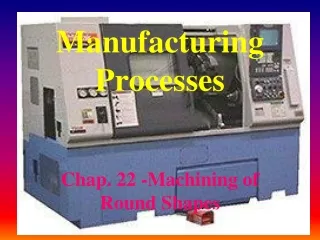
Machining Operation and Types of Machining Tools Machining • Machining is manufacturing process that involves removing materials using cutting tools for getting rid of the unwanted materials from some workpiece and converting it into the shape you desire. A large piece of stock is used for cutting the workpiece. The large stock might be in any shape such as solid bar, flat sheet, beam or even hollow tubes. The process can also be performed on some existing part like forging or casting. Machining Operations • Machining operations are classified into 3 principle processes and they are turning, drilling and milling. There are other operations too that fall in miscellaneous categories such as boring, sawing, shaping, and broaching. A specific machine tool is required for taking care of each machining operation.
Types of Machining Tools Machining is categorized into the types of machining tools explained in detail: Drilling In drilling process holes are created in the metal through circular cylinders. A twist drill is used for accomplishing this task. 75% of the metal cutting material is removed through the drilling operation. The drill enters the workpiece and cuts a hole which is equal to the diameter of the tool that was used for cutting the whole. A drill has a pointed end which can easily cut a hole in the work piece.
Types of Machining Tools Machining is categorized into the types of machining tools explained in detail: Turning Turning is basically a lathe operation by which the metal is removed from the workpiece outside its diameter using a cutting tool. This operation is performed on a lathe which is a machine where the workpiece is adjusted and the tool is kept stationary whereas the workpiece is rotated. Lathes are specially designed for the turning operation and they help in cutting the metal in the most precise way. The workpiece is placed on the chuck and the machine rotates the stationary tool to cut the unwanted parts from the piece.
Types of Machining Tools Machining is categorized into the types of machining tools explained in detail: Milling Milling is one of the fundamental operations in machining. This manufacturing process is less accurate than the turning processes because the degree of freedom is high. Milling fabricates the object which is not axially symmetric. A milling machine is required for this purpose along with a fixture, cutter and of course the workpiece. The workpiece here is the material that is already shaped and it needs milling. It is secured to the fixture, ready for being milled. The cutter is also secured to the machine. It has sharp teeth and it rotates at a high speed. The workpiece is fed to the cutter and it removes the unwanted metal from the piece.
Types of Machining Tools Machining is categorized into the types of machining tools explained in detail: Grinding Grinding process is used for improving the finish of the surface and tightening up the tolerance by removing the remaining unwanted materials from the surface. Grinding machines are used for this purpose to produce parts of identical shape, size and finish.
Types of Machining Tools Machining is categorized into the types of machining tools explained in detail: Chip Formation In chip formation process materials are cut through mechanical means by using tools like milling cutters, saws and lathes. It is an integral part of the engineering of developing machines and cutting tools.
Lathe Operations Types and Cutting Tools Shaping up different materials and performing various functions such as sanding, deformation, cutting, facing, knurling, drilling, turning and much more is done with the lathe machines. Special tools are used in order to perform these various operations. Read on to know more about the lathe operations: What Is Lathe? Lathe is a machine that helps in shaping several material pieces in the desired shapes. A lathe is a machine that rotates the piece on the axis in order to perform various operations like cutting, facing, knurling, deformation and more. Metal spinning, thermal spraying, woodturning and metalworking are the common operations performed with a lathe machine. One can even shape pottery with this working wonder. Whatever material used in lathe machine whether metal or wood is molded first. The most commonly used lathes are the woodworking lathes.
Lathe Operations Types and Cutting Tools Lathes Operations The general operations done with the lathe are grooving, turning, cutting, sanding and etc. if anyone wants to operate the lathe machine then he must first know about the feeds, cutting speed, depth of the cut and usage of tool should be considered. Each lathe operation has got its own factors that need to be considered before doing the work. The factors should be used properly so that one can avoid from mishandling and mishaps while performing any kind of lathe operation. With every cut desired the speed, depth and feed of the lathe machine is changed for precision.
Types of Lathe Operation The working of the lathe machine changes with every operation and cut desired. There are a lot of operations used for using the lathe machine. Some of the common lathe operations are: Facing This is usually the first step of any lathe operation on the lathe machine. The metal is cut from the end to make it fit in the right angle of the axis and remove the marks. Tapering Tapering is to cut the metal to nearly a cone shape with the help of the compound slide. This is something in between the parallel turning and facing off. If one is willing to change the angle then they can adjust the compound slide as they like. Parallel Turning This operation is adopted in order to cut the metal parallel to the axis. Parallel turning is done to decrease the diameter of the metal. Parting The part is removed so that it faces the ends. For this the parting tool is involved in slowly to make perform the operation. For to make the cut deeper the parting tool is pulled out and transferred to the side for the cut and to prevent the tool from breaking.
Types of Lathe Cutting Tools There are several lathe cutting tools that help in cutting with the lathe machine. The commonly used tools are mentioned below: Carbide tip tools Grooving tool Cut-Off blade Parting blades Boring bar Side tool
Electrical Discharge Machine (EDM) Types, Advantages and disadvantages Electrical discharge machine is stated as a spark eroding, burning, spark machining, wire burning and die sinking equipment. This machine is used to get the desired shapes of materials by using the electrical discharges or sparks. The discharge is made between two electrodes which are separated by a dielectric liquid subject to the electric voltage. The electrodes are named the tool-electrode and the work piece electrode. The electric discharge becomes greater when the distance between the two electrodes reduces. Thus, the material gets removed from the electrodes. Fresh dielectric liquid is introduced in the inter-electrode volume. This process is also called flushing. When the current flows again the difference of potential present between the electrodes is restored before the breakdown.
Electrical Discharge Machine (EDM) Types, Advantages and disadvantages Definition The electrical discharge machine is a machine that follows some technique in order to shape the surfaces of metal objects with the help of a dielectric liquid and a tool that releases a high intensity electric discharge. EDM History In 1770, the impulsive effect of the electrical discharges of EDM was observed. This effect was discovered by the English physicist Joseph Priestly. The types of electrical discharge machines introduced were the Die-sink in 1943 and the Wire-cut machine in 1960s.
Types of Electrical Discharge Machine Sinker EDM The Sinker EDM is also called a volume EDM or cavity EDM. This has got a work piece and an electrode present in an insulating fluid. The work piece and the electrode are connected with specific supply of power. Due to the power electrical potential is created between the two components. When the electrode reaches the work piece then the dielectric discharged is released and forms a plasma channel with slight sparks.
Types of Electrical Discharge Machine Sinker EDM Applications The sinker EDM is used when the material parts of any object requires high tolerance or corner radius. There are a lot of products and parts of those products made from Sinker EDM. Usually the production molds and dies are made with the help of this sinker EDM. It is convenient to use for making such production dies and molds. Advantages Sinker EDM process can do wonders for your production industry and provides durable results with high-quality finishes. Following are the advantages of Sinker EDM: Cuts exotic materials easily Tough materials are easy to cut Little or no polishing is required after the process is complete Cuts thin materials without by preventing any damage Disadvantages Excessive power consumption Slow material removal No or less conductive materials produced
Types of Electrical Discharge Machine Wire EDM Introduced in 1969, the Wire EDM machining is a single-strand metal wire which is pretty thin made from brass present in the workpiece and also in dielectric fluid tank. Wire EDM is used in cutting plates thick as 300mm. Apart from this, it is also used in making dies, punches and several tools from hard metals.
Types of Electrical Discharge Machine Wire EDM Applications Due to the flexibility of the machine the manufacturers use this to a wide range of applications. As the machine is able to cut very small pieces of materials too this is why it is a very smart choice for the production industries. Advantages Cost effective High precision Best for prototype manufacturing Flexible machine for various cuts Disadvantages Consumes high levels of energy Frequent change of brass, copper or other metal wire used in thermal stress
Ultrasonic Machining Process, Working Principles & Advantages Ultrasonic machining is changing the manufacturing industries with its superlative performance. The main reason why this machining process is used in the manufacturing area is because it evolves less heat in the process. All the operations done with the ultrasonic machining method are cost effective and best in results. Ultrasonic machining is an abrasive process which can create any material into hard and brittle form with the help of its vibrating tool and the indirect passage of abrasive particles towards the work piece. It is a low material removal rate machining process.
Ultrasonic Machining Process, Working Principles & Advantages Ultrasonic Machining It is also known as Ultrasonic impact grinding is an operation that involves a vibrating tool fluctuating the ultrasonic frequencies in order to remove the material from the work piece. The process involves an abrasive slurry that runs between the tool and the work piece. Due to this, the tool and the work piece never interact with each other. The process rarely exceeds two pounds. Ultrasonic Machine is Useful for Hard Material This method is the best choice for working with hard materials such as ceramic matrix composites, ruby, piezo-ceramics, glass, ceramics, Quartz, ferrite, diamonds, technical ceramics, alumina, PCD, sapphire, CVD silicon carbide and similar ones.
Ultrasonic Machining Process, Working Principles & Advantages Ultrasonic Machining Process The tool present in the machine for cutting the materials is made from a soft material as compared to the work piece. The tool is usually made from materials such as soft steels and nickel. When the tool vibrates, the abrasive slurry (liquid) is added which contains abrasive grains and particles. The abrasive slurry is added till the work pieces interacts with the grains. Due to the particles of liquid added, the work brittleness of the work piece abrades the surface meanwhile the tool deforms gradually.
Ultrasonic Machining Process, Working Principles & Advantages Working Principle of Ultrasonic Machining The time spent on ultrasonic machine entirely depends on the frequency of the vibrating tool. It also depends on the size of grains of the abrasive slurry, the rigidity and the viscosity as well. The grains used in the abrasive fluid are usually boron carbide or silicon carbide as they are rigid than others. The used abrasive can be carried away easily if the viscosity of the slurry fluid is less. Ultrasonic machines are the future of machining which is used all over the world for creating hard and brittle forms of materials for the industrial uses. A lot of operations can be performed with the ultrasonic machine which can benefit the industrialists in a variety of ways. The advanced technology creates solution which helps in opening up the market opportunities and has made things easier.