Guide to GST Registration Documents in India
0 likes | 2 Vues
Unlock seamless GST registration in India! This guide details essential gst registration documents, the gst registration documents list, and the process for hassle-free gst registration.


Guide to GST Registration Documents in India
E N D
Presentation Transcript
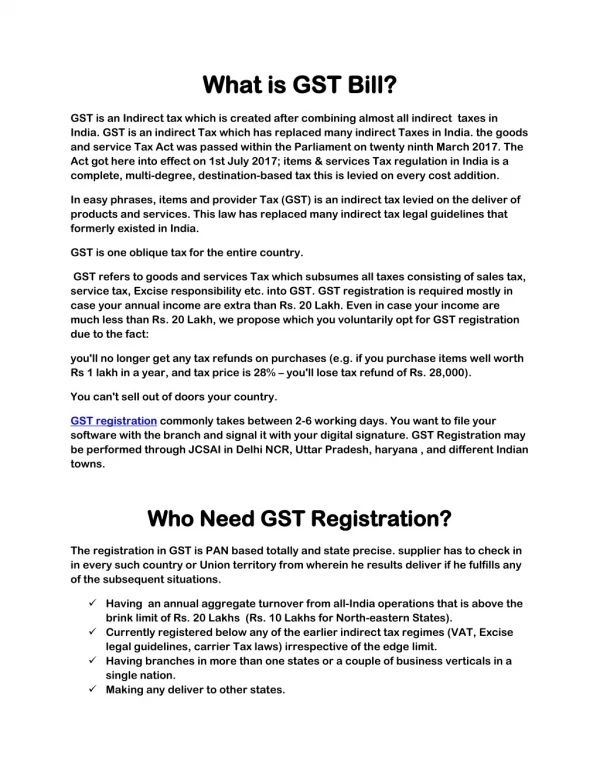
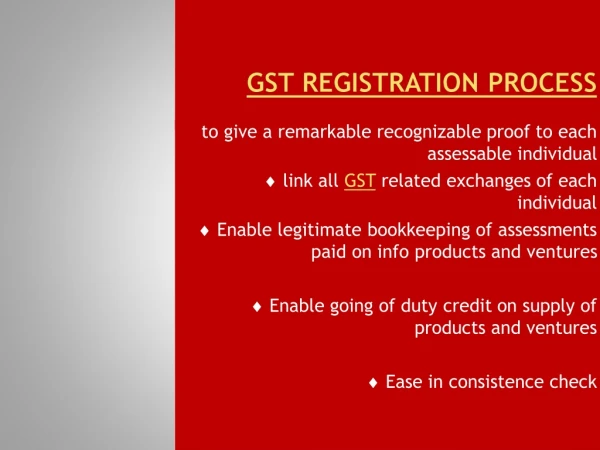
Guide to GST Registration Documents in India Securing Goods and Services Tax (GST) registration is a pivotal step for any business operating in India. It not only ensures legal compliance but also unlocks a plethora of benefits, including input tax credit and seamless interstate trade. However, the process can seem daunting, especially when it comes to gathering the necessary gst registration documents. This comprehensive guide aims to demystify the requirements, providing you with a clear understanding of the paperwork involved and streamlining your gst registration journey. Why is GST Registration Essential? Before diving into the specifics of the gst registration documents list, it's crucial to understand why this registration is so vital for your business: ● Legal Compliance:GST registration is mandatory for businesses exceeding the prescribed threshold limit of turnover (currently ₹40 lakhs for goods and ₹20 lakhs for services, with some exceptions for special category states). Operating without registration when liable can lead to penalties and legal repercussions. ● Input Tax Credit (ITC): Registered businesses can claim Input Tax Credit on the GST paid on their purchases, reducing their overall tax liability. This mechanism prevents the cascading effect of taxes, making the entire supply chain more efficient. ● Interstate Trade:GST registration is essential for businesses involved in the supply of goods or services across state borders. Without it, conducting interstate transactions becomes legally challenging. ● Enhanced Business Credibility: Holding a valid gst registration certificate enhances your business's credibility and trustworthiness among customers, suppliers, and other stakeholders. ● Access to Government Tenders: Many government tenders and contracts require businesses to be GST registered. ● Facilitates Exports: For businesses engaged in exports, gst registration is often a prerequisite for claiming refunds on taxes paid on export supplies. Who Needs to Register for GST? Generally, the following categories of individuals and businesses are required to obtain gst registration: ● Businesses with an aggregate turnover exceeding the threshold limit. ● Businesses involved in interstate supply of goods or services. ● Casual taxable persons (those who supply goods or services occasionally in a state where they don't have a fixed place of business). ● Non-resident taxable persons (those who supply goods or services from outside India to India). ● Agents of a supplier. ● Input Service Distributors (ISDs).
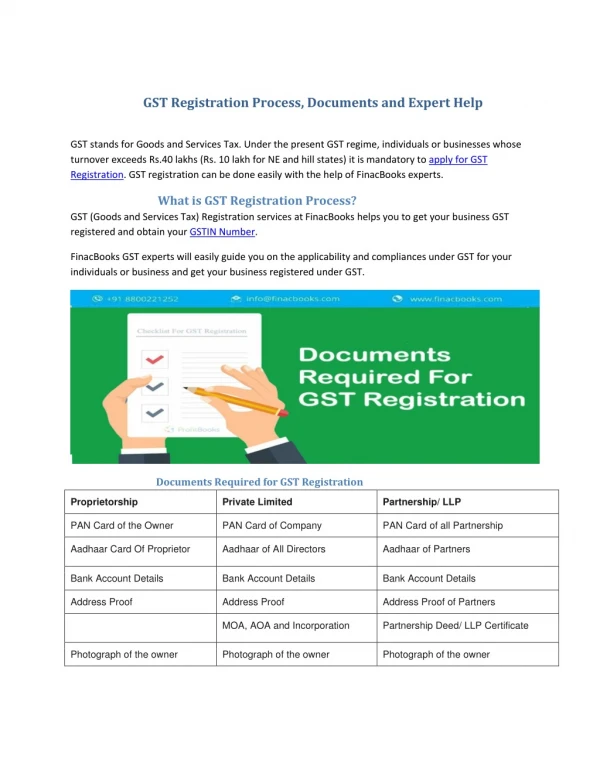
● E-commerce operators and aggregators. ● Those supplying goods or services through e-commerce operators who are required to collect tax at source (TCS). ● Every person supplying online information and database access or retrieval services from a place outside India to a person in India, other than a registered person. Decoding the GST Registration Documents List The specific gst registration documents required can vary slightly depending on the type of business entity and the state of registration. However, the following is a comprehensive gst registration documents list of commonly required documents: A. For All Types of Businesses: 1. Proof of Business Constitution: This document establishes the legal structure of your business. The specific document required depends on the type of entity: ○ Proprietorship: PAN card of the proprietor (mandatory). ○ Partnership Firm/Limited Liability Partnership (LLP): Partnership deed/LLP agreement. ○ Company (Private/Public Limited): Certificate of Incorporation issued by the Registrar of Companies (RoC), Memorandum of Association (MoA), and Articles of Association (AoA). ○ Trust/Society/Club: Registration certificate. 2. Proof of Principal Place of Business: This document provides evidence of your business's primary location. You will need at least one of the following (ensure the document is recent, generally not older than three months): ○ Owned Property: Latest property tax receipt, electricity bill, water bill, or landline telephone bill along with a copy of the property ownership document (e.g., sale deed). ○ Rented/Leased Property: Rent/lease agreement along with one of the documents mentioned above in the name of the landlord/lessor. A No Objection Certificate (NOC) from the landlord/lessor is also usually required. ○ Shared Property: NOC from the owner along with proof of ownership and one of the utility bills mentioned above. ○ SEZ Units: Allotment letter of premises. 3. Proof of Identity and Address of Promoters/Directors/Partners: This includes identification and address proof for the individuals responsible for the business. Acceptable gst registration documents include: ○ PAN card (mandatory for all promoters/directors/partners). ○ Passport. ○ Driving license. ○ Aadhaar card. ○ Voter ID card. ○ Latest bank statement (not older than three months).
○ Electricity bill, landline telephone bill, or water bill (not older than three months). 4. Bank Account Details: You will need to provide details of your business's bank account, including: ○ Scanned copy of the first page of the bank passbook showing the account holder's name, bank name, branch, account number, and MICR code. ○ Bank statement (can sometimes be accepted). ○ Cancelled cheque. 5. Digital Signature Certificate (DSC): For companies and LLPs, a Class 2 or Class 3 Digital Signature Certificate is mandatory for online gst registration. For proprietorships and partnerships, while DSC is preferred, Aadhaar-based e-signature may also be an option. 6. Authorization Form: If someone other than the promoter or authorized signatory is applying for gst registration, an authorization letter or board resolution (for companies) is required. This authorizes the signatory to act on behalf of the business. B. Additional Documents Based on Business Type: 1. For Partnership Firms/LLPs: ○ Partnership Deed (for Partnership Firms). ○ LLP Agreement (for LLPs). 2. For Companies: ○ Certificate of Incorporation. ○ Memorandum of Association (MoA). ○ Articles of Association (AoA). ○ PAN card of the company. ○ Board resolution authorizing a director to apply for GST. 3. For Trusts/Societies/Clubs: ○ Registration Certificate. ○ Trust Deed/Memorandum of Association. ○ List of trustees/managing committee members. ○ Resolution of the managing committee authorizing a member to apply for GST. 4. For Non-Resident Taxable Persons: ○ Valid passport and visa. ○ Proof of business registration in their home country. ○ Letter of authorization. ○ Digital Signature Certificate (DSC). 5. For Casual Taxable Persons:
○ PAN card. ○ Proof of principal place of business in their home state. ○ Proof of address in the state where they seek casual registration. ○ Undertaking for making advance tax deposit. Step-by-Step Guide to GST Registration Once you have gathered all the necessary gst registration documents, you can proceed with the online gst registration process on the GST portal (www.gst.gov.in). Here's a general overview of the steps involved: 1. Visit the GST Portal: Go to the official GST portal. 2. New Registration: Click on the "Services" tab, then "Registration," and select "New Registration." 3. Provide Basic Details: Fill in your basic details, including your PAN, state, district, and legal name of the business. 4. Verify Mobile and Email: Enter your mobile number and email address and verify them through OTP. 5. Temporary Reference Number (TRN): Upon successful verification, a TRN will be generated and sent to your registered email ID and mobile number. 6. Complete Part B of the Application: Log in to the GST portal using the TRN and fill in the detailed application form. This includes providing information about your business, promoters/partners/directors, principal place of business, goods and services dealt with, bank account details, etc. 7. Upload Documents: Upload the scanned copies of all the required gst registration documents in the prescribed format and size. 8. Verification: You can verify your application using either a Digital Signature Certificate (DSC) or through Aadhaar-based e-signature (OTP). Companies and LLPs are generally required to use DSC. 9. Submission: After successful verification, submit your application. 10. Acknowledgement: You will receive an Application Reference Number (ARN) upon successful submission. 11. Verification by GST Officer: The GST officer will review your application and the submitted gst registration documents. They may raise queries or ask for additional information. 12. GSTIN Allotment: If your application is approved, you will be granted a Goods and Services Tax Identification Number (GSTIN) and a GST registration certificate. You can download the certificate from the GST portal. Key Considerations for a Smooth GST Registration Process ● Accuracy of Information: Ensure that all the information provided in the application form and the gst registration documents are accurate and consistent. Any discrepancies can lead to delays or rejection of your application. ● Document Quality: Upload clear and legible scanned copies of all the required documents. Blurry or incomplete documents can cause issues. ● File Size and Format: Adhere to the prescribed file size and format (usually PDF or JPEG) for uploading documents on the GST portal.
● Timely Response to Queries: If the GST officer raises any queries, respond to them promptly and provide the necessary clarifications or additional documents. ● Professional Assistance: If you find the process complex, consider seeking assistance from a tax professional or GST consultant. They can guide you through the process and ensure that all the requirements are met. Conclusion Obtaining gst registration is a crucial step for businesses in India. While the process involves submitting various gst registration documents, understanding the gst registration documents list and following the correct procedure can make the journey smoother. By carefully preparing the required paperwork and ensuring accuracy in your application, you can successfully obtain your GSTIN and unlock the benefits of this unified tax regime. Remember to stay updated with the latest rules and regulations related to GST registration, as they may be subject to change. This comprehensive guide serves as a valuable resource to help you navigate the paperwork maze and achieve seamless gst registration for your business.