Why Study BSc Aviation in Chennai
0 likes | 0 Vues
What is B.Sc. Aviation?<br>B.Sc. Aviation (Bachelor of Science in Aviation) is a 3-year undergraduate program designed for students who want to build a career in the aviation industry.<br>The course focuses on:<br>u2022tAirport operations<br>u2022tAirline systems<br>u2022tAviation safety<br>u2022tNavigation basics<br>u2022tAviation regulations<br>u2022tGround operations and service departments<br>


Why Study BSc Aviation in Chennai
E N D
Presentation Transcript
Why Study BSc Aviation in Chennai? Every year, thousands of students in Tamil Nadu finish Class 12 and face the same big question: What should I study next? Engineering? Medicine? Commerce? But today, a growing number of students are exploring a career that feels exciting, global, and full of long-term growth: Aviation. If you’ve ever searched for: •What is B.Sc. Aviation? •Is aviation a good career after 12th? •What jobs are available after B.Sc. Aviation? This guide will help you understand the course clearly, without confusion.
What is B.Sc. Aviation? B.Sc. Aviation (Bachelor of Science in Aviation) is a 3-year undergraduate program designed for students who want to build a career in the aviation industry. The course focuses on: •Airport operations •Airline systems •Aviation safety •Navigation basics •Aviation regulations •Ground operations and service departments Important note: B.Sc. Aviation is not pilot training. If you want to become a pilot, you need CPL training and DGCA licensing separately. This degree is mainly for students who want careers in: •Airport management •Airline operations •Ground handling •Aviation services •Safety and compliance What Do You Study in B.Sc. Aviation? The curriculum is built to give students both theoretical understanding and industry- level exposure. Common subjects include: •Airport Operations – passenger, baggage, cargo, scheduling •Air Regulations – DGCA rules, ICAO guidelines, aviation law •Aviation Meteorology – weather basics and flight safety •Navigation Systems – aviation navigation and airport systems •Aircraft Handling & Basic Systems – ground operations knowledge •Aviation Safety & Emergency Procedures – safety protocols and response •Communication & Customer Service – airline and airport-facing skills
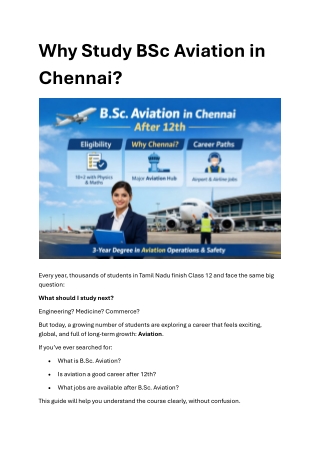
Key takeaway: This course helps students understand aviation as a complete industry system, not only the flying part. Eligibility for B.Sc. Aviation After 12th Most universities follow simple eligibility criteria: •10+2 with Physics and Mathematics •Minimum 50% aggregate marks (varies slightly by university) Why Students Choose B.Sc. Aviation After 12th Aviation is one of India’s fastest-growing industries, and that growth creates career opportunities for students. 1) India’s Aviation Industry is Expanding Airlines are adding new aircraft. Airports are growing capacity. New routes are opening under the UDAN scheme. This creates demand for trained aviation professionals in multiple departments. 2) Strong Starting Salaries Many entry-level roles start around: ₹3 LPA to ₹5 LPA (depending on role and company) With experience, salaries can grow steadily. 3) Multiple Career Options Unlike many degrees that lead to one narrow job path, B.Sc. Aviation opens doors to several roles, such as: •Airport Operations Executive •Ground Handling Supervisor •Airline Customer Service Manager •Cargo Executive / Load Planner •Aviation Safety Officer •Airline Operations Coordinator •Aviation Security roles 4) Global Career Potential Aviation is global by nature, and skilled professionals often find opportunities in:
•Middle East •Southeast Asia •International airlines and airports •Aviation service companies 5) Prestige and Professionalism Aviation careers are respected because the industry demands: •Discipline •Communication •Safety mindset •Strong coordination skills Why Chennai is a Great City to Study B.Sc. Aviation Chennai is one of South India’s major aviation hubs. With Chennai International Airport (MAA) and strong aviation infrastructure, students studying here often get better ecosystem exposure compared to smaller cities. Studying in Chennai can offer: •Proximity to a major airport •Better industry exposure opportunities •Stronger placement networks •Access to aviation events and real-world learning B.Sc. Aviation vs Other Aviation Courses (Quick Comparison) Many students confuse B.Sc. Aviation with other aviation programs. Here’s a simple breakdown: •B.Sc. Aviation – airport operations + airline systems + safety •B.Sc. Aeronautical Science – technical aviation science + aircraft systems •BBA Aviation – business + airline management •AME (DGCA) – aircraft maintenance engineering (licensing path) •CPL (Pilot Training) – flying + DGCA licensing •MBA Aviation – leadership roles after graduation Skills You Need to Succeed in Aviation
Aviation employers look beyond marks. The strongest professionals usually have: •Good communication •Attention to detail •Calm decision-making •Teamwork •Adaptability •Basic technical understanding Career Path After B.Sc. Aviation A typical career progression looks like this: Entry-Level (Year 1–3) •Airport Operations Executive •Airline Ground Staff •Cargo / Load Planning roles •Customer service roles Mid-Level (Year 3–7) •Senior Operations Executive •Ground Operations Supervisor •Safety and compliance roles •Dispatch support roles (with certification) Senior-Level (Year 7+) •Airport Operations Manager •Regional Operations Head •Aviation Consultant •Aviation Faculty / Trainer Many students also choose to do an MBA in Aviation Management later for faster growth. Final Thoughts: Is B.Sc. Aviation the Right Choice After 12th?
If you want a career that is: •Exciting •Global •Respected •Full of growth •Not limited to one job role Then B.Sc. Aviation is a strong option after 12th, especially if you study in a city like Chennai where the aviation ecosystem is active. For students looking for structured aviation education with real industry exposure, programs supported by training experts like MH Cockpit can be worth exploring.