CNG Powertrain Market
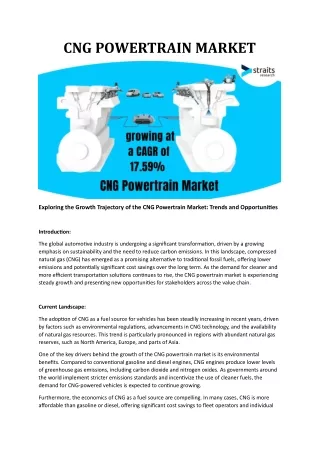
The Global CNG Powertrain Market is predicted to be valued at USD 155.6 billion in 2025 and is expected to grow to USD 726.1 billion by 2034, registering a compound annual growth rate (CAGR) of 18.7% from 2025 to 2034. <br><br>Read More Information for this Reports: https://dimensionmarketresearch.com/report/cng-powertrain-market/

CNG Powertrain Market
E N D
Presentation Transcript
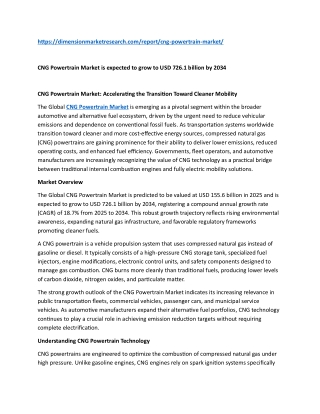
https://dimensionmarketresearch.com/report/cng-powertrain-market/https://dimensionmarketresearch.com/report/cng-powertrain-market/ CNG Powertrain Marketis expected to grow to USD 726.1 billion by 2034 CNG Powertrain Market: Accelerating the Transition Toward Cleaner Mobility The Global CNG Powertrain Market is emerging as a pivotal segment within the broader automotive and alternative fuel ecosystem, driven by the urgent need to reduce vehicular emissions and dependence on conventional fossil fuels. As transportation systems worldwide transition toward cleaner and more cost-effective energy sources, compressed natural gas (CNG) powertrains are gaining prominence for their ability to deliver lower emissions, reduced operating costs, and enhanced fuel efficiency. Governments, fleet operators, and automotive manufacturers are increasingly recognizing the value of CNG technology as a practical bridge between traditional internal combustion engines and fully electric mobility solutions. Market Overview The Global CNG Powertrain Market is predicted to be valued at USD 155.6 billion in 2025 and is expected to grow to USD 726.1 billion by 2034, registering a compound annual growth rate (CAGR) of 18.7% from 2025 to 2034. This robust growth trajectory reflects rising environmental awareness, expanding natural gas infrastructure, and favorable regulatory frameworks promoting cleaner fuels. A CNG powertrain is a vehicle propulsion system that uses compressed natural gas instead of gasoline or diesel. It typically consists of a high-pressure CNG storage tank, specialized fuel injectors, engine modifications, electronic control units, and safety components designed to manage gas combustion. CNG burns more cleanly than traditional fuels, producing lower levels of carbon dioxide, nitrogen oxides, and particulate matter. The strong growth outlook of the CNG Powertrain Market indicates its increasing relevance in public transportation fleets, commercial vehicles, passenger cars, and municipal service vehicles. As automotive manufacturers expand their alternative fuel portfolios, CNG technology continues to play a crucial role in achieving emission reduction targets without requiring complete electrification. Understanding CNG Powertrain Technology CNG powertrains are engineered to optimize the combustion of compressed natural gas under high pressure. Unlike gasoline engines, CNG engines rely on spark ignition systems specifically
calibrated for methane-based fuel. The integration of reinforced fuel tanks capable of withstanding high pressure is central to the safety and efficiency of the system. Key components of a CNG powertrain include CNG Storage Tanks designed to store gas at pressures typically around 200–250 bar Pressure Regulators that reduce gas pressure before combustion Fuel Injectors optimized for precise gas delivery Electronic Control Units that monitor and regulate combustion parameters Modified Engine Components tailored for natural gas properties Modern CNG powertrains are increasingly integrated with advanced engine management systems to enhance performance, fuel economy, and emissions control. Bi-fuel and dual-fuel configurations are also gaining traction, allowing vehicles to switch between CNG and conventional fuels based on availability and driving conditions. Key Growth Drivers in the CNG Powertrain Market Stringent Emission Regulations Governments worldwide are implementing strict emission standards to combat air pollution and climate change. CNG vehicles emit significantly lower greenhouse gases and pollutants compared to diesel and gasoline counterparts, making them compliant with evolving environmental policies. Cost Efficiency and Fuel Savings CNG is generally more affordable than traditional fuels, offering substantial savings for fleet operators and individual vehicle owners. Lower fuel costs, combined with reduced engine wear and maintenance requirements, enhance the total cost advantage of CNG vehicles. Abundant Natural Gas Reserves The availability of natural gas reserves in many regions ensures a stable and diversified energy supply. Countries with domestic gas production are leveraging this advantage to promote CNG adoption and reduce reliance on imported crude oil. Expansion of Refueling Infrastructure Growing investment in CNG refueling stations is eliminating one of the primary barriers to adoption. Urban centers and highway corridors are increasingly equipped with CNG fueling facilities, encouraging both passenger and commercial vehicle usage. Public Transportation Electrification Alternatives While electric buses are gaining popularity, CNG-powered buses offer a cost-effective alternative with lower infrastructure investment. Many municipalities are adopting CNG fleets to achieve cleaner transportation without the complexities of large-scale electrification.
Market Segmentation Insights The CNG Powertrain Market can be segmented based on vehicle type, component, and application. By Vehicle Type Passenger Vehicles are witnessing rising adoption due to affordability and emission benefits Light Commercial Vehicles benefit from fuel cost savings and operational efficiency Heavy Commercial Vehicles leverage CNG for long-haul transport and logistics Buses and Municipal Vehicles represent a significant adoption segment in urban areas By Component Fuel Storage Systems remain a critical segment due to safety and durability requirements Engine and Control Units drive innovation in performance optimization Fuel Injection Systems are evolving for improved precision and efficiency By Application Personal Transportation continues to expand in emerging economies Fleet Operations show strong demand due to cost-effectiveness Public Transport Networks are transitioning toward cleaner fuel alternatives Technological Advancements and Innovation Trends Innovation within the CNG Powertrain Market is centered around efficiency, safety, and integration with hybrid systems. Advanced composite materials are being used in CNG tanks to reduce weight while maintaining structural integrity. Electronic control systems are becoming more sophisticated, enabling real-time monitoring of fuel consumption and emissions. Hybrid CNG-electric systems are also emerging as a transitional technology, combining the environmental benefits of natural gas with electric propulsion. Additionally, renewable natural gas derived from organic waste is gaining attention, further enhancing the sustainability profile of CNG vehicles. Digital diagnostics and telematics integration allow fleet operators to optimize fuel management and predictive maintenance. These technological improvements are strengthening the competitiveness of CNG powertrains in the evolving mobility landscape. Challenges Impacting the Market Despite its growth potential, the CNG Powertrain Market faces several challenges. Infrastructure Gaps in Developing Regions Although refueling networks are expanding, rural and remote areas often lack adequate CNG infrastructure, limiting widespread adoption.
Vehicle Conversion Costs Converting existing vehicles to CNG systems can be expensive, potentially deterring individual consumers. Competition from Electric Vehicles The rapid advancement of battery electric vehicles presents competitive pressure. However, CNG remains a practical solution in regions where electric infrastructure is limited. Storage Space Limitations CNG tanks require significant space within vehicles, which may reduce cargo or passenger capacity in certain models. Regional Analysis Asia-Pacific is projected to hold the largest share in the global CNG Powertrain market with a revenue share of 70.1% by the end of 2025. The region benefits from a massive population base, rising vehicle production, and government policies encouraging the adoption of cleaner fuels. Rapid urbanization and severe air pollution concerns are driving demand for alternative fuel vehicles across major cities. Incentive programs, subsidies, and expanding refueling networks further support market dominance in the region. North America is experiencing steady growth due to increased interest in alternative fuels and investments in natural gas infrastructure. Fleet operators, particularly in logistics and public transportation, are integrating CNG vehicles to reduce operating expenses and meet sustainability targets. Europe demonstrates consistent adoption driven by emission reduction mandates and energy diversification strategies. Several countries are investing in renewable natural gas to complement traditional CNG infrastructure. Latin America and the Middle East & Africa are gradually expanding their CNG vehicle fleets, particularly in urban transportation systems and government-operated vehicles. Domestic natural gas availability in certain countries enhances market potential. Download a Complimentary PDF Sample Report: https://dimensionmarketresearch.com/request-sample/cng-powertrain-market/ Impact on Automotive Industry and Supply Chain The CNG Powertrain Market is influencing automotive manufacturing strategies and supply chain dynamics. Original equipment manufacturers are expanding CNG-compatible vehicle portfolios to cater to both domestic and export markets. Component suppliers are focusing on lightweight tank designs, advanced injectors, and high-performance engine calibration systems.
The aftermarket segment also plays a significant role, offering retrofitting solutions for commercial fleets. This dual market structure enhances growth opportunities across both OEM and conversion markets. Environmental and Economic Advantages CNG vehicles produce fewer carbon emissions and virtually eliminate particulate matter compared to diesel engines. Reduced engine deposits and cleaner combustion contribute to longer engine life and lower maintenance costs. From an economic perspective, CNG powertrains support energy diversification and enhance national energy security. By utilizing domestically produced natural gas, countries can reduce fuel import bills and stabilize fuel pricing. Future Outlook of the CNG Powertrain Market The long-term outlook for the CNG Powertrain Market remains highly optimistic. The projected CAGR of 18.7% through 2034 underscores strong momentum driven by policy support, technological innovation, and cost advantages. As renewable natural gas production increases, CNG vehicles may further reduce lifecycle emissions. Integration with smart mobility solutions and digital fleet management systems will enhance operational efficiency. The transition toward low-carbon mobility is multifaceted, and CNG powertrains are expected to remain a key component in regions balancing environmental goals with economic feasibility. Frequently Asked Questions (FAQs) 1.What is a CNG powertrain? A CNG powertrain is a vehicle propulsion system that uses compressed natural gas instead of gasoline or diesel, incorporating specialized tanks, injectors, and engine modifications for gas combustion. 2.Why is the CNG Powertrain Market growing rapidly? The market is expanding due to strict emission regulations, lower fuel costs, growing infrastructure, and increasing demand for cleaner transportation solutions. 3.Which region leads the CNG Powertrain Market? Asia-Pacific dominates the market with a projected revenue share of 70.1% by 2025, driven by population growth, vehicle production, and supportive government policies.
4.Are CNG vehicles cheaper to operate than gasoline vehicles? Yes, CNG typically costs less than gasoline, resulting in lower fuel expenses and reduced maintenance costs over time. 5.What is the market forecast for 2034? The CNG Powertrain Market is expected to reach USD 726.1 billion by 2034, growing at a CAGR of 18.7% from 2025. Summary of Key Insights The CNG Powertrain Market is poised for substantial growth, expanding from USD 155.6 billion in 2025 to USD 726.1 billion by 2034. Strong regulatory support, cost advantages, and abundant natural gas reserves are driving adoption across passenger vehicles, commercial fleets, and public transportation systems. Asia-Pacific leads the market with a dominant revenue share, while other regions steadily expand infrastructure and policy support. Despite competition from electric vehicles and infrastructure challenges, CNG powertrains remain a viable and scalable solution in the global transition toward sustainable mobility. Purchase the report for comprehensive details: https://dimensionmarketresearch.com/checkout/cng-powertrain-market/ Meta Title: CNG Powertrain Market Size, Share & Growth Forecast 2034 Meta Description: Explore the Global CNG Powertrain Market analysis, growth drivers, regional insights, and forecast to 2034. Discover trends, opportunities, and competitive landscape shaping cleaner vehicle propulsion systems. Tags: CNG Powertrain Market, Compressed Natural Gas Vehicles, Alternative Fuel Vehicles, Natural Gas Engine Market, Clean Transportation Solutions, Automotive Powertrain Market, CNG Infrastructure Growth, Sustainable Mobility Market, Bi-Fuel Vehicle Systems, Commercial CNG Vehicles