When Do You Really Need Scan to BIM Services in Your Construction Project?
0 likes | 0 Vues
Modern construction projects need accuracy and speed with control over cost. So, when is the right time to use Scan to BIM Services?


When Do You Really Need Scan to BIM Services in Your Construction Project?
E N D
Presentation Transcript
When Do You Really Need Scan to BIM Services in Your Construction Project?
Modern construction projects need accuracy and speed with control over cost. So, when is the right time to useScan to BIM Services? In today’s construction lifecycle, accuracy is not optional. It is the base of every successful project. Old methods like manual surveys and paper drawings often leave gaps. Those gaps turn into mistakes, delays, and extra costs. These gaps are filled partially via Scan to BIM. It creates a digital model of the building using point cloud data and laser scans. Teams can plan and build with confidence because that model depicts the actual conditions on site. 👉 McKinsey reports that projects using point cloud to BIM workflows cut rework costs by up to 30% and finish 20–25% faster. Furthermore, it goes beyond structure and design. After the building is finished, scan to BIM services is also important. Facility managers can use BIM models to track assets and schedule maintenance. They can also connect these models with IoT sensors. This supports the creation of digital twins, where the digital model and the real building work together. The real question is not whether you will need Scan to BIM Services. It is when. Renovations, complex MEP installations, and large infrastructure projects often demand them. They help teams work together and support compliance in regulated industries. Scan to BIMis now a regular part of construction. Using it at the right time helps lower risk and keep projects moving smoothly. Learn more about how it works and why it matters in What is Scan to BIM? Benefits Explained
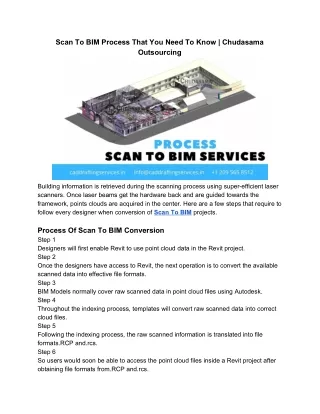
Why Scan to BIM Services Matter The Evolution of Construction Technology Construction keeps changing, and the same applies to the tools people use to get the job done. Back in the day, everything started with hand-drawn plans, but then CAD (Computer‑Aided Design) was introduced and made drawings digital. That was a big step. Then came BIM (Building Information Modeling), which did not just make drawings smarter- it packed them with extra information like materials, costs, and schedules, making it easier for teams to stay on the same page. Now, Scan to BIM modeling serviceselevate the standard. Rather than starting with a drawing, the process starts with the actual building itself. Teams use laser scanners to grab millions of data points straight from the site. All those points come together as a “point cloud.” That cloud is then converted into a BIM model. What you get is a Digital Twin- a digital copy of the real structure that stays with you the whole way through the construction lifecycle. Defining Scan to BIM At its core, Scan to BIMis about turning what is physically on site into something you can use and work with in a model. A laser scanner captures the true shape and size of a space, down to the smallest detail. That data- the point cloud- was imported into BIMsoftware. From there, experts build a model that does not just look like the building; it actually understands the condition of the building.
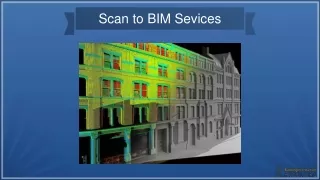
It is more than just a 3D picture. It is packed with useful details about walls, floors, pipes, equipment, and more. Teams rely on these models to plan renovations, coordinate MEP systems, or double-check compliance. Basically, point cloud to BIMconversion bridges the gap between what is already there and what you want to create next. Side by side comparion of a Raw Point Cloud vs. a Finished BIM Model
Situations Where You Really Need Scan to BIM Renovation & Retrofit Projects Starting a renovation can feel like stepping into uncertainty. Old buildings? Most of them do not have the latest drawings, and the paperwork you find is probably missing half the details. That is a problem for architects and contractors trying to make plans. Here’s where the laser scan to BIM servicessteps in. You point the scanner at the building, grab an exact snapshot of what is actually there, and turn all that data into a digital model. You can see where every wall, floor, and pipe really fits- no more guessing. That kind of accuracy helps teams avoid surprises, decrease errors, and actually stick to the plan. See how Scan to BIM improves precision in heritage projects in How Scan to BIM Increases Accuracy in Restoring Historic Structures? Complex MEP Installations If at any time you notice a project stop suddenly because pipes, ducts, and wires are all struggling to occupy the same place, you recognize how disorderly MEP (mechanical, electrical, plumbing) can become. Scan to BIM conversion services integrate all those systems into a single clear model, so everyone can spot conflicts before they become a problem. Engineers get a chance to fix issues and tweak designs early on, making sure everything fits the way it should. It is a real time-saver, and it means less rework later. For places like hospitals or data centers, where the MEP is designed for heavy use, and downtime is not an option, this kind of coordination matters a lot. Learn how Scan to BIM minimizes design conflicts in How Scan to BIM Improves Clash Detection in Construction
Facility Management & Asset Tracking After the construction is finished, the work doesnot stop. After that, Scan to BIM continues to be valuable. Facility managers depend on BIM models to monitor equipment, plan out maintenance, and make smarter connections with building automation systems. Introduce Digital Twin technology, and you have a live, up-to-date record of the building that shows how things are running, predicts when you will need repairs, and links up with IoT sensors for real-time updates. It is a smarter, faster way to look after big, complicated facilities- and it helps your building’s assets last longer. Large Infrastructure Projects Consider airports, factories, or massive hospitals. These places are definitely not simple, and there is no space for taking shortcuts. Precision and compliance are required. Scan to BIM services provider makes sure you catch every detail and meet all the regulations. The BIM model becomes the one place everyone- architects, engineers, inspectors- can find the accurate information. It keeps things organized, lowers risk, and makes sure safety rules are followed. On big infrastructure jobs where one error can lead to huge losses, Scan to BIM is not just helpful. It is necessary.
Benefits of Scan to BIM Services Accuracy & Risk Reduction Construction projects quickly collapse if the plans are inaccurate or if a measurement is done incorrectly. Even a tiny mistake may grow into a major problem. That is where Scan to BIM modeling services step in. It captures every detail of the building as it actually is. The process takes a 3D scan (a point cloud) and turns it into a detailed BIM model. Teams now have a dependable base. With accurate data, you avoid design errors, cut down on rework, and avoid those expensive, last-minute delays. In the end, projects run more smoothly and feel a lot less risky. Cost & Time Savings Every project is under pressure to save money and finish on time. Rework, confusion, design clashes- these are the common causes that push costs out of control. Scan to BIM catches issues early, before they turn into major problems during the build. Moreover, with everyone using the same reliable model, planning and coordination just move faster. Less wasted time, fewer surprises, and a smoother process overall. For owners and contractors, that means finishing sooner and spending less.
Collaboration & Transparency Construction is a collaborative effort. You are dealing with stakeholders, architects, engineers, and contractors- all with different needs. If teams are not on the same page, progress slows. Scan to BIM fixes that by giving everyone access to a single, shared digital model. Information is clear, people understand each other, and teamwork actually happens. When everyone is looking at the same data, making decisions gets easier, and trust starts to grow. Since the model tracks changes, there is nothing to hide- all remain responsible and aligned. Choosing the Right Scan to BIM Services Provider Key Evaluation Criteria Experience in Point Cloud to BIM Do not simply choose anyone who says they offer Scan to BIM services. Look for teams who have actually turned messy point clouds into solid BIM models- and done it for projects like hospitals, offices, data centers, even schools. SmartCADD has handled various challenging spaces, and our portfolio shows that we can handle complex environments. Industry Certifications Certifications reveal much to you. If a company has something like ISO 19650 or is an Autodesk Authorized Partner, that means they stick to the rules. SmartCADD emphasizes quality and repeat clients, and we hold formal certifications to back up our processes.
Technology Stack (Leica, Faro, Autodesk) Tech is not just a detail- it is everything. Whoever you hire should know how to operate Leica and Faro scanners for capturing the point cloud, and Autodesk Revit for building the model itself.SmartCADD’s services are built around Autodesk Revit, which is commonly seen as the industry standard. Planning to outsource? Learn what to consider in Everything You Need to Know Before Outsourcing Scan to BIM Services Common Pitfalls to Avoid Overpromising accuracy If someone promises “perfect” accuracy, do not believe it. Point cloud data always needs a human touch to analyze. Ask for real examples- sample models, accuracy reports- so you can see if their models really match real conditions in the field. Lack of integration with existing BIM workflows If a complex BIM model is incompatible with your current configuration, it is worthless. If a provider delivers a model that can not plug into your software or standards, you are trapped. SmartCADD focuses heavily on integration- like clash detection and asset management. We offer compatibility with your team’s processes.
Future of Scan to BIM AI & Automation in BIM Conversion AI and automation are truly disrupting the world of Scan to BIM. Right now, turning raw point clouds into full BIM models still means hours of manual work. Yet as AI and machine learning come into play, that is changing fast. These tools can spot walls, floors, and MEP systems straight from a scan and build them into the model on their own. That means reduced tedious tasks for people and faster results. And when you add Digital Twin tech into the equation, your BIM model is not just a bunch of lines and shapes anymore- it actually gives you real-time information about how the building performs, what needs fixing, and even how it is using energy. Integration with AR/VR & Digital Twins Walking through a BIM model in virtual reality? It is not science fiction anymore. Now, teams can step inside a project before it is even built. For difficult tasks, this helps everyone spot design problems early and makes it way easier to reach a common understanding. And when you incorporate Digital Twins, these tools show you how the finished building will really work- how well the systems perform, the way people navigate, and related factors. It removes the guesswork from planning and makes day-to-day facility management smoother.
Conclusion • Use Scan to BIM services when you need accurate and reliable records.For big projects, complex MEP systems, facility management, and renovations, accurate models are essential. They help keep work smooth and organized. • The benefits are clear: • Fewer errors, more accuracy. • Save time and money. • Better compliance and teamwork. • Ready for Scan to BIM services that fit your needs? Contact our team- we are here to help.