How to Crack SSB Interview: A Complete Preparation Guide
0 likes | 0 Vues
The Services Selection Board interview is a five-day assessment process for candidates aspiring to become officers in the Indian Armed Forces. It includes psychometric tests, group tasks, and personal interviews to evaluate a candidateu2019s personality, leadership ability, and core officer-like qualities. Unlike conventional interviews, the SSB focuses on overall behaviour, decision-making, and social effectiveness. Understanding this process clearly is essential for candidates who want to know how to Crack SSB interview through structured preparation rather than memorisation.


How to Crack SSB Interview: A Complete Preparation Guide
E N D
Presentation Transcript
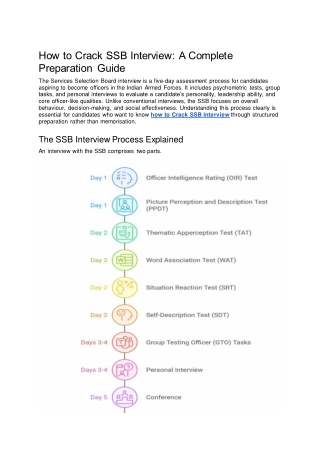
How to Crack SSB Interview: A Complete Preparation Guide The Services Selection Board interview is a five-day assessment process for candidates aspiring to become officers in the Indian Armed Forces. It includes psychometric tests, group tasks, and personal interviews to evaluate a candidate’s personality, leadership ability, and core officer-like qualities. Unlike conventional interviews, the SSB focuses on overall behaviour, decision-making, and social effectiveness. Understanding this process clearly is essential for candidates who want to know how to Crack SSB interview through structured preparation rather than memorisation. The SSB Interview Process Explained An interview with the SSB comprises two parts.
Stage I ( Day 1, of the 5 Interview Days) Officer Intelligence Rating (OIR) Test The Picture Perception and Description Test (PPDT) If candidates do well in Stage I, they are invited to participate in Stage II. Stage two lasts 4 days, during which there are a variety of psychological assessments, GTO (Group Testing Officer) tasks, and a personal interview. Stage I: The First Tie Breaker Officer Intelligence Rating Test The OIR test contains 50 questions, one minute each, and spans over 30 minutes of verbal and non-verbal reasoning. The questions focus on: Timely management: Answer questions you are sure of at the start first Consistent Practice: Previous year's test papers and reasoning books Accuracy: Do not answer questions you don't know, as you will lose points for incorrect answers. 32-second ambiguous pictures: You will be shown a picture, and you will need to describe the story in 30 seconds. Your story will be evaluated, and so will the picture you describe. Perception and narrative: You will need to show evidence of both in pairs. Main strategies: Recognise traits like age, sex, and affect right away. Craft an optimistic, resolution-focused narrative and action story. Instead of fantasy, demonstrate realistic and practical solutions to problems. Fit the narrative to a four-minute time limit. Candidates will discuss the narrative in groups of 10 to 15 after writing. The groups will have three minutes to come to a common story. Tips for group talking: Concise, confident storytelling. Be an active and engaged listener. Find a middle ground to build consensus. Be open to brilliant ideas and demonstrate adaptability. Stage II: The Thorough Evaluation Psychological Assessments (Day 2) 1. Thematic Apperception Test (TAT): This involves viewing twelve pictures (11 images plus 1 blank) for thirty seconds each and creating a narrative for each. There should be no effort to put on a persona. Pay attention to the following: The main character should be the agent of the action. The issues raised within the plot should be matters that occur in real life and be within the story.
The problems illustrated should be realistic, have positive outcomes and be the result of an effort. The story should align to a certain degree of mental and emotional maturity and an understanding of the social context of the story. 2. Word Association Test (WAT): This involves 60 current terms that will be displayed for 15 seconds each, with the participant required to write a positive commentary on each term. There should be no definition in terms ofa book or the use of material systematic approaches. There should be no negativity or pessimistic commentary. There should be no overthinking of the issues and matters required in the questions. 3. Situation Reaction Test (SRT): For this test, 60 different scenarios will be presented and you will be required to answer in a single sentence. Demonstrate: Practical decision making. There should not be any inclination to blame other people. Self-interest and the social issues should be in a proper balance. The solutions should be realistic. 4. Self-Description Test (SDT): This involves completing the statement, "How do you think you will be described by: yourself, your parents, your teachers, and your friends". Group Testing Officer Tasks (Days 3-4) GTO assignments measure your practical ability, teamwork, and ability to lead in the context of doing practical, physical, and outdoor exercises. These include: 1. Group Discussion: A subject will be provided for the group to deliberate on for 40 minutes. For this segment, demonstrate knowledge and ability to reason, while being respectful to other participants. Ensure that your contribution is valuable and avoid dominating the conversation. Group Exercise Activities: Your group gets a map and a mission. You will individually strategize for the first 20 minutes and then come together to present a group strategy. Consider all the constraints and logically prioritize objectives. PGT, HGT, and GOR: These are mental-physical challenges that focus on teamwork and problem-solving. Some of the challenges you will focus on are: Rule adherence Workable ideation Physical system execution Active participation Team encouragement Situational calmness Lecturette: 3-minute speech that you will have to present. You will have a choice of 4 topics. Be confident, respectful of time, and have an awareness of the issues at lunchtime.
Individual Obstacle Completion: Trying to complete 10 independently placed obstacles to be completed in a time frame. Shows determination and is a reflection of the effort placed. Personal Interview (Day 3 or 4) An officer of the force will have a brief 30-45 minute conversation examining your background, interests, opinions about current affairs, and why you are pursuing a career in the military. Preparation areas: Hometown, family, and education details Hobbies and interests Current affairs (national and international) Basic knowledge about the armed forces Why do you want to become an officer Strengths, weaknesses, and life experiences Interview Approach: Be honest, and your inconsistencies will be exposed Avoid worrying about complicated questions. If you are lost, that's okay Keep your head up, keep your hands relaxed, and avoid fidgeting Passion for the job will be appreciated Conference (Day 5) All assessors will confer about your results. Some candidates may be called for clarification. You will receive the results later that evening. Officer-Like Qualities Assessed 15 Officer-Like Qualities have been divided into 4 categories: Social Adjustment: social adaptability, social cooperation, sense of social responsibility Intellectual: reasoning, organising, expression Dynamic: initiative, courage, determination, stamina, self-confidence Effective: practical, intelligent, judicious These qualities can be developed, albeit through time and deliberate concentration. Genuine Preparation Strategy 3-6 months before: Read the newspaper every day, especially the editorials Practice verbal, non-verbal reasoning Improve your physical condition (running, push-ups, sit-ups) Make sure to have a hobby that you can discuss at length Read military leader biographies 1 month before: Complete mock tests for hiring OIR and PPDT. Practice WAT and TAT, use a timer Be aware of defence and geopolitical movements Complete a self-assessment of your personal, social, and professional life History. Focus on articulation and confidence.
General Development: Involve yourself in group activities and sports. Be a leader in your school or work projects. Have a developed opinion on social and national issues. Focus on communication. Mental and physical stamina; build strength. Common Mistakes to Avoid Trying to act like someone else: Assessors can easily notice inconsistencies. Memorizing answers: This is more about your personalitythan preparation. Being overconfident or underconfident: Both extremes work against you. Ignoring physical fitness: Many candidates struggle during GTO. Neglecting current affairs: This demonstrates a lack of awareness. Not being a team player: Individual brilliance is of no value without teamwork. Final Recommendations There are no shortcuts in the SSB. The personality assessment reflects your real self, not an assumed one. Genuine self-improvement is the only effective approach for anyone aiming to How to Crack SSB interview successfully. The SSB looks for individuals who strive to become better versions of themselves, as the qualities expected are the same traits found in capable leaders across all fields. Not clearing the SSB on the first attempt is common, and many officers have succeeded in later attempts by identifying their weaknesses and improving them through experience. The SSB interview is not just a selection process; it is an evaluation of your motivation to wear the uniform and your readiness to take on responsibility. It should be seen as an opportunity for honest self-assessment rather than just another exam.

![[PDF] Free Download Christopher Hitchens: The Last Interview By Christopher Hitchens & Stephen Fry](https://cdn4.slideserve.com/8139449/slide1-dt.jpg)