Understanding Educational Objectives: Creating Effective Learning Goals
This resource offers a comprehensive guide to understanding educational objectives and how they relate to overarching goals in educational settings. It delves into the differences between general aims and specific, measurable objectives that teachers create to ensure effective instruction. With clear examples, such as troubleshooting a BASIC computer program and applying Ohm's law, this guide focuses on observable behaviors, conditions for achievement, and criteria for proficiency, aligned with Bloom's domains of learning, including cognitive, affective, and psychomotor objectives.

Understanding Educational Objectives: Creating Effective Learning Goals
E N D
Presentation Transcript
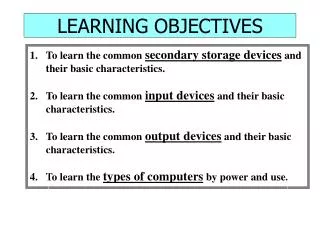
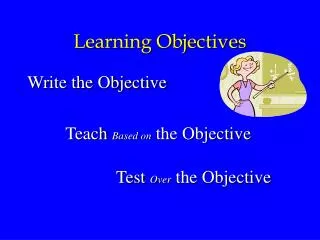
Learning Objectives Write the Objective Teach Based on the Objective Test Over the Objective
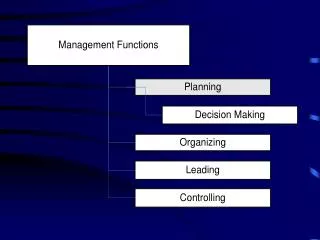
Educational Goals • Goals are general statements of intent • Goals guide objectives Legislators develop Aims Administrators place Goals Teachers write Objectives • Goal verbs include: Understand, learn, know, increase (knowledge), acquire
Educational Objectives(AKA “Learning, Behavioral, Student”) • A learning objective is a statement of the measurable learning that is intended to take place as a result of instruction. • Complete objectives … • State what the student will be able to do (observable behavior) • With the conditions under which they should be able to demonstrate (condition) • Under the expected degree of proficiency (criterion)
Educational Objectives(AKA “Learning, Behavioral, Student”) • A learning objective is a statement of the measurable learning that is intended to take place as a result of instruction. • Complete objectives … • State what the student will be able to do (observable behavior) • With the conditions under which they should be able to demonstrate (condition) • Under the expected degree of proficiency (criterion)
Educational Objectives(AKA “Learning, Behavioral, Student”) • A learning objective is a statement of the measurable learning that is intended to take place as a result of instruction. • Complete objectives … • State what the student will be able to do (observable behavior) • With the conditions under which they should be able to demonstrate (condition) • Under the expected degree of proficiency (criterion)
Educational Objectives(AKA “Learning, Behavioral, Student”) • A learning objective is a statement of the measurable learning that is intended to take place as a result of instruction. • Complete objectives … • State what the student will be able to do (observable behavior) • With the conditions under which they should be able to demonstrate (condition) • Under the expected degree of proficiency (criterion)
Objectives • Without notes or references, the students should be able to list in order the steps in troubleshooting a BASIC computer program with no mistakes. Observable Behavior?
Objectives • Without notes or references, the students should be able to list in order the steps in troubleshooting a BASIC computer program with no mistakes. Observable Behavior?
Objectives • Without notes or references, the students should be able to listin order the steps in troubleshooting a BASIC computer program with no mistakes. Condition?
Objectives • Without notes or references, the students should be able to listin order the steps in troubleshooting a BASIC computer program with no mistakes. Condition?
Objectives • Without notes or references, the students should be able to listin order the steps in troubleshooting a BASIC computer program with no mistakes. Criterion?
Objectives • Without notes or references, the students should be able to listin order the steps in troubleshooting a BASIC computer program with no mistakes. Criterion?
Objectives • Without notes or references, the students should be able to listin order the steps in troubleshooting a BASIC computer program with no mistakes. • Given the values of two of the three variables in Ohm’s law, the students should be able to calculate the value of the remaining variable 90% of the time.
Objectives • Without notes or references, the students should be able to listin order the steps in troubleshooting a BASIC computer program with no mistakes. • Given the values of two of the three variables in Ohm’s law, the students should be able to calculate the value of the remaining variable 90% of the time.
Objectives • Without notes or references, the students should be able to listin order the steps in troubleshooting a BASIC computer program with no mistakes. • Given the values of two of the three variables in Ohm’s law, the students should be able to calculate the value of the remaining variable 90% of the time.
Objectives • Without notes or references, the students should be able to listin order the steps in troubleshooting a BASIC computer program with no mistakes. • Given the values of two of the three variables in Ohm’s law, the students should be able to calculate the value of the remaining variable 90% of the time.
Types (domains) of learning objectives • Cognitive objectives • Describe the knowledge that learners are to acquire • Affective objectives • Describe the attitudes, feelings, and dispositions that learners are expected to develop • Psychomotor objectives • Relate to the manipulative and motor skills that learners are to master
Behavioral Domains • The Cognitive Domain (Bloom, 1956) • Intellectual skills • Knowledge – Remembering the information • Comprehension – Understanding the meaning • Application – Using the information • Analysis – Breaking down into parts • Synthesis – Producing a new whole • Evaluation – Judging the value
Behavioral Domains • The Affective Domain (Bloom, 1964) • Emotions, feelings & values • Receiving - Willing to listen or see • Responding - Active participation • Valuing - Internalize the worthiness • Organization - Ability to see the value • Characterization by a value - Behavior consistent with a value system
Behavioral Domains • The Psychomotor Domain • Muscular, motor skills, “hands-on” • Readiness - Willingness for an activity • Observation - Watches & is interested • Perception - Senses & becomes able • Response - Practices a skill • Adaptation - Develops and masters a skill