How Does AI-Driven DevOps Improve Mobile App Development in Chicago?
AI-driven DevOps is revolutionizing Chicagou2019s mobile app development by improving speed, quality, and efficiency. Using machine learning, automation, and predictive analytics, companies deliver apps faster, reduce defects, cut costs, and gain a competitive edge across industries.
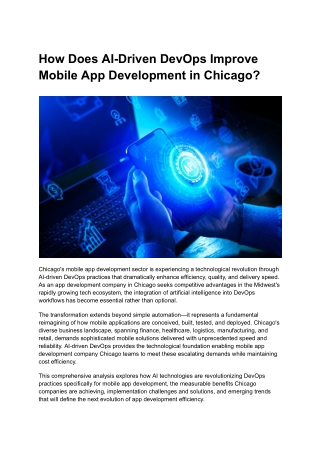

How Does AI-Driven DevOps Improve Mobile App Development in Chicago?
E N D
Presentation Transcript
How Does AI-Driven DevOps Improve Mobile App Development in Chicago? Chicago's mobile app development sector is experiencing a technological revolution through AI-driven DevOps practices that dramatically enhance efficiency, quality, and delivery speed. As an app development company in Chicago seeks competitive advantages in the Midwest's rapidly growing tech ecosystem, the integration of artificial intelligence into DevOps workflows has become essential rather than optional. The transformation extends beyond simple automation—it represents a fundamental reimagining of how mobile applications are conceived, built, tested, and deployed. Chicago's diverse business landscape, spanning finance, healthcare, logistics, manufacturing, and retail, demands sophisticated mobile solutions delivered with unprecedented speed and reliability. AI-driven DevOps provides the technological foundation enabling mobile app development company Chicago teams to meet these escalating demands while maintaining cost efficiency. This comprehensive analysis explores how AI technologies are revolutionizing DevOps practices specifically for mobile app development, the measurable benefits Chicago companies are achieving, implementation challenges and solutions, and emerging trends that will define the next evolution of app development efficiency.
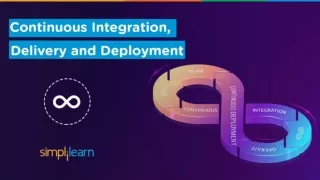
The Evolution of DevOps in Chicago's Mobile App Development DevOps—the combination of Development and Operations—has transformed software delivery over the past decade. Chicago's mobile app development community embraced these practices early, recognizing that the city's competitive business environment demanded faster release cycles and higher reliability than traditional waterfall methodologies could deliver. Featured Snippet Optimization: AI-driven DevOps enhances mobile app development efficiency through machine learning predicting system failures, natural language processing automating documentation and code generation, intelligent automation streamlining testing and deployment, and predictive analytics optimizing resource allocation. Chicago app development companies report 30-40% faster delivery, 50% fewer production defects, and 35% cost reductions. The introduction of AI technologies elevates DevOps from process improvement to genuine competitive advantage. Traditional DevOps focused on collaboration, continuous integration, and automated deployment. AI-driven DevOps adds predictive capabilities, intelligent decision-making, and adaptive optimization that human teams alone cannot achieve at scale. For a mobile app development company in Chicago, this evolution means responding to client requests within days rather than weeks, deploying updates without service disruption, and identifying potential issues before they impact users. The philosophy of AI integration propels Chicago's innovation ecosystem forward, redefining mobile app construction, testing, and deployment standards. Major AI Technologies Transforming Mobile DevOps The transformation of DevOps through AI encompasses multiple technologies that leading Chicago app development companies are implementing: Core AI technologies powering Chicago's mobile DevOps revolution: ● Machine learning algorithms analyze massive volumes of operational data to predict potential failures before they occur, significantly reducing app downtime and crashes ● Natural language processing (NLP) automates documentation generation, assists code writing, and even suggests bug fixes, allowing developers to focus on complex creative challenges ● Intelligent automation systems handle testing, monitoring, and deployment phases with minimal manual intervention, dramatically accelerating release cycles ● Predictive analytics optimize resource allocation, anticipate scaling needs, and identify performance bottlenecks before they impact user experiences
Machine learning techniques now sift through app performance metrics, user behavior patterns, and system logs to proactively prevent failures. For an app development company in Chicago serving enterprises across finance and healthcare, this translates to significantly lower downtime and applications running smoothly under demanding conditions. These systems spot patterns indicating security risks, performance degradation, or impending crashes, enabling proactive resolution rather than reactive firefighting. Natural language processing has changed how developers interact with development tools and documentation. Code review comments, API documentation, and even user stories can be partially automated, freeing developers to focus on sophisticated problem-solving. This proves especially valuable for Chicago firms undertaking complex projects with enormous codebases serving diverse client needs. Mobile-Specific AI DevOps Applications Mobile app development introduces unique challenges—multiple platforms (iOS and Android), diverse device configurations, varying network conditions, and app store approval processes. AI-driven DevOps addresses these mobile-specific concerns through automated cross-platform testing validating apps across hundreds of device configurations, intelligent crash reporting identifying root causes from stack traces and user context, performance optimization analyzing real-world usage patterns to improve responsiveness, and app store optimization using AI to predict approval issues before submission. Measurable Benefits for Chicago App Development Companies Chicago's competitive mobile app development market rewards efficiency and quality. AI-driven DevOps delivers both through measurable improvements that directly impact business outcomes. Accelerated time-to-market represents perhaps the most obvious competitive advantage. Chicago's business environment demands speed—the ability to launch new features, respond to market changes, and iterate based on user feedback faster than competitors. AI automation of testing, continuous integration, and deployment allows mobile app development company Chicago teams to release updates 30-40% faster than traditional approaches, meeting aggressive client timelines that were previously impossible. Operational cost reductions of 25-35% are commonly reported by Chicago app development firms following AI-driven DevOps adoption. Cost efficiency results from fewer production errors requiring expensive emergency fixes, reduced manual testing effort through intelligent automation, optimized cloud infrastructure usage through predictive scaling, and faster development cycles enabling teams to serve more clients. These savings can be reinvested in innovation, passed to clients through competitive pricing, or converted to improved profit margins. Software quality improvements manifest through dramatically fewer post-release bugs and crashes. AI-powered testing tools detect edge cases and potential issues that manual
testing typically misses. Chicago clients in regulated industries like healthcare and finance particularly value this reliability, as app failures can result in compliance violations, revenue loss, and reputation damage. Companies report 40-50% reduction in production defects after implementing comprehensive AI-driven testing. Enhanced developer productivity and satisfaction emerges as an unexpected but valuable benefit. By automating tedious tasks—writing boilerplate code, configuring deployment pipelines, monitoring system health—AI allows developers to focus on creative problem-solving they find most engaging. Chicago's competitive talent market makes developer retention critical, and teams working with modern AI-powered tools report higher job satisfaction and lower turnover rates. Real-World Implementation in Chicago's Tech Ecosystem Leading app development companies in Chicago have pioneered AI-driven DevOps implementations serving the city's diverse industries: A Chicago-based fintech app developer implemented machine learning-powered testing that reduced their QA cycle from two weeks to three days while improving defect detection rates by 45%. The system learned common bug patterns from historical data, automatically generating test cases covering scenarios human testers might overlook. A healthcare mobile app company serving Chicago hospitals deployed AI-driven continuous integration that automatically reviews code for HIPAA compliance issues, security vulnerabilities, and performance problems. The system flags potential issues before code merges, preventing compliance violations that could trigger regulatory penalties. An e-commerce app development firm uses predictive analytics to optimize cloud infrastructure costs, automatically scaling resources based on anticipated demand patterns. During Chicago's peak shopping seasons, the system preemptively provisions capacity preventing slowdowns while reducing infrastructure costs 30% annually through intelligent resource management. Implementation Challenges and Chicago-Specific Solutions Chicago app development companies face several challenges implementing AI-driven DevOps: Key implementation challenges and solutions: ● Initial investment requirements - Advanced AI tools and team training increase upfront costs, but Chicago firms view this as strategic investment yielding long-term efficiency gains
● Cultural resistance to automation - Some developers fear AI replacement, resolved through change management emphasizing AI as augmentation rather than replacement ● Technical integration complexity - Connecting AI systems with existing tools requires phased implementation starting with highest-value areas ● Talent acquisition challenges - Finding developers with both mobile expertise and AI/DevOps knowledge remains difficult in Chicago's competitive market The advanced technology and team training required for AI-driven DevOps represent significant initial expenditure. However, savvy mobile app development company Chicago leadership views this as calculated investment considering the multi-fold returns in efficiency, quality, and competitive positioning. Most firms achieve positive ROI within 12-18 months through operational savings and increased project capacity. Cultural resistance poses challenges as development teams worry about automation replacing their roles. Successful Chicago companies address this through comprehensive change management frameworks that position AI as augmentation enhancing developer capabilities rather than threatening job security. The most effective approaches involve developers in AI tool selection and implementation, giving them ownership of the transformation. Technical integration issues arise when incorporating AI capabilities into existing development pipelines, particularly for established firms with legacy workflows. Solutions typically involve phased strategies where AI systems are systematically implemented into DevOps pipelines starting with areas offering clearest benefits—often automated testing or deployment automation—then expanding as teams gain comfort and expertise. Best Practices from Leading Chicago Mobile Developers The finest app development companies in Chicago have developed guidelines for successful AI-powered DevOps implementation: Strategy-first approach ensures AI investments align with business objectives. The most successful Chicago firms identify specific process bottlenecks or quality issues before selecting AI solutions, rather than adopting technology for its own sake. This targeted approach maximizes ROI and accelerates adoption by solving genuine pain points developers recognize. Continuous learning culture proves essential as AI technologies evolve rapidly. Top Chicago development services invest substantially in ongoing education, providing developers access to training, conferences, and experimentation time with emerging AI tools. This investment maintains competitive advantage as capabilities advance. Balanced automation optimizes for both efficiency and control. The best implementations allow AI to manage routine decisions—test case generation, deployment scheduling, infrastructure scaling—while humans retain authority over architectural decisions, security
policies, and strategic direction. This balance leverages AI strengths while maintaining human judgment for complex decisions. Measurement and iteration ensure AI implementations deliver promised value. Leading Chicago firms establish clear metrics before AI adoption—deployment frequency, defect rates, development velocity—then continuously monitor and refine AI systems to maximize these outcomes. Regular retrospectives identify areas where AI performs well and where human intervention remains superior. Emerging Trends in Chicago's AI-Driven Mobile DevOps Chicago app development companies are exploring several emerging trends that will define the next evolution of AI-driven DevOps: Edge computing integration enables faster decision-making by processing data closer to its origin. For Chicago firms developing IoT applications or distributed mobile systems serving multiple geographic markets, this approach enhances app responsiveness and reduces latency. AI-powered edge processing allows mobile apps to make intelligent decisions locally rather than requiring constant cloud connectivity. Self-healing and self-optimizing systems represent the next frontier. Certain development environments can now automatically adjust resources, reconfigure components, and even repair code issues without human intervention. While still emerging, Chicago companies are piloting systems that autonomously fix performance bottlenecks or security vulnerabilities detected in production environments. AI ethics and governance frameworks are becoming critical as AI assumes more decision-making authority. Leading Chicago mobile app development companies are establishing policies governing AI usage, ensuring automated decisions align with organizational values, client expectations, and regulatory requirements. This proactive approach prevents issues that have plagued other markets where AI deployments proceeded without adequate governance. Conclusion For Chicago's mobile app development ecosystem, AI-driven DevOps represents a fundamental competitive requirement rather than optional enhancement. The integration of artificial intelligence into development workflows enables faster delivery, superior quality, and more sophisticated solutions serving clients across Chicago's diverse industries. As client expectations escalate and market competition intensifies, app development companies in Chicago that embrace these technologies position themselves to not just meet but exceed client demands. The journey involves challenges—initial investment, cultural adaptation, technical integration—but the benefits in operational efficiency, product quality, and market positioning make this evolution essential for sustained relevance.
AI-powered DevOps is transforming Chicago's mobile app development landscape, fundamentally altering how applications are created, tested, and deployed. Companies moving decisively to adopt these practices will establish themselves as innovation leaders in the Midwest's thriving tech economy, delivering mobile solutions with speed and quality that sets new industry standards. With cutting-edge AI-driven DevOps practices, Syndell Tech's Chicago operations deliver mobile applications faster and with higher quality, helping businesses across the Midwest achieve their digital transformation objectives efficiently. FAQs Q-1: How does AI-driven DevOps specifically benefit mobile app development versus traditional software development? Mobile app development presents unique challenges that AI-driven DevOps addresses particularly well. Key mobile-specific benefits include automated cross-platform testing across hundreds of iOS and Android device configurations intelligent crash analytics that identify root causes from diverse device environments, app store optimization predicting approval issues before submission, and performance optimization across varying network conditions and device capabilities. Q-2: What is the typical investment required for a Chicago mobile app development company to implement AI-driven DevOps? Initial investment varies based on company size and current infrastructure maturity. Small to mid-sized Chicago app development companies typically invest $75,000-$200,000 for comprehensive AI-driven DevOps implementation including AI-powered testing platforms ($20,000-$50,000 annually), continuous integration/deployment tools with AI capabilities ($15,000-$40,000 annually). Q-3: How long does it take to implement AI-driven DevOps for a mobile app development team in Chicago? Implementation timelines depend on starting point and scope. Most Chicago mobile app development companies follow phased approaches spanning 4-9 months for comprehensive implementation. Initial assessment and planning requires 3-4 weeks identifying process bottlenecks and selecting AI tools. Q-4: What skills do mobile app developers need to work effectively with AI-driven DevOps tools? Most Chicago app development companies provide training to bridge skill gaps rather than requiring developers to possess all expertise initially. The key is willingness to learn and adapt—successful teams typically include a mix of mobile development experts and DevOps/AI specialists who collaborate effectively. Q-5: Can smaller mobile app development companies in Chicago benefit from AI-driven DevOps, or is it only for large enterprises?
Smaller Chicago app development companies can absolutely benefit from AI-driven DevOps, often more dramatically than large enterprises. Modern cloud-based AI DevOps tools offer flexible pricing that scales with usage, making them accessible without massive upfront investment.








![Download [ebook] The Chicago Manual of Style Full](https://cdn5.slideserve.com/11084177/slide1-dt.jpg)