Salesforce Sales Cloud Pricing and Licensing
Salesforce Sales Cloud serves as a cornerstone for empowering sales teams, driving revenue growth, and fostering customer relationships. By understanding the nuances of Sales Cloud pricing, licensing, features, and implementation best practices, organizations can harness the full potential of this powerful CRM platform. Whether you're a start-up looking to scale your sales operations or a multinational corporation seeking to optimize your sales processes, Salesforce Sales Cloud offers the flexibility, scalability, and innovation required to stay ahead in today's dynamic business landscape.

Salesforce Sales Cloud Pricing and Licensing
E N D
Presentation Transcript
Salesforce Sales Cloud Pricing and Licensing In today's competitive business landscape, leveraging cutting-edge Customer Relationship Management (CRM) tools is paramount for organizations aiming to streamline their sales processes, enhance customer relationships, and drive revenue growth. Salesforce, a pioneer in cloud-based CRM solutions, offers a suite of powerful tools tailored to meet diverse business needs. Among these offerings, Salesforce Sales Cloud stands out as a robust platform designed to empower sales teams and maximize productivity. In this article, we delve into the intricacies of Salesforce Sales Cloud pricing and licensing, shedding light on essential aspects such as features, implementation, and the distinction between Sales Cloud and other Salesforce offerings. Introduction to Salesforce Sales Cloud: Salesforce Sales Cloud serves as the cornerstone of many organizations' sales strategies, providing a comprehensive set of tools to manage leads, opportunities, accounts, and contacts efficiently. With its intuitive interface and customizable features, Sales Cloud enables sales professionals to focus on what they do best – selling. Key features of Salesforce Sales Cloud include: 1.Lead Management: Streamline lead capturing, qualification, and nurturing processes to convert leads into opportunities effectively. 2.Opportunity Management: Track sales opportunities through various stages of the sales pipeline, ensuring transparency and accountability. 3.Account and Contact Management: Centralize customer information for a 360-degree view of accounts and contacts, facilitating personalized interactions. 4.Sales Collaboration: Foster collaboration among sales teams through features like Chatter, enabling seamless communication and knowledge sharing. 5.Reports and Dashboards: Gain actionable insights into sales performance with customizable reports and dashboards, empowering data-driven decision-making. Salesforce Sales Cloud Pricing and Licensing: When considering Salesforce Sales Cloud, understanding its pricing and licensing structure is crucial for making informed decisions aligned with your organization's budget and requirements. Salesforce offers flexible pricing tiers and licensing options to cater to businesses of all sizes, ranging from startups to large enterprises. The pricing model typically includes the following components: 1.Editions: Salesforce Sales Cloud is available in multiple editions, such as Essentials, Professional, Enterprise, and Unlimited. Each edition offers different features and functionalities tailored to suit specific business needs. 2.User Licenses: Salesforce adopts a per-user licensing model, where organizations pay for each user accessing the Sales Cloud platform. User licenses can be categorized based on roles and permissions, such as Sales User, Service User, or Marketing User, with corresponding access levels and capabilities. 3.Add-Ons and Customizations: Organizations can enhance Sales Cloud's capabilities by integrating add-ons or implementing customizations to address unique business requirements. These may include additional features, third-party integrations, or custom- built solutions developed using Salesforce's robust development tools.
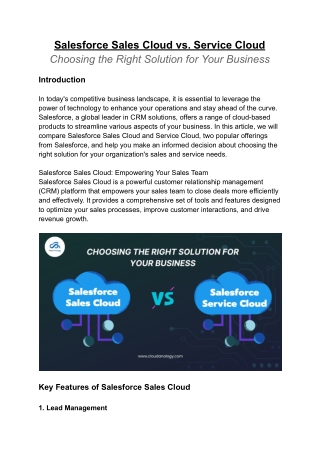
4.Implementation and Support Services: Apart from subscription fees, organizations should also consider implementation and support services provided by Salesforce or its certified partners. These services encompass initial setup, configuration, data migration, training, and ongoing support, ensuring a smooth transition to Sales Cloud and maximizing its value. Salesforce Implementation Guide: Implementing Salesforce Sales Cloud successfully requires careful planning, execution, and adoption strategies. To streamline the implementation process and maximize ROI, organizations can follow these best practices outlined in the Salesforce Implementation Guide: 1.Define Objectives and Requirements: Clearly define your organization's objectives, business processes, and user requirements before embarking on the implementation journey. Conduct stakeholder interviews and workshops to gather insights and align expectations. 2.Customization and Configuration: Leverage Salesforce's powerful customization tools, such as Custom Objects, Fields, and Workflows, to tailor Sales Cloud to your specific business needs. Focus on configuring key modules like Leads, Opportunities, and Accounts to reflect your sales processes accurately. 3.Data Migration and Integration: Ensure seamless data migration from legacy systems or existing CRM platforms to Sales Cloud. Utilize data cleansing and deduplication techniques to maintain data integrity. Additionally, integrate Sales Cloud with other enterprise systems such as ERP or marketing automation platforms to enable data synchronization and streamline workflows. 4.User Training and Adoption: Invest in comprehensive training programs to familiarize users with Sales Cloud's features and functionalities. Provide ongoing support and resources to encourage user adoption and maximize productivity. Foster a culture of continuous learning and improvement within your organization. 5.Performance Monitoring and Optimization: Continuously monitor key performance metrics and user feedback to identify areas for improvement. Leverage Salesforce's reporting and analytics capabilities to gain actionable insights into sales performance, pipeline health, and customer engagement. Implement iterative enhancements and optimizations to drive continuous improvement. Differentiating Sales Cloud from Service Cloud: While both Sales Cloud and Service Cloud are integral components of Salesforce CRM ecosystem, they cater to distinct business functions and workflows. Understanding the differences between Sales Cloud and Service Cloud is essential for choosing the right solution for your organization: • Sales Cloud: Primarily designed for sales teams, Sales Cloud focuses on managing leads, opportunities, accounts, and contacts throughout the sales lifecycle. It enables sales professionals to streamline their processes, collaborate effectively, and drive revenue growth through personalized interactions and data-driven insights. • Service Cloud: In contrast, Service Cloud is tailored for customer service and support teams, empowering them to deliver exceptional customer experiences across various channels – including phone, email, chat, and social media. Service Cloud features robust case management, omnichannel support, knowledge management, and self-service capabilities to resolve customer issues efficiently and enhance satisfaction.
While Sales Cloud and Service Cloud share some common features, such as a unified data model and seamless integration with other Salesforce products, their primary focus areas and target audiences differ significantly. Conclusion: In conclusion, Salesforce Sales Cloud serves as a cornerstone for empowering sales teams, driving revenue growth, and fostering customer relationships. By understanding the nuances of Sales Cloud pricing, licensing, features, and implementation best practices, organizations can harness the full potential of this powerful CRM platform. Whether you're a start-up looking to scale your sales operations or a multinational corporation seeking to optimize your sales processes, Salesforce Sales Cloud offers the flexibility, scalability, and innovation required to stay ahead in today's dynamic business landscape. Salesforce features