Download
1 / 12
0 likes | 1 Vues
u201cThis presentation provides a comprehensive guide to the key technical components of Oracle Fusion Cloud. It covers the core areas that power enterprise cloud applications, including Data Loading, Reporting, Web Services Integrations, Extensions & Customizations, and Oracle Cloud Tools such as Visual Builder, Process Cloud Service, and Oracle Integration Cloud. The deck is designed for developers, technical consultants, and IT professionals aiming to master Oracle Fusion Technical skills for real-world implementations, integrations, and reporting. Each module includes detailed explanations, wo

E N D
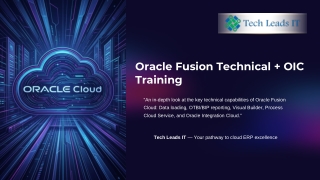
Oracle Fusion Technical + OIC Training “An in-depth look at the key technical capabilities of Oracle Fusion Cloud: Data loading, OTBI/BIP reporting, Visual Builder, Process Cloud Service, and Oracle Integration Cloud.” Tech Leads IT — Your pathway to cloud ERP excellence
COURSE OVERVIEW Why This Training Will Transform Your Career Core Competencies You'll Develop Focus on Real-World Technical Development Data Migration & Integration Patterns: Learn both inbound and outbound integration strategies using industry-standard approaches Enterprise Reporting Solutions: Master BI Publisher for pixel- perfect reports and OTBI for real-time business intelligence Oracle Integration Cloud (OIC): Build sophisticated integration flows connecting Fusion to external systems This isn't just theory—it's practical, hands-on training designed for the challenges you'll face in actual Oracle Fusion implementation projects. You'll learn by doing, working through scenarios that mirror real client engagements and enterprise deployments. Custom Application Development: Leverage Visual Builder to create tailored user experiences Comprehensive Technical Skill Building Business Process Automation: Design approval workflows with Process Cloud Service (PCS) Master the complete technical toolkit required for Oracle Fusion success, from foundational concepts to advanced integration patterns. Each module builds on the previous one, creating a cohesive learning journey that takes you from novice to confident practitioner. This training is based on the proven Oracle fusion technical training curriculum , trusted by hundreds of successful Fusion professionals worldwide. +91 8125323232 www.techleadsit.com
Key Tools & Modules You Will Master OTBI & BI Publisher 1 Build sophisticated reports that deliver actionable insights. Learn to design pixel-perfect BI Publisher reports with custom templates, and create real-time OTBI analyses that empower business users to make data-driven decisions. Master report scheduling, distribution, and migration across environments. Data Migration Tools 2 Become proficient with FBDI (File-Based Data Import) for high-volume bulk data uploads and ADFdi (Spreadsheet Data Loader) for user-friendly Excel- based data management. Understand validation rules, error handling, and best practices for ensuring data integrity during migration. Web Services & APIs 3 Master both SOAP and REST integration patterns to connect Fusion with external systems. Learn to consume and expose web services, handle authentication, manage payloads, and implement error handling for robust, production-ready integrations. Extensions & Customizations 4 Extend Fusion functionality without modifying core code using Page Composer for UI personalization, Application Composer for adding custom objects and fields, and Visual Builder for creating entirely new applications that seamlessly integrate with Fusion. Oracle Cloud Platform Tools 5 Leverage Process Cloud Service (PCS) to model approval workflows and business processes, and Oracle Integration Cloud (OIC) to orchestrate complex integrations with pre-built adapters, sophisticated mapping capabilities, and comprehensive monitoring tools. +91 8125323232 www.techleadsit.com
MODULE 1 Introduction to Oracle Fusion Technical Architecture Understanding the Oracle Fusion Ecosystem Oracle Fusion Cloud Applications represent a comprehensive suite of enterprise software built on modern cloud architecture. Unlike traditional on-premise ERP systems, Fusion leverages cloud-native technologies to deliver scalability, security, and continuous innovation. The platform integrates modules across Finance, HR, Supply Chain, and more—all sharing a common data model and security framework. Fusion Architecture: How Modules Interact At its core, Fusion follows a service-oriented architecture (SOA) where modules communicate through well-defined web services and APIs. This modular design allows for flexible implementations where organizations can adopt specific modules based on business needs while maintaining seamless data flow across the enterprise. Understanding this architecture is crucial for designing effective integrations and customizations. Cloud Service Models Explained Functional Setup Manager SaaS (Software as a Service): Complete applications like Fusion HCM or Financials, fully managed by Oracle FSM is your command center for configuring Fusion modules. It provides a structured approach to implementation with guided setup flows, dependency tracking, and validation tools. Understanding FSM is essential for both implementation and ongoing maintenance activities. PaaS (Platform as a Service): Development platforms like Visual Builder and Integration Cloud for extending functionality IaaS (Infrastructure as a Service): Underlying compute, storage, and networking resources www.techleadsit.com +91 8125323232
MODULE 2 Security: Protecting Your Fusion Environment RBAC Model Foundation Role-Based Access Control (RBAC) is the cornerstone of Fusion security. Rather than assigning permissions directly to users, access is granted through roles that encapsulate specific privileges. This approach ensures consistency, simplifies auditing, and makes it easier to onboard new users or adjust permissions as responsibilities change. Security Console Mastery Role Provisioning Process Navigate the Security Console with confidence to manage the entire security lifecycle. Learn to search for roles, analyze role hierarchies, understand role inheritance, and use the security reports that help you maintain compliance and troubleshoot access issues efficiently. Master the end-to-end process of provisioning roles to users. Understand the approval workflow, learn to create role mapping rules that automatically assign roles based on user attributes like department or location, and discover best practices for maintaining clean, auditable role assignments. Understanding Role Types and Their Purpose Job Roles Duty Roles Data Roles Abstract Roles The highest level of abstraction, job roles represent real-world job functions like "Accounts Payable Manager" and aggregate multiple duty roles together. Duty roles represent specific business functions such as "Invoice Creation" or "Expense Report Approval" and contain the actual privileges needed to perform tasks. Data roles control access to specific data sets, ensuring users only see information relevant to their business unit, legal entity, or other organizational dimension. Abstract roles serve as building blocks, grouping common privileges that are inherited by other roles. They simplify role maintenance by centralizing common permissions. Learn to manage functional users (service accounts used for integrations), set granular permissions at the object and action level, and implement the principle of least privilege to maintain a secure yet functional environment. Understanding these security fundamentals is critical for any technical role in Fusion implementations. +91 8125323232 www.techleadsit.com
MODULE 3 Data Loading: Mastering Inbound Integrations Why Data Loading Matters Every Fusion implementation begins with data migration—moving master data, transactional records, and historical information from legacy systems into Fusion. Whether it's a one-time migration during go-live or ongoing data synchronization, understanding the right tools and techniques is essential for project success. Poor data loading practices can lead to project delays, data quality issues, and user frustration. FBDI: Your Bulk Data Loading Powerhouse File-Based Data Import (FBDI) is Oracle's native framework for high-volume data uploads. Using predefined templates, you can load thousands of records across various modules—from Chart of Accounts to Employee Master to Supplier information. FBDI handles complex business logic, performs validations, and ensures referential integrity. Key capabilities include: Loading related objects in a single batch (parent-child relationships) Comprehensive validation before committing data Detailed error reporting for troubleshooting Support for creates, updates, and corrections Scheduled or on-demand execution Discover available services using the Fusion Web Services catalog Understand WSDL structures and REST API documentation Handle authentication using OAuth or username tokens Implement error handling and retry logic Monitor integration success through logs and alerts Inbound Web Services: Real-Time Integration When batch loading isn't sufficient, web services enable real-time, system-to- system integration. Fusion exposes both SOAP and REST APIs for creating and updating records programmatically. Learn to: +91 8125323232 Best Practice: Always validate your data in a test environment first. Use FBDI error reports to identify and fix issues before loading into production. Document your templates and transformation logic for future reference. www.techleadsit.com
MODULE 4 HCM Technical Components: Managing Human Capital Data Overview of HCM Modules and Technical Architecture Oracle Fusion HCM (Human Capital Management) is one of the most widely implemented Fusion modules, managing the complete employee lifecycle from recruitment to retirement. The HCM suite includes Core HR, Talent Management, Payroll, Benefits, and Time & Labor modules—all integrated through a common person model. As a technical professional, you'll frequently work with HCM data structures, integrations, and customizations, making this module essential to master. 01 02 03 Master Data Creation Strategy HCM Data Loader (HDL) Mastery Spreadsheet Data Loader for HCM Before loading employees, establish foundational master data including Legal Entities, Business Units, Departments, Jobs, Positions, Grades, and Locations. Understanding the hierarchical relationships and dependencies between these objects is critical for successful data migration. Each entity has specific validation rules and required fields that must be satisfied. HCM Data Loader is a specialized, high-performance tool designed specifically for HCM data migration. Unlike FBDI, HDL uses a flat-file format (.dat) and can process millions of records efficiently. Learn to construct HDL files with proper syntax, manage date- effective records, handle multiple business objects in sequence, and troubleshoot common loading errors using the HDL error reports. For smaller volumes and user-friendly data management, the HCM Spreadsheet Data Loader provides Excel templates for various HCM objects. This tool is particularly valuable for ongoing maintenance activities, corrections, and situations where business users need to manage data directly without IT intervention. Master template customization and validation rules. 04 05 Fast Formulas Fundamentals Data Validation & Error Resolution Fast Formulas are Oracle's proprietary scripting language for calculations in Payroll, Benefits, Absence Management, and Total Compensation. Learn to write formulas for salary calculations, eligibility rules, accrual policies, and custom derivations. Understand formula types, context variables, database items, and the formula development lifecycle including testing and migration. Develop systematic approaches to data validation before, during, and after loading. Learn to interpret error messages, use SQL queries to validate data integrity, implement data quality checks, and create reconciliation reports that ensure 100% accuracy. Master the art of troubleshooting common issues like missing prerequisites, invalid references, and date-effectivity conflicts. +91 8125323232 www.techleadsit.com
MODULE 5 Data Extraction & Enterprise Reporting BI Publisher: Pixel-Perfect Report Design BI Publisher is Oracle's enterprise reporting solution for creating production- quality reports with precise formatting control. Whether you need invoices, regulatory reports, payslips, or executive dashboards, BI Publisher delivers. Core capabilities you'll master: Data Model Development: Create SQL queries, leverage view objects, and combine multiple data sets into cohesive data models Template Design: Build report layouts using RTF, Excel, or PDF templates with dynamic content, conditional formatting, and sophisticated calculations Report Parameters: Implement user-friendly parameters with LOVs (Lists of Values), cascading parameters, and default values Scheduling & Bursting: Automate report delivery on schedules and burst reports to multiple recipients based on data attributes Migration Strategies: Move reports between environments using proper version control and deployment best practices Technical skills covered: Understanding subject areas and the star schema architecture Creating analyses with columns, filters, prompts, and calculated measures Designing interactive dashboards with multiple visualizations Implementing row-level security and data access policies Optimizing query performance for large datasets OTBI: Real-Time Business Intelligence Oracle Transactional Business Intelligence (OTBI) provides self-service analytics capabilities, allowing business users to create ad-hoc analyses and dashboards without technical assistance. Built on Oracle BI platform, OTBI accesses real-time transactional data. +91 8125323232 www.techleadsit.com
MODULE 6 Extensions & Web Services Integration Integrate via Web Services Connect external systems using SOAP and REST APIs Understand Core Architecture Learn ADF fundamentals and Fusion's extensibility framework Apply Customization Tools Use Page Composer and Application Composer for safe extensions Deploy & Monitor Implement changes and track integration performance Extending Fusion Applications Without Breaking Core ADF Architecture Essentials Oracle Application Development Framework (ADF) is the foundation upon which Fusion is built. Understanding ADF architecture—including the Model-View-Controller pattern, business components, and task flows—is essential for effective customization. Learn how Fusion leverages ADF to provide a responsive, component-based user interface that can be extended without modifying Oracle's base code. Page Composer: UI Personalization Key capabilities: Add custom fields to standard pages Hide irrelevant fields to simplify user experience Create role-specific or user-specific personalizations Modify page layouts and component arrangements Add custom content like text, images, or embedded components Page Composer empowers you to modify Fusion pages at runtime without coding. Add fields, hide sections, rearrange layouts, create conditional visibility rules, and personalize pages for specific roles or users. All changes are stored as metadata layers that survive patches and upgrades, ensuring your customizations remain intact as Oracle releases updates. +91 8125323232 www.techleadsit.com
FINAL MODULE Advanced Cloud Tools: VBCS, PCS & OIC Oracle Integration Cloud (OIC) Process Cloud Service (PCS) Visual Builder Cloud Service (VBCS) OIC is the integration backbone of Oracle Cloud, providing a unified platform for connecting Fusion with third-party applications, on-premise systems, and cloud services. With 100+ pre-built adapters, sophisticated mapping tools, and enterprise-grade monitoring, OIC accelerates integration development while ensuring reliability and scalability. Process Cloud Service enables you to model, automate, and optimize business processes. Design approval workflows using BPMN 2.0 notation, implement complex decision logic with DMN (Decision Model and Notation), create forms for user interaction, define business rules, and monitor process performance through analytics dashboards. Visual Builder is Oracle's low-code development platform for creating modern, responsive web and mobile applications that extend Fusion functionality. Build custom applications with drag- and-drop UI components, integrate seamlessly with Fusion REST APIs, implement complex business logic using JavaScript, and deploy applications directly to Oracle Cloud without infrastructure management. Core components mastered: Connections & Adapters: Configure connections to Fusion, Salesforce, Workday, databases, file servers, and more using pre-built adapters with built-in best practices Integration Flows: Design orchestration integrations that implement complex business logic, transformations, and routing rules What you'll build: Custom self-service portals, mobile apps for field workers, approval interfaces, data entry forms, and analytical dashboards. Learn to create data-driven applications, implement navigation flows, manage application security, and integrate with external REST services beyond Fusion. Common use cases: Multi-level approval workflows, exception handling processes, document routing, compliance workflows, and cross-functional business processes that span multiple systems. Master process versioning, task assignment strategies, escalation rules, and integration with Fusion events and notifications. Data Mapping: Transform data between source and target formats using visual mappers, XSLT, or JavaScript Your Path Forward: From Training to Career Success Completing this comprehensive training positions you as a highly valuable Oracle Fusion technical professional. You'll have hands-on experience with the tools, techniques, and best practices that drive successful implementations. Whether you're joining a consulting firm, working for an end-user organization, or pursuing independent consulting opportunities, these skills are in high demand. Continue learning through Oracle documentation, community forums, certification programs, and real-world projects. The journey doesn't end here—it's just the beginning of an exciting career in Oracle Fusion technology. +91 8125323232 www.techleadsit.com
ENROLL NOW Become a Certified Oracle Fusion Technical Consultant +91 8125 32 32 32 info@techleadsit.com www.techleadsit.com Batch starting soon—limited seats available +91 8125323232 +91 8125323232 www.techleadsit.com www.techleadsit.com
Thank You www.techleadsit.com +91 8125323232 +91 8125323232 www.techleadsit.com www.techleadsit.com