Download
1 / 6
0 likes | 1 Vues
Digital future in Saudi Arabia and the GCC is being pushed by information hubs. Nevertheless, the greater the responsibility the greater. Companies should not stop there and begin to apply the next-generation plans that will safeguard against the physical attacks, cyberattack, and insider threats.<br>Enterprises can be able to create a robust, future-proof defense by following Rack-level Security, Server Room Security, proactive Data Center Threat Detection, advanced Data Center Encryption, infrastructure strengthening with Data Center Firewalls

E N D
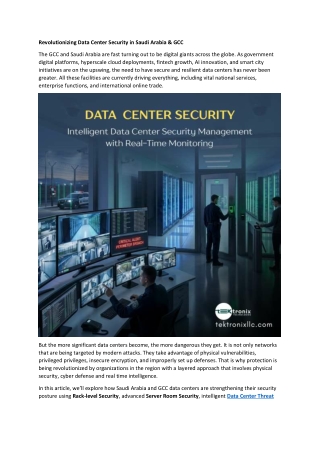
Revolutionizing Data Center Security in Saudi Arabia & GCC The GCC and Saudi Arabia are fast turning out to be digital giants across the globe. As government digital platforms, hyperscale cloud deployments, fintech growth, AI innovation, and smart city initiatives are on the upswing, the need to have secure and resilient data centers has never been greater. All these facilities are currently driving everything, including vital national services, enterprise functions, and international online trade. But the more significant data centers become, the more dangerous they get. It is not only networks that are being targeted by modern attacks. They take advantage of physical vulnerabilities, privileged privileges, insecure encryption, and improperly set up defenses. That is why protection is being revolutionized by organizations in the region with a layered approach that involves physical security, cyber defense and real time intelligence. In this article, we’ll explore how Saudi Arabia and GCC data centers are strengthening their security posture using Rack-level Security, advanced Server Room Security, intelligent Data Center Threat
Detection, robust Data Center Encryption, high-performance Data Center Firewalls, and complete Cybersecurity for Data Centers. Why Data Center Security Matters More Than Ever in the GCC Saudi Arabia and GCC data centers are no longer an IT facility, they are now a national digital infrastructure. During the downtime or a security breach of a data center, even the large numbers of people can be affected including: • Government services and citizen platforms • Banking systems and online transactions • Healthcare databases and clinical systems • Energy and industrial operations • Logistics, aviation, and transport networks At this level of stakes, security cannot be the same as it has been. It should be active, multifaceted, and strong. The New Reality: Threats Facing Modern Data Centers The threats facing data centers are more sophisticated, focused, and long-term today. Common risks include: • Unauthorized physical entry • Insider misuse of access privileges • Malware and ransomware attacks • Data theft and leaks • DDoS attacks that disrupt operations • Supply chain vulnerabilities The facility, to be immune to such dangers, should be secured at all levels, i.e. at the door, rack, firewall or encryption key. Rack-level Security: Protecting What Matters Most Rack-level Security is one of the most critical upgrades in modern data centers. Rack-level systems do not depend on perimeter protection measures such as doors and cages to secure the physical location of servers and data. Key benefits of Rack-level Security include: • Preventing unauthorized access to server racks • Creating clear accountability through access logs • Strengthening security in shared or colocation environments • Reducing risk from insider threats
The rack-level security is emerging as the default of high-value workloads (banking, government applications, and cloud infrastructure) in Saudi Arabia and the GCC. Server Room Security: Securing the Physical Environment The first configuration of data center security involves the management of physical access to the data center and individual server rooms within the data center. Strong Server Room Security make sure that only authorized persons will have access to sensitive areas. Effective Server Room Security typically includes: • Multi-factor access control at entry doors • Mantrap systems to prevent tailgating • CCTV surveillance and intrusion detection • Visitor and contractor management policies • Zone-based access permissions This assists in avoiding physical sabotage, stealing and unintentional disruptions that may cause significant downtime. Data Center Threat Detection: Real-Time Awareness for Faster Response Conventional security tends to identify the threats when they are already caused. The contemporary data centers require real-time visibility. Data Center Threat Detection offers preventive management that helps to detect abnormalities before they occur. Modern Data Center Threat Detection can detect: • Suspicious login attempts • Unusual access behaviour • Network anomalies and lateral movement • System changes that indicate compromise Data Center Encryption: Keeping Information Safe Everywhere Despite the high security level, they could still be breached. This is why Data Center Encryption is a necessity- this will make the stolen or intercepted data useless to an attacker. Best practices in Data Center Encryption include: • Encrypting data at rest (stored in servers and databases) • Encrypting data in transit (moving across networks) • Strong encryption key management • Secure backup encryption to prevent ransomware damage In the case of Saudi and GCC companies that handle regulated information and national infrastructure, encryption is one of the compliances and trust conditions. Data Center Firewalls: The First Line of Network Defense
There is no contemporary data center that is able to run safely without strong firewall protection. Data Center Firewalls are used to filter the incoming and outgoing traffic to prevent unauthorized access and block malicious traffic. Advanced Data Center Firewalls support: • Deep packet inspection • Application-aware controls • Intrusion prevention systems (IPS) • Network segmentation for isolation • Policy-based traffic management Firewall architecture helps data centers to minimize attack surfaces and guard core systems against attacks. Cybersecurity for Data Centers: A Complete, Layered Strategy Security in the future does not consist of one tool, a single tool but an integrated framework. Cybersecurity for Data Centers is a collaborative effort involving people, processes and technology to ensure complete protection. A mature cybersecurity approach includes: • Identity and access management (IAM) • Endpoint detection and response (EDR) • Security information and event management (SIEM) • Incident response planning and drills • Continuous patching and vulnerability management • Zero-trust security models Here is a layered model that will make sure that in case one level of defense is compromised, there will be others to protect the facility. Converging Physical + Cyber Security for Stronger Defense The project of integrating physical and digital systems of security is one of the most significant security trends in Saudi Arabia and the GCC. This convergence brings the integrated security environment where: • Physical access logs correlate with cyber access logs • Security teams get complete situational awareness • Threat investigations become faster and more accurate • Response actions can be automated This single architecture will be the backbone of the hyperscale cloud, national, and enterprise digital transformation data centers.
Compliance, Governance, and Trust in Saudi & GCC Data Centers Security in the present is also concerned with fulfilling regulatory needs and establishing customer confidence. As data sovereignty, privacy and critical infrastructure regulations gain increased popularity, data centers should show: • Full audit trails for access and changes • Strong data protection and encryption controls • Continuous monitoring and reporting • Clear security governance policies The data center operators become able to attract enterprise customers, government contracts, and long-term relationships, which is achieved by high security maturity. Conclusion Digital future in Saudi Arabia and the GCC is being pushed by information hubs. Nevertheless, the greater the responsibility the greater. Companies should not stop there and begin to apply the next- generation plans that will safeguard against the physical attacks, cyberattack, and insider threats. Enterprises can be able to create a robust, future-proof defense by following Rack-level Security, Server Room Security, proactive Data Center Threat Detection, advanced Data Center Encryption, infrastructure strengthening with Data Center Firewalls, and creating a complete Cybersecurity for Data Centers. The data center revolution in security has already begun to occur- and today organizations that do it will reap the benefits in the digital economy tomorrow. FAQs 1. What is rack-level security of a data center? Rack-level Security is used to provide security around individual server racks, controlled access by locking and logging access, and only authorized personnel are allowed access to the critical equipment. 2. What is the significance of server room security? Server Room Security helps eliminate unauthorized physical access and insider threats, as well as safeguard critical systems against theft or malfunction. 3. What is the mechanism of data center threat detection? The Data Center Threat Detection is a tool that tracks the activity of the system and network and detects unusual behaviour and potential cyberattack in real-time. 4. Should the data centers be encrypted when firewalls are robust? Yes. Data Center Encryption secures data even when the attackers bypass the firewalls or access the information stored or transmitted. 5. What is included in cybersecurity of data centers?
Cybersecurity Data Center involves identity management, surveillance, firewalls, encryption, reaction to an incident, and layered defense mechanisms. For more information contact us on: Tektronix Technology Systems Dubai-Head Office connect@tektronixllc.com +971 55 232 2390 Office No.1E1 | Hamarain Center 132 Abu Baker Al Siddique Rd – Deira – Dubai P.O. Box 85955 Or click on the below link for more information: https://www.tektronixllc.com/services/six-layered-data-center-security
