Understanding Litecoin: A Decentralized Digital Currency
0 likes | 10 Vues
Litecoin is a peer-to-peer cryptocurrency, created by Charlie Lee in 2011 as a "lighter" alternative to Bitcoin. It operates on a decentralized, open-source global payment network. Litecoin is known for its faster transaction speeds and lower fees compared to Bitcoin, making it more efficient for everyday transactions. It uses the Scrypt hashing algorithm, allowing for easier mining. With a capped supply of 84 million coins, Litecoin offers a transparent, secure way to exchange value without the need for intermediaries. https://thecryptoexchange.ca/what-is-litecoin


Understanding Litecoin: A Decentralized Digital Currency
E N D
Presentation Transcript
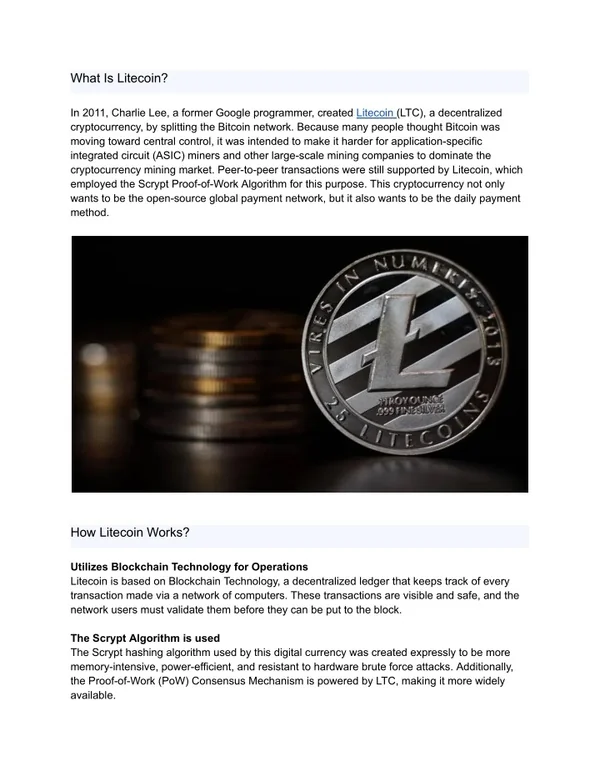
What Is Litecoin? In 2011, Charlie Lee, a former Google programmer, created Litecoin (LTC), a decentralized cryptocurrency, by splitting the Bitcoin network. Because many people thought Bitcoin was moving toward central control, it was intended to make it harder for application-specific integrated circuit (ASIC) miners and other large-scale mining companies to dominate the cryptocurrency mining market. Peer-to-peer transactions were still supported by Litecoin, which employed the Scrypt Proof-of-Work Algorithm for this purpose. This cryptocurrency not only wants to be the open-source global payment network, but it also wants to be the daily payment method. How Litecoin Works? Utilizes Blockchain Technology for Operations Litecoin is based on Blockchain Technology, a decentralized ledger that keeps track of every transaction made via a network of computers. These transactions are visible and safe, and the network users must validate them before they can be put to the block. The Scrypt Algorithm is used The Scrypt hashing algorithm used by this digital currency was created expressly to be more memory-intensive, power-efficient, and resistant to hardware brute force attacks. Additionally, the Proof-of-Work (PoW) Consensus Mechanism is powered by LTC, making it more widely available.
Transaction Record The total cost of a transaction is decreased because the fee structure for transferring LTC is 1/50th that of Bitcoin. Peer-to-peer transactions can be started quickly by broadcasting on the Litecoin network, providing the recipient's address details, and obtaining digital authentication. Following this, a new block containing the sender's transaction data is created. Once the transaction has been confirmed, it is added to the blockchain ledger, which is accessible to all network users. Digital Wallets for Interaction and Storage Litecoin can be stored and used by users through digital wallets, which come with a private key that enables safe sending and receiving of LTC. These include wallet encryption, which requires a password to view account balances or transactions. Advantages Of Litecoins ● ● ● ● Ultimate Privacy And Efficiency Scalability Stability and Longevity Capacity Conclusion
The market value of Litecoin is approximately $6.02 Billion as of May 5, 2024. Being an open-source global payment network that requires no central authority, its best used for peer-to-peer transactions (especially microtransactions), investment and trading.