Download
1 / 3
0 likes | 2 Vues
The National Pension System (NPS) will undergo its most significant overhaul from October 1, 2025, when the Pension Fund Regulatory and Development Authority (PFRDA) introduces a Multiple Scheme Framework (MSF) for non-government subscribers.

E N D
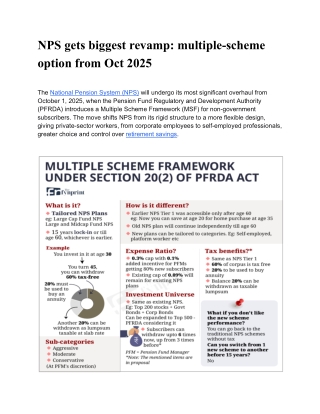
NPS gets biggest revamp: multiple-scheme option from Oct 2025 The National Pension System (NPS) will undergo its most significant overhaul from October 1, 2025, when the Pension Fund Regulatory and Development Authority (PFRDA) introduces a Multiple Scheme Framework (MSF) for non-government subscribers. The move shifts NPS from its rigid structure to a more flexible design, giving private-sector workers, from corporate employees to self-employed professionals, greater choice and control over retirement savings.
Structure: Under the new facility, subscribers can hold multiple schemes under a single Permanent Retirement Account Number (PRAN), with their Permanent Account Number (PAN) serving as a common link. Until now, investors were limited to just one investment option per tier with a single record-keeper. The MSF allows savers to align portfolios with changing retirement goals and risk appetite. Investment choices: Pension Funds (PF) will be allowed to design schemes tailored to different groups, such as gig-economy workers or corporate employees, with possibility for employer co-contributions. Each scheme must offer at least two variants; 'Moderate' and 'High-risk', with the high-risk option permitting up to 100% equity allocation. Funds may also offer a low-risk variant. These schemes will be available across both Tier I (retirement-focused) and Tier II (voluntary savings) accounts. Withdrawals: A key change lies in withdrawals. Unlike the traditional Tier I account, which locks funds until age 60, MSF schemes allow access after 15 years or at 60, whichever comes first. Once the 15-year vesting period ends, investors can withdraw up to 80% of their corpus. Out of the 80%, 60% is tax free and, 20% is taxable at slab rate. The balance 20% is mandatorily directed towards an annuity that pays taxable income for life. While this provision offers flexibility, some advisors caution it could dilute the retirement focus of NPS. “NPS, as the name suggests, is a retirement product. Allowing withdrawals just after 15 years undermines its core purpose,” said Suresh Sadagopan, founder of Ladder7 Financial Advisories, a fee-only financial planning firm. “Flexibility is not always a virtue in retirement planning. If given an early exit option, many investors may use it, jeopardising their long-term financial security.” Costs: The new schemes will come at a higher price. Expenses are capped at 0.30% of assets annually, compared with the 0.03–0.09% range under current plans. To push growth, Pension Funds can earn an additional 0.10% if their scheme attracts mostly new investors, but this incentive is limited to three years or until the scheme reaches 50 lakh subscribers. “As the annual charges are now capped at 0.30% of AUM against the earlier 0.03–0.09% range, there is an incentive for Pension Funds to promote higher-fee schemes despite regulatory oversight,” said Abhishek Kumar, founder of fee-only advisory firm SahajMoney.
Oversight: Central Recordkeeping Agencies (CRAs) will provide consolidated statements, enabling investors to track holdings scheme-wise and in total. Each scheme will also be benchmarked against a market index for performance disclosure. But since the circular does not define how benchmarks should be selected, funds could choose indices that flatter their performance. PFRDA should step in with regular audits to prevent such bias, Kumar added. Exit options: During the 15-year vesting period, investors cannot move directly from one MSF scheme to another MSF. However, they can switch to the traditional “Common Schemes” without tax implications. “If a subscriber is not happy with how a new MSF fund is progressing, they have the option of switching out of it and into the existing Common Schemes,” said Kurian Jose, CEO of Tata Pension Fund. PFRDA has also come up with latest proposals that are set to fundamentally transform the NPS. These significant reforms, impacting withdrawals, partial access, and financial planning, are currently open for https://www.pfrda.org.in/web/pfrda/w/exposure-draft-amendments-to-pension-fund-regul atory-and-development-authority-exits-and-withdrawals-under-the-national-pension-syst em-regulations-2015-2, marking a pivotal shift in the NPS landscape. Source:- https://thefynprint.com/nps/nps-gets-biggest-revamp-multiple-scheme-option-from-oct-2 025?id=68cb202da9db3c0a823bddc4