Generative AI Development Explained_ Models, Training, and Deployment
This PDF explains Generative AI development by covering its core models, training processes, fine-tuning methods, deployment strategies, and ethical challenges involved in building scalable AI applications.

Generative AI Development Explained_ Models, Training, and Deployment
E N D
Presentation Transcript
Artificial intelligence has moved beyond rule-based automation into systems that can create, reason, and adapt. This shift is driven by models capable of generating text, images, code, and even decision logic with minimal human input. As organizations push for smarter digital products and faster innovation cycles, Generative AI Development has become a core technology powering modern software ecosystems. Its ability to learn patterns from massive datasets and produce original outputs is redefining how applications are built and scaled across industries. What Is Generative AI Development? Generative AI Development refers to the process of designing, training, optimizing, and deploying AI systems that can generate new content rather than simply analyze existing data. Unlike traditional AI models that focus on classification or prediction, generative models learn underlying data distributions to produce meaningful outputs such as natural language responses, images, audio, or synthetic data. This approach enables applications like AI copilots, content generation tools, intelligent assistants, and simulation systems that continuously evolve through learning and feedback. Core Generative AI Models Powering Modern Applications Large Language Models (LLMs) Large Language Models are trained on vast text corpora to understand context, semantics, and intent. They power conversational AI, document summarization, code generation, and knowledge assistants. LLMs rely on transformer architectures that scale effectively with data and compute. Diffusion Models Diffusion models generate outputs by gradually transforming noise into structured data. They are widely used in image, video, and media generation, offering high-quality and controllable outputs compared to earlier generative techniques. Generative Adversarial Networks (GANs) GANs consist of two competing networks a generator and a discriminator, that improve through adversarial learning. They are effective for realistic image synthesis, data augmentation, and style transfer but require careful training to avoid instability.
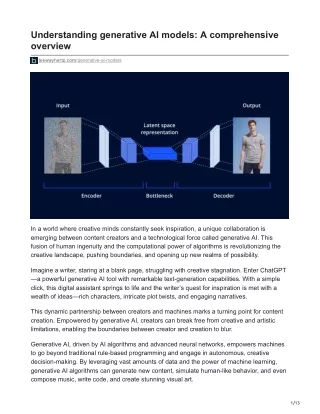
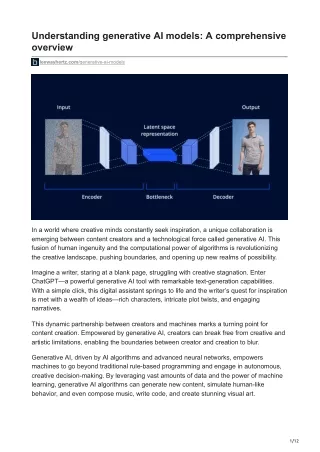
Variational Autoencoders (VAEs) VAEs encode data into a latent space and reconstruct it with controlled variation. They are useful for anomaly detection, representation learning, and scenarios where interpretability of generated outputs is important. Data Collection and Training Process in Generative AI Development Data Collection and Preparation High-quality data is the foundation of any generative system. This stage involves sourcing relevant datasets, cleaning inconsistencies, removing duplicates, and ensuring data diversity. Proper preprocessing reduces bias and improves output reliability. Model Training Approaches Training generative models can involve supervised, unsupervised, or self-supervised learning depending on the use case. Pretraining on large datasets followed by domain-specific fine-tuning is a common approach to balance performance and cost. Infrastructure and Compute Requirements Generative models demand significant compute resources. GPUs, TPUs, distributed training frameworks, and optimized storage pipelines are essential to handle large-scale training while maintaining efficiency. Fine-Tuning and Optimization of Generative AI Models Fine-Tuning Techniques Fine-tuning adapts pretrained models to specific domains or tasks using smaller, targeted datasets. This improves relevance, accuracy, and contextual understanding without retraining from scratch. Prompt Engineering and Parameter Tuning Prompt design plays a critical role in guiding model behavior, especially for LLM-based systems. Adjusting parameters such as temperature, token limits, and context windows helps balance creativity, accuracy, and consistency.
Performance Evaluation Metrics Evaluation goes beyond accuracy. Metrics such as coherence, relevance, latency, cost per inference, and human feedback are used to measure real-world effectiveness and guide continuous improvement. Deployment Strategies for Generative AI Applications Cloud-Based Deployment Cloud environments offer scalability, flexibility, and managed AI services. They are ideal for applications with fluctuating workloads and global user bases. On-Premise and Hybrid Deployment For industries with strict data governance requirements, on-premise or hybrid setups provide greater control over data security and compliance while still leveraging cloud scalability when needed. Scalability and Cost Optimization Efficient deployment involves model compression, caching, batch inference, and autoscaling mechanisms to reduce operational costs while maintaining performance. Challenges and Ethics in Generative AI Development Data Privacy and Security Risks Generative models often process sensitive information, making data protection and secure access controls essential. Improper handling can lead to data leakage or misuse. Bias, Hallucinations, and Model Accuracy Models may produce biased or incorrect outputs due to limitations in training data. Continuous monitoring and corrective feedback loops are required to maintain trust and reliability. Compliance and Responsible AI Practices Adhering to regulatory standards, ensuring transparency, and implementing responsible AI frameworks help organizations deploy generative systems ethically and sustainably.
Why Choose Osiz for Generative AI Development Osiz is a leading Generative AI Development Company specializing in building intelligent, scalable, and business-ready AI solutions. With deep expertise in large language models, custom generative architectures, and enterprise-grade deployment, Osiz helps organizations transform ideas into production-ready AI systems. The team follows a structured development approach that prioritizes data security, model accuracy, and performance optimization. By combining advanced AI engineering with real-world industry knowledge, Osiz delivers generative AI solutions that are reliable, compliant, and built for long-term growth.