Download
1 / 9
0 likes | 1 Vues
Discover why Indian Knowledge Systems (IKS) are essential for todayu2019s children. Learn how IKS restores cultural roots, boosts learning, and builds confident global citizens.

E N D
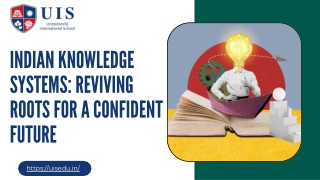
INDIAN KNOWLEDGE SYSTEMS: REVIVING ROOTS FOR A CONFIDENT FUTURE https://uisedu.in/
What Are Indian Knowledge Systems (IKS)? Indian Knowledge Systems (IKS), or Bharatiya Jnana Parampara, refers to the systematic, rigorous bodies of knowledge developed on the Indian subcontinent over thousands of years, encompassing science, technology, philosophy, medicine, governance, arts, ecology, ethics, and aesthetics. In practice today, IKS shapes the Indian worldview through concepts of Dharma, Rta, cyclical time, guru-shishya parampara, samskaras, family values, and festivals tied to astronomy and seasons.
India’s Timeless Contributions to Global Knowledge Academically, it represents world-class contributions: Panini’s formal grammar (4th century BCE), Baudhayana’s theorem centuries before Pythagoras, Aryabhata’s heliocentric astronomy, Sushruta’s plastic surgery, Charaka’s internal medicine, Kautilya’s statecraft, the six darshanas of philosophy taught at ancient universities like Takshashila and Nalanda; the list is endless.
The Identity Crisis: Why Today’s Children Are Losing Their Roots In today’s India, IKS has become profoundly relevant precisely because most children are losing their civilizational roots. They enthusiastically celebrate Halloween and Valentine’s Day but remain unaware of the astronomical and agricultural significance of Makar Sankranti or Holi. They can name Greek gods yet struggle to explain the 33 koti Devatas or the essence of the Upanishads. English-medium “international” curricula often reduce Indian achievements to “mythology” while treating Greco-Roman stories as classics, breeding a subtle sense of cultural inferiority.
The World Adopts What India Abandons Meanwhile, the West is embracing what we are abandoning: Yoga is now a multi- billion-dollar global industry, mindfulness (repackaged Vipassana) is taught at Harvard and Google; and turmeric, Neem and jamun face foreign patents while being dismissed at home as “unscientific”. At a time when the world grapples with climate crises, mental-health epidemics, and unsustainable growth, IKS offers ready solutions—sacred groves, Bishnoi conservation ethics, pranayama for stress, and circular-economy principles embedded in our texts—yet our own children risk growing up alienated from this heritage. Schools bear the primary responsibility for reversing this wash-out; they can introduce compulsory IKS credit courses from Class 6 onwards, teaching Mathematics through Pingala’s binary system and Madhava’s infinite series, Science through Vaisheshika atomism and Ayurvedic inoculation, and History through original sources rather than colonial narratives, etc.
Extracurricular Activities must celebrate Indian genius: shlokathon and subhashitam competitions, traditional sports festivals, science exhibitions restricted to IKS themes (yantras, herb gardens, Vastu models). The annual calendar should mark Indian Scientists’ Days for Aryabhata, Ramanujan, and Charaka, observe solstices as Uttarayana-Dakshinayana, and celebrate regional new years, focussing on their relevance —Ugadi, Vishu, Bihu, Puthandu—alongside local harvest festivals. Parents and society also need to supplement this effort. At home, children should hear Panchatantra, Jataka tales, and Thirukkural in their mother tongue rather than only Disney stories; families should perform simple samskaras and read the Gita or Subhashitani together; weekends can include classical music or dance training instead of default Western piano and Hip-Hop dance classes. Media houses and OTT platforms should produce high-quality animated and live-action content on Indian knowledge.
IKS: A Forward-Looking Framework for a Confident Generation Far from being regressive, IKS is a sophisticated, time-tested repository that complements modern science and offers uniquely Indian answers to contemporary challenges. Reviving it in education, homes, and community life is not about turning back the clock; it is about giving the next generation the pride, the perspective, and the practical wisdom to stand tall in a globalising world while remaining rooted in the richest continuous civilisation on earth.
CONTACT US ADDRESS NEXT TO HIRAMANI AAROGYADHAM B/H. SHRI ANNAPURNA DHAM KOBA-ADALAJ ROAD, ADALAJ, GANDHINAGAR 382421, GUJARAT INFO@UISEDU.IN 91-8989 58-5555
THANK YOU FOR ATTENTION https://uisedu.in/