Lines and angle
Information about lines and angles

Lines and angle
E N D
Presentation Transcript
Introduction of Lines and Angles A line is a one-dimensional figure and has no thickness. Angle. When we join two line segments at a single point, an angle is formed, or we can say, an Angle is a combination of two line segments at a common endpoint.
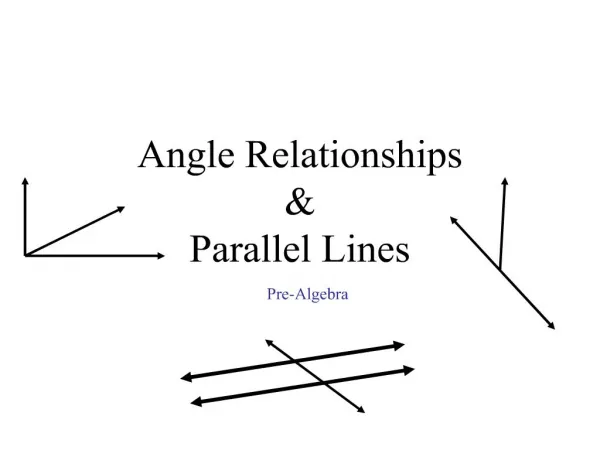
Types of Lines There are different type of Lines: • Parallel Line • Perpendicular Line • Intersecting Line • Transversal Line
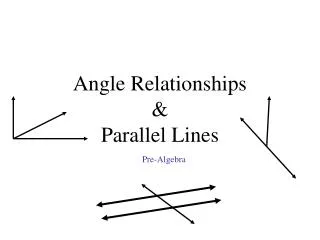
Parallel Lines When two lines that run together separated by the same distance and do not meet are known as parallel lines
Perpendicular Lines A line is said to be perpendicular to another line if the two lines intersect at a right angle. This property of being perpendicular is the relationship between two lines which meet at a right angle (90 degrees).
Intersecting Lines Two non-parallel lines may meet at a point and those lines are called intersecting lines. Intersecting lines are two lines that share exactly one point. This shared point is called the point of intersection.
Transversal Lines The Transversal line is a straight line that cuts two or more lines which may or may not be parallel.
Types of Angles There are different types of angle • Acute Angle • Obtuse Angle • Right Angle • Straight Angle
Acute Angle An angle which measures less than 90° is called an acute angle.
Obtuse Angle An angle that measures greater than 90° is known as the obtuse angle.
Right Angle An angle which measures exactly 90° is called a right angle.
Straight Angle The angle which measures exactly 180° is called a straight angle.