Using Pipetting Robots_ Enhancing Laboratory Efficiency
Contemporary laboratories are under continuous pressure to provide precise results faster, more efficiently, and with fewer human errors. With the advancement of technology, one of the strongest innovations that increases lab productivity is the robot micropipette.<br>These automated platforms have transformed liquid manipulation for laboratory technicians and scientists with uniformity, efficiency, and reduced fatigue. But what makes pipetting robots so revolutionary in laboratories?<br>Let us examine the overall use of automated liquid handling instruments.


Using Pipetting Robots_ Enhancing Laboratory Efficiency
E N D
Presentation Transcript
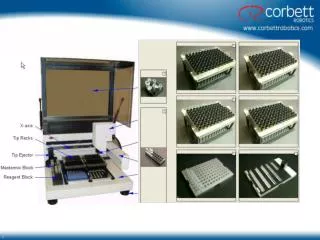
Using Pipetting Robots: Enhancing Laboratory Efficiency Contemporary laboratories are under continuous pressure to provide precise results faster, more efficiently, and with fewer human errors. With the advancement of technology, one of the strongest innovations that increases lab productivity is the robot micropipette. These automated platforms have transformed liquid manipulation for laboratory technicians and scientists with uniformity, efficiency, and reduced fatigue. But what makes pipetting robots so revolutionary in laboratories? Let us examine the overall use of automated liquid handling instruments and how pipetting robots are improving efficiency in research, diagnostics, pharmaceuticals, and beyond. What are Pipetting Robots? Liquid handling robots, also known as pipetting robots, are machines that perform tasks that were previously done manually with the help of pipettes. Pipetting robots have
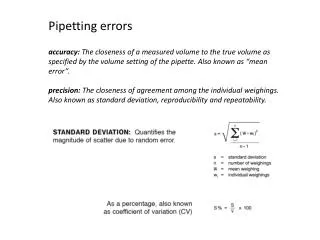
precision mechanisms and software that allow them to add and remove liquids between different samples or containers with great accuracy. They find application from the extraction of DNA/RNA to drug discovery's high-throughput screening, not only hastening the process but also standardising every step. 1. Increased Accuracy and Precision One of the key benefits of pipetting robots is precision. Unlike manual pipetting, whose range of variation is reliant on the expertise and stability of the user, robotic pipetting is controlled by sensors and computer software, which provide precise volumes each time. This removes cross-contamination and human error, both major problems in sensitive experiments, quite considerably. 2. Increased Throughput Speed is of the essence in most laboratories. Pipetting robots handle dozens or hundreds of samples in a single pass without interruption and are therefore well-placed for high-throughput applications. This greatly accelerates the rate of experiments and enables scientists to concentrate on interpreting data and analysis rather than monotonous manual work. 3. Integration with Liquid Handling Instruments The capacity of pipetting robots is doubled when combined with otherliquid handling instruments. These include reservoirs, mixers, and dispensers, which combine with robotic systems to fully automate entire workflows. Regardless of whether a 96-well PCR plate or serial dilutions are being prepared, the built-in design ensures precision and efficiency in every step. Most advanced pipetting robots are designed in modular form, hence they can be tailored to fit the individual needs of experiments. 4. Transition from Manual to Electronic Devices Even though traditional micropipettes have been a lab standard for decades, they are increasingly being replaced by more intelligent, ergonomic pipettes. The shift from electronic to manual pipettes is a trend driven by requirements for compatibility, convenience, and consistency.
One of the most important advances in the area is the electronic pipette pump. These pumps mechanise aspiration and dispensing through motorised motion, reducing user fatigue and enhancing the precision of pipetting. They are particularly valuable in repetitive processes or the handling of volatile chemicals or thixotropic chemicals, where high control is necessary. How do Electronic Pipettes Complete Automation? An electronic pipette provides a compromise between manual pipetting and full automation systems. They are best for laboratories that are not yet ready to invest in complete robotic systems but require greater accuracy and convenience. Electronic pipettes will also have programmable parameters, memory functions, and digital displays, making them significantly more convenient to use than manual ones. They also support semi-automatic installations, which are flexible enough to cater to changing lab needs. Where robotic pipetting is not yet feasible, due to cost, space, or space considerations. Electronic pipettes offer a compelling alternative for better performance and precision. Titration Specific Equipment: Welcome to the E-Burette Accumulation and control are required for titration experiments. That is where the e-burette comes in. While mechanical glass burettes are operated by a manual interface, e-burettes provide direct digital control over titrant flow, improving repeatability as well as constraining parallax error. Suche-burettes are generally accompanied by data analysis software programs that provide immediate monitoring and recording of the data, enabling scientists to keep safe and reliable records of volume dispensed, flow rate, and endpoint detection. Coupled with pipetting robots or electronic pipettes, e-burettes maximise complex workflows, best suited for pharma, analytical chem labs, and university research. Benefits of Pipetting Robots The following are the primary advantages that pipetting robots provide to laboratories: ● Consistency: Collect and prepare sample preparation for multiple experiments. This will be useful and time-saving through your experiments.
● Time-Saving: Saving time is the goal. Automation in the laboratory can enable laboratories to process more samples in a given period, without causing any delay. ● Cost-Effectiveness: In a laboratory, the initial cost of acquisition may be high, but pipetting robots save pennies on reagents, mistakes, and labour costs in the long term. ● Data Integration: High-end systems can be integrated with Laboratory Information Management Systems (LIMS) to provide real-time tracking and reporting of data. ● Scalability: From a small research institution to a big pharma company, pipetting robots can be scaled up or down to fit your operations. As they can be supported due to their enhanced versatility. Real-World Applications of Pipetting Robots Let's look at some actual application areas where pipetting robots are contributing: ● Genomics: Automation of sample preparation for next-gen sequencing. This can be helpful for speeding up the experimentation process. ● Drug Discovery: Screening compound libraries by high-throughput screening. Robotics can focus on minute details that may have been missed through the microscope lens in the laboratory. ● Diagnostics: Processing hundreds of patient samples daily with minimal error. It will also streamline the experiment and keep the results up to date. ● Food and Beverages: Testing for quality in manufacturing plants, food and beverages need constant scrutiny throughout their manufacturing. Robotic interference may keep the edibles in check by maintaining their quality. ● Environmental Science: Scaled testing of water and soil samples will improve the overall environmental quality. This will also enhance the scientific environmental standards with precise measurements. Selecting the Right System for Your Laboratory When you select a pipetting robot or companion device for your laboratory, think about: ● Range of Volume: In a laboratory, which volume do you handle most frequently throughout the experiment? ● Throughout Requirements: This depends on the number of experiments you are conducting in a day. For which you need external support for enhancing the process.
● Ability to Integrate: Will the robot have to be interfaced to other lab instruments or computer software? ● User Interface: Is the system easy to use for your staff? ● Budget: What are the purchase price and recurring costs, such as maintenance, consumables, etc.? Lab instrument companies like Microlit will typically offer demo models and service with reconfiguring of the system to your specific needs. The Future of Laboratory Automation As advances in robotics and artificial intelligence continue, pipetting robots will become smart, with needs foreseen, aberrant behaviours detected, and self-optimal performance offered. Through historical data read using machine learning algorithms, future equipment might even predict experimental outcomes or propose process optimisation. Besides, cloud integration will ensure remote monitoring, as sample progression will be posted in real time from anywhere in the world. With green features like smart reagent management, laboratories in the future will be quicker, greener, and more accurate than they are today. Conclusion In the high-speed research and diagnostic settings of today, accuracy and speed are not negotiable. Pipetting robots and associated equipment like micropipettes, electronic pipette pumps, and e-burettes are at the forefront of revolutionising laboratory workflows. Whether you’re stepping into automation with a reliable electronic pipette or investing in a full-fledged robotic liquid handling system, the benefits are clear: fewer errors, faster results, and better science. With automation becoming the rule rather than the exception, now is the ideal time for labs to get on board, one accurate drop at a time. Are you a laboratory looking to elevate your experiment standards? Contact Microlit today and move towards more efficient experimenting.