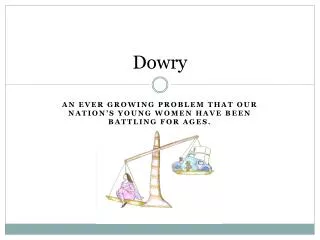
Dowry Prohibition Act
The Indian government passed the Dowry Prohibition Act of 1961 in an effort to end the country's dower practice. Because of this, it is illegal to give, receive, or demand dower. The term "dowry" refers to any assets or security that the bride's family gives or plans to give to the groom's family, either directly or indirectly, at the time of marriage. https://www.edrafter.in/dowry-prohibition-act/


Dowry Prohibition Act
E N D
Presentation Transcript
DOWRY PROHIBITION ACT
WHAT IS THE 1961 DOWRY PROHIBITION ACT? The Indian government passed the Dowry Prohibition Act of 1961 in an effort to end the country's dower practice. Because of this, it is illegal to give, receive, or demand dower. The term "dowry" refers to any assets or security that the bride's family gives or plans to give to the groom's family, either directly or indirectly, at the time of marriage.
THE DOWRY PROHIBITION ACT WAS PASSED IN WHICH YEAR? In response to mounting social pressure to protect women from dower abuse, the Indian Parliament passed the Dowry Prohibition Act of 1961. This Act was a significant turning point in the fight against domestic abuse and dower, and it was also a significant chapter in Indian parliamentary history.
FOR WHAT REASON WAS THE DOWRY PROHIBITION ACT NECESSARY? The Dowry Prohibition Act of 1961 was passed because the dower system is the scourge of Indian society. In addition to posing financial difficulties for families, dower customs served to legitimise economic exploitation and gender inequality. Women were harassed, abused, and even killed as a result of the unfulfilled expectations of dower, demonstrating the urgent need for legal grounds to oppose them. The Act aimed to stop these kinds of activities, shield women from harassment, and advance gender equality.
WHAT ARE THE DOWRY CASE RULES? Guidelines for dower in situations governed by the 1961 Dowry Prohibition Act: Prohibition of Dowry For offenders Registering Complaints Dowry Lists Empowerment of Women