Labour Availability on Construction Projects
Construction industry has backward and forward linkages with various other industries like cement, steel, tiles, wood, furniture, electronics etc.
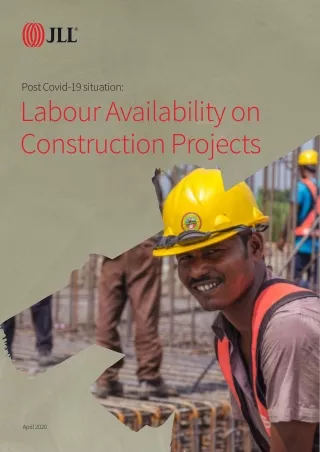

Labour Availability on Construction Projects
E N D
Presentation Transcript
Post Covid-19 situation: Labour Availability on Construction Projects April 2020
Objective Assess the impact of COVID-19 outbreak on migrant construction workforce in India. Construction Industry: Snapshot Construction industry has backward and forward linkages with various other industries like cement, steel, tiles, wood, furniture, electronics etc. that catalyses employment generation in the country. There are mainly three segments in the construction industry: real estate construction which includes residential and commercial construction, infrastructure building which includes roads, railways, power; industrial construction that consists of oil and gas refineries, pipelines, textiles . The construction industry is the second largest employer in India after agriculture. This sector is highly fragmented and labour-intensive. With the latest assessment the sector provides employment to approx. 50 million people. Hence the workforce especially the migrant ones become a key role in supporting this sector. Post Covid-19 situation: Labour Availability on Construction Projects 2
Workforce involved: Migrant labour The Economic Survey 2016-17 had estimated that at least nine million people migrate annually within the country, most of them in search of work, while the recent census says the total number of internal migrants in the country stands at a staggering 139 million. (Around 35% of this work in construction industry). Uttar Pradesh and Bihar are the biggest source states, followed closely by Madhya Pradesh, Punjab, Rajasthan, Uttarakhand, and West Bengal; the major destination states are Delhi, Maharashtra, Tamil Nadu, Gujarat, Andhra Pradesh, Telangana and Kerala. and informal market in key sectors such as construction, hotels, textiles, manufacturing, transportation, services, and domestic work. Most of them find work as unskilled labor since they enter the job market at a very early age. They experience no upward mobility and remain stagnant in the most unskilled, poorly paid, and hazardous jobs for their whole work-life span. There are number of unorganised players in the construction industry who work on a subcontract/labour contract basis. Lack of skilled and un-skilled labour in the metros where majority of construction take place trigger the influx of migrant workforce in this industry. The migrant demographic occupies one of the lowest paying Migrants in Construction Sector: In general, districts with higher urbanization rate, have a higher share of migrants in construction work. These include areas around Delhi-NCR, Gujarat, Maharashtra, Western Madhya Pradesh, Telangana, Tamil Nadu, Karnataka and West Bengal; many of them concentrated in and around large metropolitan districts like Mumbai, Ahmedabad, Delhi, Chandigarh or Kolkata (see Fig 1 and 2). Fig 1: Share of Migrant Construction Workers to Total Construction Workers Fig 2: Share of Inter-State Migrant Workers to Total Migrant Workers in Construction Source: 2001 Census Post Covid-19 situation: Labour Availability on Construction Projects 3
Current situation/ During Lockdown Not only has COVID-19 triggered a massive public health crisis but has also brought along with it an equally challenging economic situation. Migrant workforce is often left to fend for themselves with no regular place to stay, no job security and has challenges in getting support from the social infrastructure. Amid, the 41-day lockdown in India, thousands of migrants tried to return to their place of origin from their place of employment in cities, even though they were informed to stay put in their locations by the governments. Challenges of low wages - Majority of India’s daily wage and migrant population earns just 30% to 60% of the prescribed minimum wage of INR 571 to INR 692 (between $7.6 to $9.2) set by the government for skilled, semi-skilled, and unskilled workers respectively (*rates prescribed in Delhi)+4 The lockdown situation has made this class more vulnerable in many ways: • Lost work/income: As many as 92.5% of labourers have already lost one to three weeks of work%+5 • Hunger Issue: Over 80% of the country’s migrant and daily wage population fears they will run out of food before the end of the lockdown phase. Nearly as many also worry that they will not be able to find work once the lockdown ends. • No BOCW Card: More than 80% of the workers have not registered for the social security umbrella specially meant for the construction workforce. This has more to do with the awareness of their own rights.+5 • Debt-ridden: Several migrant workers also have debts to repay, which are an additional cause of anxiety without a steady stream of income. • Mental & Emotional Health Challenges: Added to the loss of income and hunger issues hundreds of migrant workers are still living in shelter homes and/or cannot be with their families. This has triggered a lot of mental and emotional challenges for them and in turn for the government and the employers • Survival of indigenous communities: Reverse migration, possibly carrying the virus, can have devastating impact on indigenous communities,” it said adding that it can wipe out endangered indigenous peoples of India and further, permanently damage the survival of many communities. permanently damage the survival of many communities. Post Covid-19 situation: Labour Availability on Construction Projects 4
Post Lockdown Scenario COVID-19 has given a new lesson in distance and could lead to a significant reduction in long-distance migration. Typically, workers wait for a crisis to be over before setting out again in search of work, however, considering the nature of crisis, the waiting period could be much longer this time, and therefore the impact on labour cost, much larger. even if those who left earlier decide to return, companies may find a shortage of labour. Besides, in addition to the economic fallouts, we can’t obviously ignore the chances of infection being carried by these migrants as they return to and from their natives. Keeping that in mind, the contractors and various other employers will have to enhance the hygiene of workplaces and ensure a sanitised environment for all. This would in turn further raise the costs involved in completing projects, in an already troubled economy. Several migrant workers who fled the big cities may never return, preferring to eke out a living on their marginal farms or find work in nearby towns. It would deprive industrial centres of labour for a long period of time, likely raising the wage burden on small- and medium-sized units struggling to crawl out of recession. In fact, we could be in an unknown territory of higher wages, less demand for labour, As like many industries construction would also try to move more towards less labour-intensive ways of output, in the fear of uncertainty and reducing life related risks in future. The counter view also is prevalent where we might have more labours returning to urban areas in the near future for want of work and wages. There may be a second wave of home-coming of migrant workers once the lockdown is lifted. Many who decided to stay back are desperately waiting for transport to be available. They would take off at the first opportunity. That would mean that, Local holidays: India, being culturally diverse, celebrates various local holidays and festivals across regions; the construction workforce tend to return to their homes to partake in the festivities and marriages. These holidays in the coming months will also have an impact on the construction sector. In a nutshell, we can say that the shortage of labour is inevitable post lockdown in construction sites at least for several weeks. Lack of manpower and delays in supplies will potentially impact project budgets, compounded by the “New Normal” of social distancing, stress on health and safety in the working conditions. Labour camp will never be the same again, where, even ailments like normal flu/ common cold would trigger suspicion and higher degree of caution. Keeping in mind the density of labour camps, good hygiene and sanitary conditions would have to be incorporated into the site infrastructure. There is no way we can work completely “COVID-free” any time before the vaccine hits the market; the measures are here to stay for a long time. Post Covid-19 situation: Labour Availability on Construction Projects 5
Post lockdown, JLL conducted survey with Indian leading contractors & suppliers and results were interesting. More than 60% of the contractors predict that the labour shortage will be there for next couple of months, which will have severe impact on the real estate sector. Survey Package undertaken 0% 10% 20% 30% 40% 50% 15% Modular / Loose Funiture / Factory Finished Product 12% 10% 9% 8% Electrical Works Safety , Security , CCTV and Access Control Interior ( Civil ) and related joinery works HVAC Works 49% Others/ Miscellaneous Labour Strength before the lockdown in Jan / Feb ‘20 40% 35% 30% 36% Percentage of Respondents 23% 25% 20% 15% 18% 9% 10% 5% 0% 6% 6% 2% >2000 1000-2000 500-1000 Labour Strength 300-500 100-300 50-100 Below 50 Current Labour Strength 60% 50% 52% Percentage of Respondents 40% 30% 20% 20% 12% 5% 4% 4% 10% 0% 2% >2000 1000-2000 500-1000 Labour Strength 300-500 100-300 50-100 Below 50 Labour Strength post lockdown 40% 35% 30% 39% Percentage of Respondents 25% 20% 15% 25% 21% 10% 5% 0% 6% 4% 3% 2% >2000 1000-2000 500-1000 Labour Strength 300-500 100-300 50-100 Below 50 Labour Return time post lockown 70.0% 63.7% 60.0% 50.0% Percentage of Respondents 40.0% 30.0% 20.0% 21.2% 6.1% 5.6% 10.0% 0.0% 1.7% 1.7% Available 0-15 days 15-30 days 1 - 2 months 2 - 4 months >4 months Timeline for Return of Labours Post Covid-19 situation: Labour Availability on Construction Projects 6
One more interesting survey result is that nearly 43% respondents were of the opinion that there is high chance that the workforce in labour camps in respective cities might move to their native towns post lockdown. Chances of Labours returning to native land 50% 45% Percentage of Respondents 40% 35% 30% 43.6% 25% 20% 15% 31.3% 25.1% 10% 5% 0% Low Medium Labour Strength High Migrant Labor Source Maharashtra, Rajasthan, North India 40% 22% UP, Bihar, Jharkhand Orissa, West Bengal, Northeast states 5% 33% Native labours Respondents expected government to support either on reduction in taxes or compensation for the struggling sector (refer graph) Help Expected from Govt. for Economic boost 120 59.2% Percentage of Respondents 100 45.8% 40.2% 80 60 40 20 5.6% 0 Compensation Reduced taxes Labour Strength Interest free loans Others Whether labor force is able to utilize governement relief in camps/native? 22.9% Yes 34.6% Don’t know 42.5% No Post Covid-19 situation: Labour Availability on Construction Projects 7
What next? Monthly ration, financial support, healthcare support & loan waivers are what the migrant workforce is looking at for turning them out of this crisis. Measures by Government: The governments in various states have started relief measures for the labour forces. As a fall out of this pandemic, a percentage of the workforce may remain in their homes in the hope of monetary/ other benefit schemes coming their way by the governments. This could result in a dilemma that would influence staying back with families even if it means a lesser financial advantage. For example, the MGNREGA may temporarily offer solution to the migrant workers; even an optimised implementation of this scheme means 100 days of work. Considering the above, Mapping of migrant workers for relief measures has already been delegated to state governments by the central ministry. The database will also help the central government to make arrangements to transport workers to their homes from relief camps or bring them to cities for work, if they desire. Post Covid-19 situation: Labour Availability on Construction Projects 8
Thought for future While this pandemic has caught the entire world completely unprepared, future BCPs need to be built on mitigating vulnerabilities of the workforce, with stronger emphasis on easy access to social security, localisation, and analysis for rapid response to such scenarios and robust private public partnerships. Ensuring that the workers are aware of and have other necessary resources/documentation to avail benefits is equally important. Construction sector should come along with the government agencies to help the labours at this crisis and formulate a strategy post covid-19 scenario as a new normal will set in from now. Apart from improved implementation of statutory norms like BOCW, ESI/PF; Developers & contractors will start thinking of giving incentives to labours. Various parameters from insurance, health check ups, labour camps, faster mechanisation, technology adaption etc will go through deep assessment and revalidation. Post Covid-19 situation: Labour Availability on Construction Projects 9
Notes / References a. References have been taken from several publications by government agencies, as well as reports published in magazine and newspapers across the country. State Percentage share Uttar Pradesh 14.83% Assam 20.28% West Bengal 15.00% b. Distribution of migrant labour from the origin states in Kerala which has one of the largest migrant population vis a vis the residents Bihar 18.10% Orissa 8.67% Others 23.13% Post Covid-19 situation: Labour Availability on Construction Projects 10
About JLL JLL (NYSE: JLL) is a leading professional services firm that specializes in real estate and investment management. JLL shapes the future of real estate for a better world by using the most advanced technology to create rewarding opportunities, amazing spaces and sustainable real estate solutions for our clients, our people and our communities. JLL is a Fortune 500 company with annual revenue of $18.0 billion, operations in over 80 countries and a global workforce of more than 93,000 as of December 31, 2019. JLL is the brand name, and a registered trademark, of Jones Lang LaSalle Incorporated. For further information, visit jll.com. About JLL India JLL is India’s premier and largest professional services firm specialising in real estate. With an audited revenue in excess of 4000 crores for FY 2018-19, the Firm is growing from strength to strength in India for the past two decades. JLL India has an extensive presence across 10 major cities (Mumbai, Delhi NCR, Bengaluru, Pune, Chennai, Hyderabad, Kolkata, Ahmedabad, Kochi and Coimbatore) and over 130 tier II & III markets with a cumulative strength of over 12,000 professionals. The Firm provides investors, developers, local corporates and multinational companies with a comprehensive range of services. This includes leasing, capital markets, research & advisory, transaction management, project development, facility management and property & asset management. These services cover various asset classes such as commercial, residential, industrial, retail, warehouse and logistics, hospitality, healthcare, senior living, data centre and education. JLL India won the Five Star Award for ‘Best Property Consultancy at the International Property Awards Asia Pacific 2018 -19. The Firm was also recognised amongst the ‘Top 100 Best Places to Work in India’ three years in a row (2017, 2018 and 2019) in the annual survey conducted by Great Place to Work® and The Economic Times. It has also been acknowledged as ‘Property Consultant of the Decade’ at the 10th CNBC-Awaaz Real Estate Awards 2015. For further information, please visit jll.co.in Authors Soorya Vijayamma soorya.vijayamma@ap.jll.com Jipu Jose James jipujose.james@ap.jll.com Rama Murthy rama.murthy@ap.jll.com Arumugam Deviprasadh deviprasadh.arumugam@ap.jll.com Monika Vaswani monika.vaswani@ap.jll.com For any business enquiries, reach out to Design Sabyasachi Chatterjee sabyasachi.chatterjee@ap.jll.com 98198 82101 Jipu Jose James jipujose.james@ap.jll.com 98840 32233 Sunita Rajeev sunita.rajeev@ap.jll.com This report is published for general information only and not to be relied upon as a sole source for any investment decision. Although high standards have been used in the preparation of the information, analysis, views and projections presented in this report, no responsibility or liability whatsoever shall be accepted by JLL for any loss or damage resultant from any use of, reliance on or reference to the contents of this document. As a general report, this material does not necessarily represent the view of JLL in relation to particular properties or projects. Reproduction of this report in whole or in part is not allowed without prior written approval of JLL to the form and content within which it appears.