Understanding Inverse Trigonometric Functions and Their Applications
This text explores inverse trigonometric functions, including sine, cosine, and tangent. It provides definitions, applicable ranges for angles, and examples to evaluate expressions in both radians and degrees. The content also highlights practical applications, such as finding angles in triangles and calculating the angle of repose for various sand piles. A series of problems and scenarios demonstrate how to apply inverse trigonometric functions in real-world contexts, making the concepts accessible for learners.


Understanding Inverse Trigonometric Functions and Their Applications
E N D
Presentation Transcript
13.4 Inverse Trigonometric Functions Algebra 2
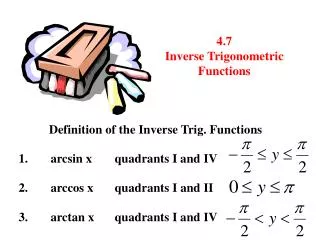
Inverse Trigonometric Functions • If -1≤a≤1, then the inverse sine of a is sin-1a=θ where sinθ=a and -90˚≤θ≤90˚. • If -1≤a, then the inverse cosine of a is cos-1a=θ and -0˚≤θ≤180˚. • If a is any real number, then the inverse tangent of a is tan-1θ=a where tanθ=a and -90˚<θ<90.˚
Examples: • Evaluate the expression in both radians and degrees.
Examples: • Evaluate the expression in both radians and degrees.
Examples: • Evaluate the expression in both radians and degrees.
Examples: • Find the measure of the angle θ for the triangles shown. 12 7 θ
Examples: • Find the measure of the angle θ for the triangles shown. θ 13 18
Example: • Solve the equation where 180˚<θ<270˚
Example: • Solve the equation where 90˚<θ<180˚
Example: • A sand pile in a yard is 4 feet high. A diameter of its base is 10 feet. • Find the angle of repose for this pile of sand. • How tall will a pile of this sand be if the base has a diameter of 40 feet?
Example: • A crane whose lower end is 4 feet off the ground has a 100 foot arm. The arm has to reach the top of a building 80 feet high. At what angle should the arm be set?
Example: • A 10 inch high pile of sand in a sandbox has a diameter of 35 inches. • What is the angle of repose for this sand? • How wide will a pile 18 inches high be?