The Fall of Rome: Causes and Consequences
40 likes | 154 Vues
Explore the decline of the Western Roman Empire and the rise of the Byzantine Empire. Learn about key events, such as the Visigoth and Vandal invasions, and theories on Rome's downfall. Discover the impact of Christianity, cultural shifts, and technological stagnation on this pivotal period in history.


The Fall of Rome: Causes and Consequences
E N D
Presentation Transcript
The empire restored by Diocletian and Constantinople continued for another hundred-plus years. • It had two capitals, Rome in the west and Constantinople in the east. • In the second half of the fourth century, Huns from Asia moved into eastern Europe and put pressure on the Germanic Visigoths. • The Visigoths moved south, crossing the Danube into Roman territory. • Initially Roman allies, the Visigoths revolted and defeated a Roman army in 378. • More Germans crossed into Roman territory.
In 410 the Visigoths sacked the city of Rome. • In 455, another group, called the Vandals, also sacked the city. • Our modern word vandal comes from the name of this ruthless tribe. • In 476, the western emperor, Romulus Augustulus, was deposed by the Germanic head of the army. • This event is usually taken as the fall of the Western Roman Empire. • The Eastern Roman Empire, the Byzantine Empire, continued on.
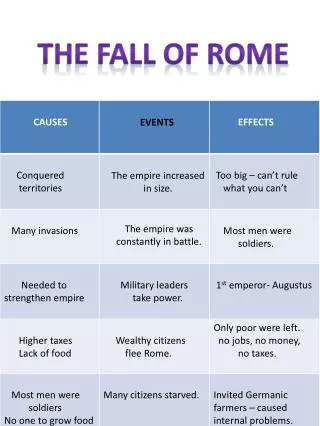
Many theories have been proposed to explain the fall of the Roman Empire: Christianity weakened Rome’s military virtues; Roman values declined as non-Italians gained prominent positions; lead poisoning from water pipes and vessels caused a mental decline; slavery held Rome back from advancing technologically; Rome’s political system proved unworkable. • Probably there is some truth in all or most of these explanations.