Understanding Avian Serology: Interpreting Immune Responses and Serological Testing
530 likes | 649 Vues
This presentation by Dr. Victoria Bowes provides an in-depth guide on the avian immune system, focusing on both non-specific and specific immunity. Learn about the mechanisms of immune responses, types of antibodies, and the importance of serology in assessing health and immunity in birds. The talk covers interpretations of testing methods like ELISA, the significance of antibody titers, and critical limitations in serological evaluations. This knowledge is essential for poultry health management and disease prevention strategies.


Understanding Avian Serology: Interpreting Immune Responses and Serological Testing
E N D
Presentation Transcript
SEROLOGY 101 Or How To Interpret Those Funny-Looking Graphs Dr. Victoria Bowes Animal Health Centre Abbotsford, BC Presented June 4, 2003
Avian Immune System • NON-SPECIFIC and SPECIFIC • border defenses (innate) • surveillance (white blood cells) • rapid elimination of harmful substances
Avian Immune System • NON-SPECIFIC IMMUNITY: anatomic – skin, mucus, cilia body temperature genetic factors sneeze, cough, vomit age, nutrition
Avian Immune System • SPECIFIC IMMUNITY: • Passive (provided in the yolk to chicks) • Acquired (must be produced by the bird) (by infection or vaccination) • Cells – lymphocytes, macrophages • Antibodies - produced by B-lymphocytes • Memory
The Immune Response • Must recognize foreign or potentially harmful intruders • Produce and co-ordinate specific (antibodies) and non-specific (lymphocytes) reactions to ATTACH, TRAP and ELIMINATE
The Immune Response • antibody: a protein produced in response to the presence of a specificantigen • antigen: a molecule capable of eliciting an immune response, usually large, complex and foreign
The Immune Response • Example: An IB virus that has it’s surface receptors coated in antibodies cannot attach itself to the cells lining the trachea, the first step in infection.
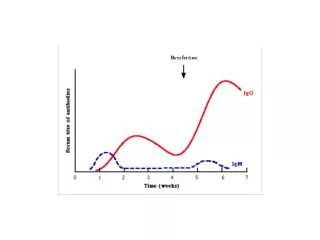
The Immune Response • PRIMARY: novel foreign antigen is processed, specific antibodies are slowly produced (short-lived) and “memory cells” become dormant • SECONDARY: “memory cells” encounter their specific antigen and are activated, antibody production is rapid and potent
Vaccines • Vaccines = INSURANCE (something you may never use but you be very glad to have if ever needed) • “Live” : gives best immune response but has side effects (weakened strains of virus) • “Killed”: less side effects but poorer immune response (excluding adjuvants)
Serology • The detection of antibodies in serum • Test methods: plate agglutination hemagglutination inhibition ELISA • Interpreting results: negative vaccination field challenge
Blood • 55% fluid: mostly water • 45% solid: cells (500:1 red : white cells), enzymes, proteins, nutrients • transports oxygen & nutrients while removing waste • serum Vs plasma
ELISA E nzyme L inked I mmuno S orbant A ssay
ELISA • easily automated • sensitive & specific • antigen-coated test plates capture specific antibodies in diluted blood sample and reagents turn shades of blue depending and the amount of antibody present • generates computer graph “histogram”
Serological Strategies • DIAGNOSTIC: field challenge “paired” samples • ASSESS VACCINATION RESPONSE: “protective” and maternal titres
Serological Strategies • small sample size is used to infer the condition of a larger population of birds • statistical techniques dictate sample size of significance • variables: flock size 12-24 /air space? testing type • pooling samples reduces test sensitivity (dilutional)
Interpretation • Serology results must be interpreted in association with other sources of information: vaccination history production data condemnation data clinical signs necropsy findings
Limitations • seroconversion takes 4-20 days • tests only “circulating” antibody • static measure (rising, stable, falling) • can’t differentiate field vs. vaccine strains • cross-reactions • test error
Titres or Titers • a unit of measurement of antibody • uses pre-determined reference numbers • historically measured by sample dilution until a standard reaction was produced dilution = “titre” • a titre of 32 ½ the antibody of 64 2X the antibody of 16
Interpreting Results 123 A BB 18 X 345 – IBD-XR • 123 – flock # • A or B – 1st or 2nd bleeding • BB – broiler breeder (or TU, BR) • 18 – age in weeks • X – submitter code (hatchery, vet) • 345 – owner code • IBD-XR – test name
Interpreting Results • MEAN TITRES: the averagetitrenumber (zero to >10,000) • each titre group (bottom line of graph) represents a different titre range depending on the virus
Interpreting Results • UNIFORMITY: %CV (coefficient of variation) < 30% excellent 30-50% good 51-80% fair > 81% poor or bimodal
Standards • Optimum Titres: minimum titre level to provide long duration immunity for breeder hens, also assuming protective. Assessed 4 weeks post-killed vaccine. ND 8/10 > 7 IBV 8/10 > 6 IBD 8/10 > 8 Reo 8/10 >5 AE 8/10 >4
Interpretation EXAMPLES The following are typical histograms