Comprehensive Video Quality Measurement Methods and Techniques for MPEG-2 and H.263 Formats
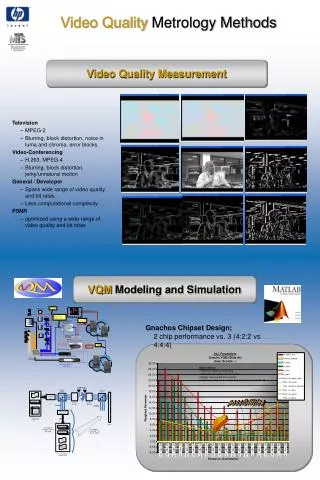
This document explores various metrology methods for assessing video quality in television and video conferencing. It covers the evaluation of MPEG-2 and H.263 formats, addressing common issues such as blurring, block distortion, noise in luma and chroma, and jerky motion. The integration of PSNR for optimizing video quality across diverse bit rates and the impact of chipset design on performance is also discussed. Emphasizing less computational complexity, it provides valuable insights for developers looking to enhance video transmission quality while managing bandwidth effectively.

Comprehensive Video Quality Measurement Methods and Techniques for MPEG-2 and H.263 Formats
E N D
Presentation Transcript
Video Quality Metrology Methods Video Quality Measurement Television • MPEG-2 • Blurring, block distortion, noise in luma and chroma, error blocks Video-Conferencing • H.263, MPEG-4 • Blurring, block distortion, jerky/unnatural motion General / Developer • Spans wide range of video quality and bit rates • Less computational complexity PSNR • optimized using a wide range of video quality and bit rates VQM Modeling and Simulation • Gnachos Chipset Design; • 2 chip performance vs. 3 (4:2:2 vs 4:4:4)