Solving Vector Problems Using Head-to-Tail and Goal Post Methods
70 likes | 207 Vues
This guide demonstrates how to solve vector addition problems using both the Head-to-Tail method and the Goal Post method. By analyzing a scenario with three vectors, we illustrate how to determine the resultant vector's magnitude and direction. The Head-to-Tail method provides an estimate, while the Goal Post method delivers a more precise calculation using the Pythagorean theorem and inverse tangent functions. Learn to visualize vector addition and accurately compute the final vector results in real-world applications.


Solving Vector Problems Using Head-to-Tail and Goal Post Methods
E N D
Presentation Transcript
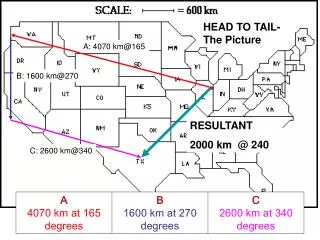
HEAD TO TAIL- The Picture A: 4070 km@165 B: 1600 km@270 RESULTANT 2000 km @ 240 C: 2600 km@340
Now we will complete the same problem using the “Goal Post Method” to solve the problem mathematically. The picture from the “Head to tail” method will help guide us through the problem. • Remember: • The Head to Tail method helps us estimate a resultant • The “Goal Post Method” gives us a reliable value
Ax HEAD TO TAIL- The Picture A: 4070 km@165 Ay B: 1600 km@270 By RESULTANT ? @ ? Ay + By + Cy C: 2600 km@340 Cy Cx Ax + Bx + Cx
To find the magnitude of the resultant use Pythagorean Theorem: Resultant 2= (sum of x)2 + (sum of y)2 Resultant 2= (-1488)2 + (-1435)2 R = 2067 km To find the direction of the resultant use inverse tangent: Tangent -1 y/x = angle in quadrant Angle = 46 degrees below west or 180 + 46 Angle = 226 degrees