Understanding Energy Flow and Intensity in Radiation: Lecture 7 Overview
This lecture delves into the relationship between energy flow, intensity, and the amplitude and power of wave sources in radiation. We recalibrate the definition of "intensity level" in terms of human physiological sensations. Explore how waves require a source and medium—comprised of coupled oscillators in equilibrium. We discuss the effects of disturbances, the nature of longitudinal and transverse waves, and the Doppler effect on observed frequencies. Additionally, the concepts of Fourier analysis and energy propagation along rays are examined, emphasizing their roles in understanding radiation phenomena.

Understanding Energy Flow and Intensity in Radiation: Lecture 7 Overview
E N D
Presentation Transcript
Radiation: Particles, Waves, Rays Physics 202 Lecture 7
Energy flow and intensity is related to the amplitude and power of the driving source
“Intensity level” recalibrates the definition of intensity to our physiological sensation
Waves require a source and a medium made up of coupled oscillators near equilibrium Longitudinal Transverse
Any disturbance in the medium acts as a damped oscillator as energy radiates away Solid Liquid Gas Air
All the elements of the medium match the oscillation of the source with a phase shift
If the source is moving, the observed frequency suffers a Doppler shift
When the frequencies of two sources differ, non-sinusoidal beats result Fourier Analysis
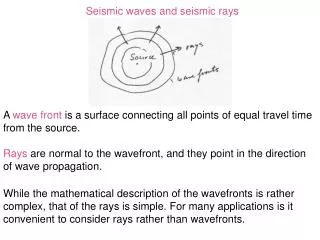
Energy propagates along “rays” which move perpendicular to the overall wave fronts Slow