SlideServe
Menu
Préférences
© SlideServe · v2026

Object recognition

abel-dunlap avatar
11 diapositives · 276 Views · Nov 20, 2014

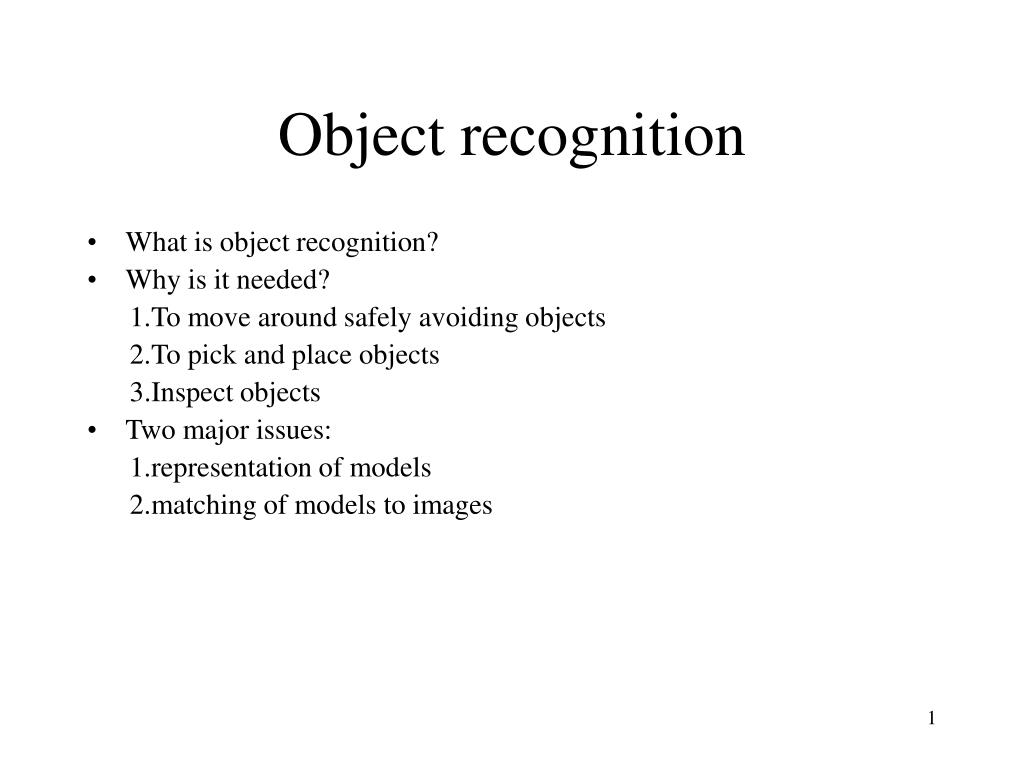
Object recognition. What is object recognition? Why is it needed? 1.To move around safely avoiding objects 2.To pick and place objects 3.Inspect objects Two major issues: 1.representation of models 2.matching of models to images. Invariants.
Object recognition - slide 1
01 / 11Object recognition
1 / 17

Télécharger la présentation

Object recognition
Une image / un lien ci-dessous est fourni (tel quel) pour télécharger la présentation

Politique de téléchargement : le contenu du site vous est fourni TEL QUEL pour votre information et votre usage personnel ; il ne peut être vendu, concédé sous licence ni partagé sur d’autres sites sans l’accord de son auteur.Le contenu vous est fourni TEL QUEL, pour votre information et votre usage personnel uniquement. Téléchargez la présentation en cliquant sur ce lien. Lors du téléchargement, si vous ne parvenez pas à télécharger une présentation, l’éditeur a peut-être supprimé le fichier de son serveur.Pendant le téléchargement, si vous ne parvenez pas à obtenir une présentation, le fichier a peut-être été supprimé par l’éditeur.

F I N

Plus de contenu associé

Transcription de la présentation
  1. Object recognition • What is object recognition? • Why is it needed? 1.To move around safely avoiding objects 2.To pick and place objects 3.Inspect objects • Two major issues: 1.representation of models 2.matching of models to images

  2. Invariants • We can use invariants to recognize simple objects: 1.They provide a simple means of comparison 2.They can provide orientation and position information. 3.Too simplistic for some applications 4.Does not give unique means of identification.

  3. Model Properties • Desirable model properties 1.direct pairing of model features and observed data features 2.direct estimation of object position and orientation 3.prediction of the appearance of the object from any position

  4. Shape representation • Common shape representation methods are characterized on different points: 1.Input representation form 2.Object reconstruction ability 3.Incomplete shape recognition ability 4.Local global description characters 5.Robustness of description. • Models used for shape representation are wireframe models,set- theoretic models and boundary representation models.

  5. Models used for shape representation • Wireframe Models 1.Store edges and vertices in a list. 2.Polyhedral representation. 3.Edge based matching. 4.Problems with ambiguous and impossible representations. 5.Problems due to no solid matter of the object represented. Solid Models are better.

  6. Contd. • Set Theoretic Modelling 1.Model is composed of primitive shapes assembled with set operators. 2.Set operators used are union(U),difference(-) and intersection.

  7. Model Based Recognition • Recognition is matching problem between scene and model description. • There are three methods which are broadly used : 1.Tree-search methods 2.Relaxed labeling methods 3.Graph Search methods(we look at this method in detail).

  8. Graph Searching • Object model and scene features are represented in relational graph structure. • A graph consists of 1.A set of nodes connected by links(also called edges or arcs). 2.Each node represents an object feature. 3.Node can be labeled with each of the feature’s properties. 4.Links of the graph represent relationships between features a.distance between centroids of features b.Adjacency of the features.

  9. Recognition • A matter of matching two graphs-graph of object model to the graph of scene containing object. • Matching methods must take into account occlusion and overlapping objects. • A graph derived from a solid model of the mug would contain the bottom which is missing from the view shown (and scene model). • So the problem is that of finding a subgraph of the complete graph derived from the solid model. • This is a large search space problem -- Use Constraints. • Thus Graph theory is big topic in its own right.

  10. Conclusion • The generation of sufficiently rich and descriptive representations from images,segmentation and grouping to identify those features that belong together, and the matching of these to object models are difficult research problems under active investigation.