Periodic Trends
Explore the history and development of the periodic table, starting with Mendeleev in 1869, who organized elements by atomic mass and observed periodic properties. Discover Henry Moseley's 1911 contributions that defined our modern table based on atomic number. Learn about the periodic law emphasizing the recurrence of properties, the discovery of noble gases, and the classifications of lanthanides and actinides. Understand the electrical nature of matter, including protons, electrons, neutrons, ions, and ionic compounds, along with their significance in chemistry.

Periodic Trends
E N D
Presentation Transcript
Periodic Trends Materials Part B
History Mendeleev-Russian 1869 organized elements according to mass and properties noticed that properties repeated periodically predicted elements, later identified as Sc,Ga,Ge
History Henry Moseley-1911 Used X-rays for determining the # of protons This is how our current periodic table is arranged.
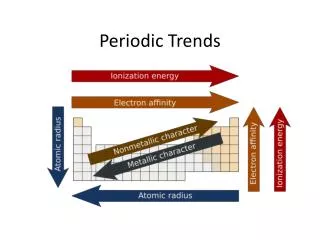
Periodic Law • Physical and chemical properties repeat periodically if arranged according to atomic number. • “Recurring or reappearing from time to time;” http://www.thefreedictionary.com • Look for patterns
History • Additional changes since Medeleev • Noble gases- William Ramsay (1906) • Lanthanides/Actinides- Glenn Seaborg (1950)
The Electrical Nature of Matter • Protons- positive • mass of 1 atomic mass unit (amu) • in nucleus • Electrons- negative • very small mass • outside of nucleus • Neutrons-neutral (no charge) • mass 1 amu • in nucleus
The Electrical Nature of Matter • Let’s try • An atom has: • 15 protons + 15 electrons = • 20 protons + 21 electrons = • 19 protons + 18 electrons = • 10 protons + 12 electrons=
Counting Subatomic Particles • Atomic Number • # of protons • Identifies the element • - this also equals the # of electrons because atoms are neutral
Counting Subatomic Particles • Mass Number • # of protons + # of neutrons • Find this by rounding the mass on the periodic table • Examples: See practice sheet
Ions and Ionic Compounds • Ions: • charged atoms; • atoms that have gained or lost electrons to form negative or positive ions • Ionic Compounds: compounds composed of positive and negative ions
The Electrical Nature of Matter • Opposites attract- • this is the glue to hold atoms together • These are chemical bonds.
Ions and Ionic Compounds Cation: a positively charged ion (Na+) Anion: a negatively charged ion (Cl-) Polyatomic ion: (many-atoms) an ions made of two or more bonded atoms (NH4+ or NO3-)
Ions and Ionic Compounds Step 1: Write the symbols for the ions side by side, with the positive ion (or most metallic element) first Step 2: Cross over the charge values to give subscripts Step 3: Check the subscripts by making sure the total charge of ions in the compound is zero, simplify Step 4: Write the formula
Ions and Ionic Compounds Let’s try: Need to use ion chart zinc oxide aluminum sulfide calcium carbonate
Ions and Ionic Compounds • Naming Compounds • Nomenclature: the method of naming chemical compounds 1. write the name of the element having a positive charge 2. add the name of the negative element 3. the negative element must be modified to end in –ide
Ions and Ionic Compounds Let’s try: Use the chart of ions NaI2 K2O BaSO4