Mastering Rhetorical Situations for Effective Communication
Understand rhetorical situations, logos, ethos, pathos, and kairos for compelling communication. Explore considerations before writing, audience analysis, and brainstorming techniques.

Mastering Rhetorical Situations for Effective Communication
E N D
Presentation Transcript
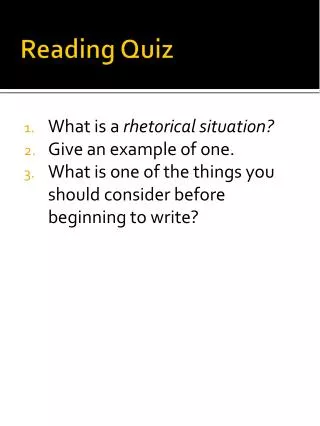
Reading Quiz • What is a rhetorical situation? • Give an example of one. • What is one of the things you should consider before beginning to write?
Rhetorical Situations Rhetoric: the art of discourse (or communication) Aristotle’s definition: "the faculty of observing in any given case the available means of persuasion."
Rhetorical Situations Logos: the logic or reason behind what you’re trying to say (often includes facts, statistics, etc.) In terms of your message: • What do you want to say? • How will you support your argument?
Rhetorical Situations Ethos: moral character, values In terms of your message: • Who are you to say it? • What is your perspective as the author of the message?
Rhetorical Situations Pathos: from the Greek for “suffering” or “experience,” represents an emotional appeal to the audience In terms of your message: • Who is your audience? • How can you make them care about what you’re trying to say?
Rhetorical Situations Kairos: the right or opportune moment In terms of your message: • When is the best time to deliver your message to your audience? • What is the best medium to do so?
Rhetorical Situations:Other Considerations • Time and length • Genre, medium, format • Tone and style
Rhetorical Situations:Practice Exercise Your Message: “I’m going to be late” Audience(s): Parents, Friend, Professor Select appropriate: • Logos • Ethos • Pathos • Medium • Tone and Style
Brainstorming Techniques • List every word that comes to mind • Think about the opposite side of the topic • Draw your subject • Try clustering: • Ask questions • Browse other examples • Collaborate with colleagues
Homework • Read: Guide, Ch. 4, pp. 90-107 • Comment on blog • Write your Memoir Proposal • (due emailed to me, with a printed copy brought to class)