Investigating Cancer Pathways through Simulation: Methodologies and Activation Models
This work focuses on the methodologies developed for simulating cancer pathways, as outlined by Hanrahan and Weinberg's "Hallmarks of Cancer." Key pathways such as EGFR, TCR, and FcεRI are explored for their roles in DNA synthesis, antigen recognition, immune response, and apoptosis. Using simulations of first passage times with varying conditions, we aim to create probability distributions for protein activation levels. Comprehensive data collection protocols and organizational frameworks are established to facilitate in-depth analysis and exploration of the dynamic behaviors of these biological systems.

Investigating Cancer Pathways through Simulation: Methodologies and Activation Models
E N D
Presentation Transcript
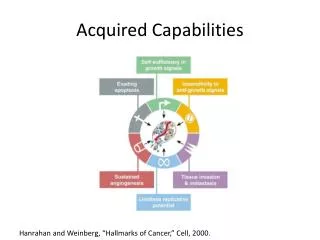
Acquired Capabilities Hanrahan and Weinberg, “Hallmarks of Cancer,” Cell, 2000.
Pathways Hanrahan and Weinberg, “Hallmarks of Cancer,” Cell, 2000.
Pathways • EGFR: DNA synthesis and cell proliferation • look for activation of Sos or Ras • Spratt, Balmick, Ratsimihah • TCR: antigen recognition • Look for activation of Erk • Packer, Rodriguez, Yalkabov • FcεRI: immune response • Look for activation of Syk • Feitzinger, Abbasi, Nunez • Apoptosis: cell death • Look for activation of • Miranda, Garib, Green • HMGB1: inflammation • Look for activation of ? • Weinberg, Zegel, Lagrange
Project Goal • Develop a probability distribution for “first passage times” by running many simulations • First passage time is the time the target protein reaches a given level of activation • Variations: • Vary ligand dose • Vary level of activation • Eliminate backward reactions • Put some molecules in an “always-on” or “always-off” state • An experiment will consist of varying one thing and developing the probability distribution for each value
Methodology • SSA simulations of assigned pathway using BioNetGen • Scripts developed for multiple runs and collecting data • Creates a directory for each run • Data collection program creates file for histogram • Use RuleBender for initial explorations • Find equilibrium values for inactive state with ODE • Find appropriate time interval (balance time to run with getting enough data)
Methodology • Saving data • One directory for each experiment • One subdirectory for each value of variable • README in toplevel directory explaining what the variable and the values are plus any problems that arose • Histogram in top-level directory • In parallel: read about pathway • Wikipedia • Books • Papers
Methodology • Splitting up the work • Other thoughts??
T-Cell Receptors Alon, An Introduction to Systems Biology.
Kinetic Proofreading in T-Cell Receptors Alon, An Introduction to Systems Biology.