Understanding Solvents: Why Some Substances Dissolve in Water While Others Don’t
Explore the fascinating world of solvents and solutes, learning why certain substances dissolve in specific solvents. This guide examines the principle of "like dissolves like," highlighting how polar solvents dissolve polar solutes, while non-polar solvents dissolve non-polar solutes. Discover exceptions where substances with both polar and non-polar characteristics can dissolve in mixed solvents like ethanol. Understand the processes of dissociation and ionization, and their implications for electrolytes and non-electrolytes, alongside real-world applications such as antifreeze and salt use.


Understanding Solvents: Why Some Substances Dissolve in Water While Others Don’t
E N D
Presentation Transcript
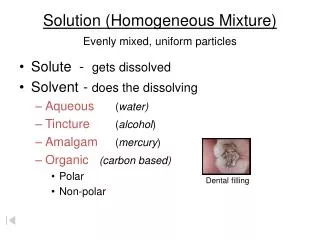
The Nature of Solvents • What dissolves what or why does a substance dissolve in one solvent but not another? • Solvents with non-polar molecules dissolve solutes with non-polar molecules • Solvents with polar molecules dissolve solutes with polar molecules • Remember “like dissolves like”
Are there any exceptions? • Yes!!!!! • Some substances form solutions with both polar and non-polar solutes • How? • Solvents such as ethanol have a polar and non-polar end which allows it to dissolve polar and non-polar solutes. • Substances with both polar and non-polar
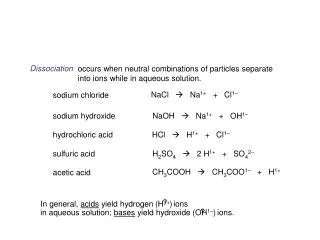
Particles in Solution • How do substances break up in solution? • Dissociation • Ionic Solids (metals bonded with non-metals) separate into positive and negative ions • Example – NaCl dissociates in Na+ and Cl- • Ionization • The breaking apart of certain polar substances to form ions when dissolved in water Example: HCl + H20 H30+ + Cl- • When a substance that separates ions or forms ions in a water solution is called an electrolyte • This means it can conduct electricity
What is a non-electrolyte? • A non-electrolyte is a substance, such as pure water, that does not conduct electricity.
Effects of Solute Particles • Why do you add antifreeze to your car instead of just using water as a coolant? • Why do you put salt on the ground when it is going to be cold?