Exploring Arete in Homer's Iliad: The Legacy of Heroism and Honor
40 likes | 196 Vues
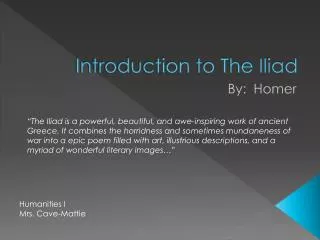
This reading guide dives into the themes of arete as celebrated in Homer's Iliad. We explore the epic's conventions, such as the invocation of the Muse, in medias res, and the use of dactylic hexameter. Key characters like Odysseus, Achilles, and Hector exemplify arete, reflecting the attributes of honor, courage, and moral excellence. The guide also examines the legendary backdrop of the Trojan War, the beauty contest among the goddesses, and the consequences of love and rivalry, posing questions about modern values of excellence and cultural significance.


Exploring Arete in Homer's Iliad: The Legacy of Heroism and Honor
E N D
Presentation Transcript
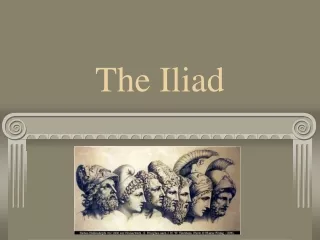
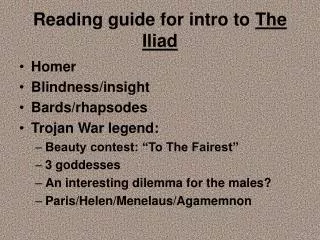
Reading guide for intro to The Iliad • Homer • Blindness/insight • Bards/rhapsodes • Trojan War legend: • Beauty contest: “To The Fairest” • 3 goddesses • An interesting dilemma for the males? • Paris/Helen/Menelaus/Agamemnon
Epic Conventions (Purpose?) • Invocation of the Muse • In Medias Res • Epic simile • Dactylic hexameter • Stock epithet • Material Possessions and honor (p.228)
Arete:Being the best you can be Homer’s epics celebrate arete in the form of his most honored human characters: Odysseus, Penelope, Telemachus, Achilles, Hector. The sense of arete is of honor, of strength, of mobility and moral correctness, of courage and bravery, of intellect. If we value arete, then we value the actions of human beings and measure our actions against those of other human beings.
What is the value of arete? How does such a commitment to excellence bind a culture together? Do we Americans value arete in any form? Is this a cultural value whose time has passed? Do any subcultures that you are aware of practice the values of arete?