Download

1 / 25

E N D
2. History of PLCs Developed in 1971
Developed to replace relays, timers, & counters
Progressed in late 1970’s
Complex mathematical
decisions
Process control
Future
3. What is a Programmable Logic Controller? A Programmable Controller (PLC) is a specialized, factory-hardened computer
4. Advantages of a PLC Smaller physical size than hard-wire solutions
Easier and faster to make changes
Internal Diagnostics
Applications can be immediately documented
Applications can be duplicated faster and less expensively
5. Basic PLC Operation Input Modules bring in field signals
Central Processing Units make decisions
Output Modules control field devices
6. What May be Added?
7. What May be Added? Programming Devices
8. What May be Added? Operator Interfaces
9. PLC Scan
10. Connections PLCs have connections to the outside world through:
Discrete Inputs
Discrete Outputs
Analog Inputs
Analog Outputs
13. What is the CPU’s Function? The CPU has two main sections
User Memory
Decision Making
14. What is Stored in User Memory? Information for temporary or permanent storage is kept in User Memory
Math Results
Product Count
15. User Memory All computers, including PLCs, run on Binary (Base 2) numbers
A Binary number can only be a 1 or a 0
A BIT is a single Binary digit
16. User Memory Decimal System
Ten digits
Base 10
Weights
10, 100, 1000, ...
17. User Memory Computer memory is measured in K
K stands for KILO
Kilo means thousand
The closest round binary number to 1000 is 1024
18. Types of Memory RAM - Random Access Memory
Data can be written to and read from
ROM - Read Only Memory
Data can be read, but not written to
EPROM - Erasable Programmable Read Only Memory
Data can be written to, but is not easily altered
19. Programming Three Standard Languages
Ladder Logic
Statement List
Function Blocks
Siemens Carries Seven Total Languages
Add-ons
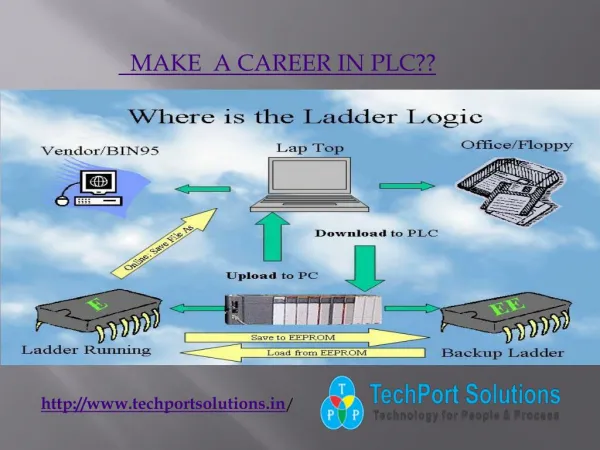
20. Ladder Logic Ladder Logic (LAD) is the most common PLC programming language in the United States
LAD was developed from electromechanical schematic symbols
21. Statement List Statement List (STL) is the most common programming language outside of the United States
Higher learning curve
Faster to program
22. Statement List LD I0.0
A I0.1
= Q0.0
23. Basic PLC applications There are two types of PLC applications
Machine Control
Process Control
25. Questions?
26. Assignments Job #21