Size Matters for AC Performance
Choosing the right air conditioning system size is critical for comfort, efficiency, and long-term performance. Proper tonnage ensures even cooling, better humidity control, lower energy bills, and a longer system lifespan. Oversized or undersized units lead to discomfort and higher costs, making accurate load calculations essential.<br><br>Learn how to choose the right air conditioning system with expert guidance from AC Direct.<br>

Size Matters for AC Performance
E N D
Presentation Transcript
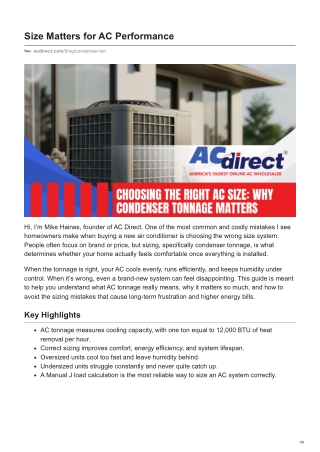
Size Matters for AC Performance acdirect.com/blog/condenser-ton Hi, I’m Mike Haines, founder of AC Direct. One of the most common and costly mistakes I see homeowners make when buying a new air conditioner is choosing the wrong size system. People often focus on brand or price, but sizing, specifically condenser tonnage, is what determines whether your home actually feels comfortable once everything is installed. When the tonnage is right, your AC cools evenly, runs efficiently, and keeps humidity under control. When it’s wrong, even a brand-new system can feel disappointing. This guide is meant to help you understand what AC tonnage really means, why it matters so much, and how to avoid the sizing mistakes that cause long-term frustration and higher energy bills. Key Highlights AC tonnage measures cooling capacity, with one ton equal to 12,000 BTU of heat removal per hour. Correct sizing improves comfort, energy efficiency, and system lifespan. Oversized units cool too fast and leave humidity behind. Undersized units struggle constantly and never quite catch up. A Manual J load calculation is the most reliable way to size an AC system correctly. 1/6
What Is HVAC Condenser Tonnage? In HVAC terms, tonnage has nothing to do with weight. It refers to how much heat an air conditioner can remove from your home in one hour. One ton equals 12,000 BTU, which stands for British Thermal Units. The term comes from the days when cooling was measured by how much ice it took to cool a space. Today, it’s simply a way to express capacity. A one-ton system removes 12,000 BTU per hour, a two-ton system removes 24,000 BTU, and so on. If you want a quick reference point, this breakdown of an Air conditioner 12 000 btu can help put those numbers into perspective. Why AC Tonnage Matters for Homeowners Proper AC sizing is the difference between a system that feels steady and one that constantly feels off. When the tonnage matches your home’s cooling load, the system runs long enough to cool the air and remove moisture without overworking itself. From a homeowner’s point of view, choosing the right size of Air conditioning heating units means lower energy bills, fewer repairs, and more consistent comfort across rooms. It also means the system is far more likely to reach its expected lifespan instead of burning out early. What Happens When an AC Unit Is Oversized I hear this a lot: “I figured bigger would be better.” It sounds logical, but in HVAC, bigger usually causes problems. An oversized AC cools the space too quickly and shuts off before it can remove enough moisture from the air. This is called short cycling. The result is a home that feels cool but clammy, uneven temperatures from room to room, and higher wear on components like the compressor. Over time, this constant on-and-off behavior shortens the life of the system. What Happens When an AC Unit Is Undersized An undersized unit has the opposite problem. It runs constantly, especially during hot weather, and still struggles to reach the thermostat setting. When this happens, energy bills climb, comfort drops, and the system experiences nonstop strain. I see this most often in homes where square footage alone was used to size the system, without considering insulation, windows, or layout. How to Calculate the Correct AC Tonnage There are online calculators and rough estimates floating around, but the most accurate method is a professional Manual J load calculation. This calculation looks at how your specific home gains and loses heat instead of relying on averages. 2/6
If someone is recommending tonnage without asking detailed questions about your home, that’s a red flag. Factors That Affect Cooling Load A proper load calculation considers many details, including: Square footage: Larger spaces need more cooling capacity. Insulation quality: Well-insulated homes lose less conditioned air. Window efficiency: Older or sun-facing windows add heat quickly. Climate: Hotter regions require higher capacity. Home orientation: Sun exposure matters more than people realize. Occupancy: People generate heat. Appliances and lighting: Heat-producing equipment adds load. Understanding BTU in Real Terms BTU is simply a way to measure heat movement. In air conditioning, it tells you how much heat the system can remove from your home per hour. Once you understand that one ton equals 12,000 BTU, it becomes easier to compare systems and understand why sizing jumps in half-ton or full-ton increments. Condenser Tonnage Chart for Rough Estimating While this does not replace a professional calculation, these ranges give a general idea: 600 to 1,000 sq ft: 1.5 tons 1,000 to 1,200 sq ft: 2 tons 1,200 to 1,400 sq ft: 2.5 tons 1,400 to 1,600 sq ft: 3 tons 1,600 to 2,000 sq ft: 3.5 tons 2,000 to 2,400 sq ft: 4 tons 2,400 to 2,800 sq ft: 5 tons Why a Manual J Calculation Is Worth It I’ll be blunt here. Skipping a proper load calculation is one of the fastest ways to end up unhappy with a new system. Square footage alone does not tell the full story. A Manual J calculation accounts for how your specific home behaves, not how homes in general behave. That precision is what prevents comfort issues and wasted money. Common AC Sizing Mistakes I See Assuming bigger automatically means better Ignoring insulation and air sealing 3/6
Overlooking window condition and layout Using rules of thumb without verification Skipping professional evaluation entirely How Tonnage and SEER Work Together Tonnage tells you how much cooling a system can provide. SEER tells you how efficiently it does that job. You need both. A high-efficiency system that is the wrong size still performs poorly. Likewise, a properly sized system with a decent efficiency rating often performs better in real-world conditions. Many homeowners consider options like a 15 seer ac unit as a balance between cost and efficiency. Cost Differences Between Tonnage Sizes Larger systems cost more, both in equipment and installation. Higher efficiency ratings also raise the price. The goal is not to buy the biggest or most expensive unit, but the one that fits your home correctly. I always recommend getting multiple quotes and making sure each contractor explains how they arrived at their sizing recommendation. Ways to Reduce Cooling Load Before Replacing Your AC Improve insulation where possible Seal air leaks around doors and windows Upgrade old windows Use blinds or curtains during peak sun hours Install a programmable thermostat If you live in Massachusetts, programs like Mass Save may help offset the cost of energy efficiency upgrades. When It Makes Sense to Upgrade Your Condenser The system is 10 to 15 years old Efficiency has noticeably declined Repairs are becoming frequent Comfort is uneven despite maintenance Choosing the Right HVAC Contractor A good contractor will ask questions, perform calculations, and explain their recommendations clearly. If someone skips the evaluation and jumps straight to tonnage, I would slow the conversation down. 4/6
Licensing, insurance, references, and transparency matter just as much as the equipment itself. Frequently Asked Questions What does 'ton' mean in HVAC? In HVAC, a 'ton' refers to the amount of heat an air conditioner can remove from a space in one hour. One ton is equivalent to 12,000 BTU (British Thermal Units). How do I determine the correct AC tonnage for my home? While you can use online calculators and rules of thumb, the most accurate method is to have a professional HVAC contractor perform a Manual J load calculation. This takes into account factors like your home's size, insulation, climate, and window efficiency. What happens if my AC unit is too big? An oversized AC unit will cycle on and off too frequently, leading to poor dehumidification, temperature fluctuations, and increased energy bills. It can also put unnecessary strain on the system, shortening its lifespan. What happens if my AC unit is too small? An undersized AC unit will struggle to cool your home adequately, especially on hot days. It will run constantly, leading to high energy bills and premature wear and tear on the system. You'll also experience uneven temperatures throughout your home. Does a higher SEER rating mean I can get a smaller AC unit? No. SEER rating indicates the efficiency of the AC unit, not its cooling capacity. You still need to determine the correct tonnage for your home based on its cooling load. How much does it cost to replace an AC condenser? The cost of replacing an AC condenser varies depending on the tonnage, SEER rating, brand, and installation complexity. On average, you can expect to pay between $3,000 and $7,000 for a complete replacement. Final Thoughts Choosing the right condenser ton is not about guessing or following outdated rules. It is about matching the system to how your home actually behaves. When tonnage is right, comfort improves, energy use stabilizes, and the system lasts longer. If there is one takeaway from this guide, it is that proper sizing is worth the time and attention it requires. 5/6
If this helped clear things up, then it did its job. Understanding your system puts you in a much stronger position to make the right call when it’s time to upgrade. 6/6