
SlideServe
Menu
Préférences
© SlideServe · v2026

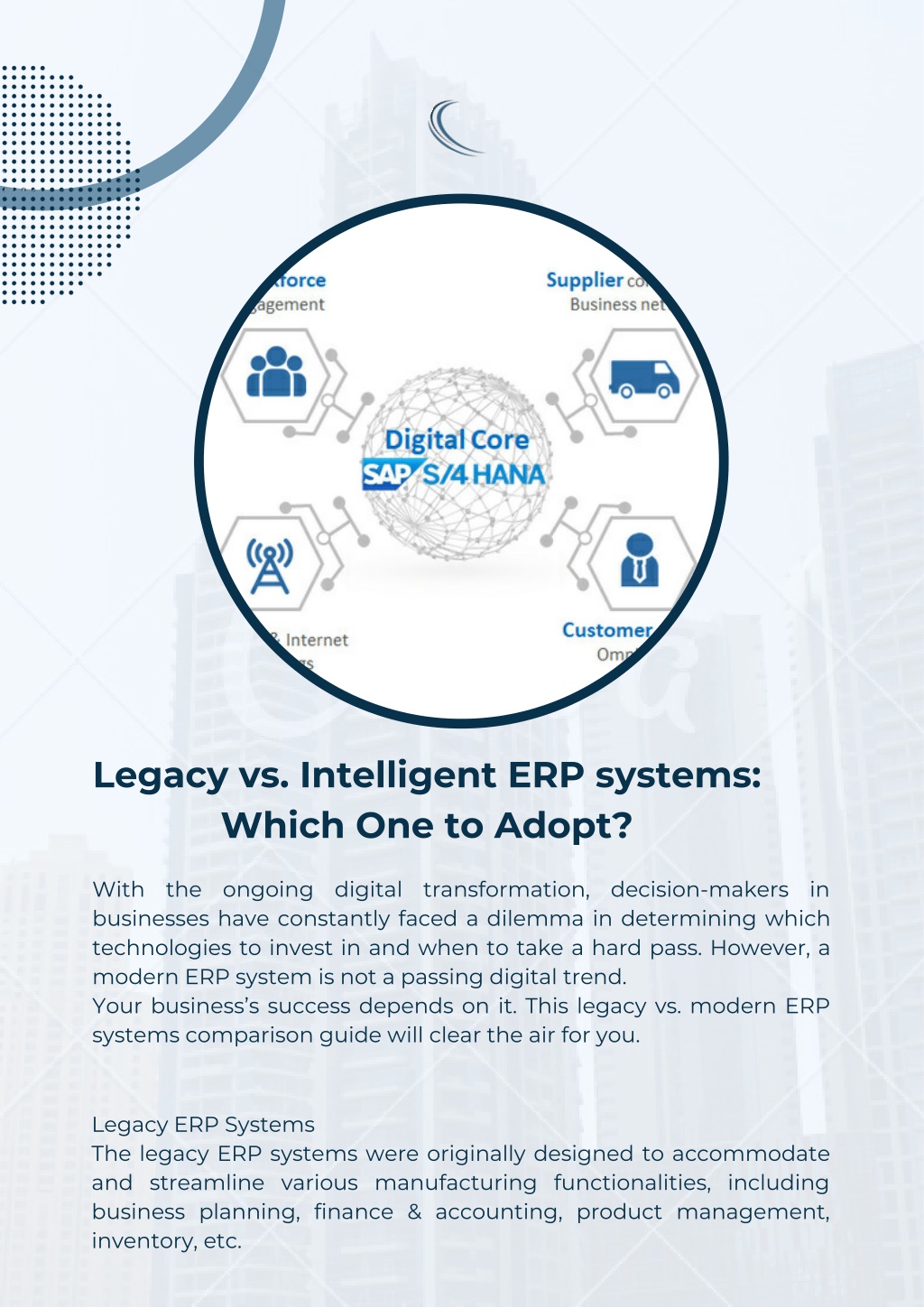
Legacy vs. Intelligent ERP systems Which One to Adopt

aciinfotech12 avatar
2 diapositives · 44 Views · Sep 02, 2022

The legacy ERP systems were originally designed to accommodate and streamline various manufacturing functionalities, including business planning, finance & accounting, product management, inventory, etc. Visit us!
Legacy vs. Intelligent ERP systems Which One to Adopt - slide 1
01 / 2Legacy vs. Intelligent ERP systems Which One to Adopt
1 / 17

Télécharger la présentation

Legacy vs. Intelligent ERP systems Which One to Adopt
Une image / un lien ci-dessous est fourni (tel quel) pour télécharger la présentation

Politique de téléchargement : le contenu du site vous est fourni TEL QUEL pour votre information et votre usage personnel ; il ne peut être vendu, concédé sous licence ni partagé sur d’autres sites sans l’accord de son auteur.Le contenu vous est fourni TEL QUEL, pour votre information et votre usage personnel uniquement. Téléchargez la présentation en cliquant sur ce lien. Lors du téléchargement, si vous ne parvenez pas à télécharger une présentation, l’éditeur a peut-être supprimé le fichier de son serveur.Pendant le téléchargement, si vous ne parvenez pas à obtenir une présentation, le fichier a peut-être été supprimé par l’éditeur.

F I N

Plus de contenu associé

Transcription de la présentation
  1. Legacy vs. Intelligent ERP systems: Which One to Adopt? technologies to invest in and when to take a hard pass. However, a modern ERP system is not a passing digital trend. Your business’s success depends on it. This legacy vs. modern ERP systems comparison guide will clear the air for you. With the ongoing digital transformation, decision-makers in businesses have constantly faced a dilemma in determining which Legacy ERP Systems The legacy ERP systems were originally designed to accommodate and streamline various manufacturing functionalities, including business planning, finance & accounting, product management, inventory, etc.

  2. They were built using legacy programming and installed physically on the manufacturing site. Every time a manufacturer needed multi- site capabilities, separate legacy ERP systems were stationed at different sites and if additional features were required, they had to be programmed separately too. While the once-innovative technology worked fantastically for a while, it could not sustain the growing need for more functionalities. Ultimately, that led to siloed departments and repeated downtimes. On top of it, people had to extract and analyze data manually. If your business still has a legacy ERP system, it’s likely hampering your ability to gain a competitive advantage and thrive in a volatile market. Modern ERP Systems Modern ERP systems refer to cloud-based solutions that support company-wide deployment, several personalization, and centralization. They outperform legacy ERP systems in every aspect. According to the 2020 Accenture ERP Report, about 46% of businesses are using cloud-based (private cloud) ERP solutions, while 25% are using on-site ERP systems. Interestingly, 17% of them have deployed hybrid ERP, which is a combination of cloud-based and on-site ERP systems. integrations, scalability, Also, it’s not just manufacturing companies that require ERP today. Though most companies with a supply chain are better off using an ERP system, almost any business can leverage it. Prominent examples include hospitality, construction, nonprofit groups, healthcare, etc. So, are you missing out on something by not implementing a modern ERP system? The following section will make that clear for you.