Download
1 / 9
90 likes | 259 Vues
This presentation by Thomas Packer explores the potential and challenges of Semantic Web technologies as outlined by Ian Horrocks. The current web, while user-friendly, can evolve into a more intelligent tool through improved knowledge representation, natural language processing, and agent systems. Key challenges include understanding distributed information and natural language semantics. Horrocks emphasizes that while a full realization of the Semantic Web is still distant, existing technologies like OWL and RDF are crucial for developing high-value applications and enriching data extraction from web pages.

E N D
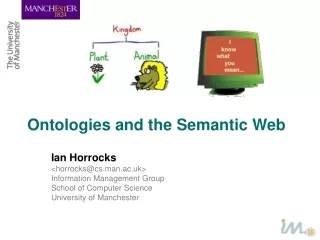
Ontologiesand the Semantic Web by Ian Horrocks presented by Thomas Packer
Overview • The current web is simple and usable. • More could be done to build more intelligent tools (agents). • Doing this requires solving hard problems: • Knowledge representation and reasoning • Natural language processing • Computer vision • Agent systems • “My aim here is to show here that even if a full realization of the Semantic Web is still a long way off, Semantic Web technologies already have an important influence on the development of information technology.”
Challenges • Natural language: • Page says “Harry Potter has a pet named Hedwig.” • Search for pages about wizards owning raptors. • Solution: interpret and represent in machine readable format. • Distributed information: • Ask a question whose answer is not found on one page. • Solution: Integrate facts in integratable formats.
Challenge Solved • Page says “Harry Potter has a pet named Hedwig.” • Search for pages about wizards owning raptors.
OWL and Class Definitions • Extensional Definition • Intensional Definition
Use of Description Logic in OWL Ontologies • Infer new facts • Unlike databases with a closed-world assumption (e.g. unasserted information is assumed false) • Temporary inconsistency allowed • Unlike database that prevent assertions that violate constraints (e.g. unique names) • Warnings in a ontology development environment to guide debugging.
Conclusion • OWL and RDF are good tools, particularly in applications where • Information has high value • The schema plays an important role • Information may be incomplete • They are working on making it more expressive (OWL 2 and SWRL), scalable and modular. • Will be more useful as more people use them and provide tools for working with them. • Our research could make use of existing knowledge, plus reasoning, to do better information extraction from web pages.