Evolving Paradigms in Public Administration: Insights from Developed Nations
This article explores the evolution of Public Administration (PA) systems in developed nations, highlighting key characteristics that distinguish them from developing systems. It discusses historical growth through major revolutions and pivotal shifts, including the rise of neoconservative governments and the Keynesian model post-Great Depression. The discussion offers insights into old vs. new paradigms in PA, illustrating how paradigms shape research and practice within the field. A notable quote from John Maynard Keynes emphasizes the role of government in addressing unmet societal needs.

Evolving Paradigms in Public Administration: Insights from Developed Nations
E N D
Presentation Transcript
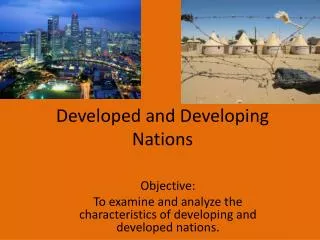
TOPICS • Quote of the day • Evolution of PA in developed systems • Similar but not equal • Key characteristics of developed vis a vis developing PA systems • Historical growth of government • Paradigms in Public Administration Old PA Paradigm shift: the New Public Administration The New Public Service: A new paradigm?
Quote of the day “The important thing for Government is not to do things which individuals are doing already, and to do them a little better or a little worse; but to do those things which at present are not done at all.” John Maynard Keynes: The End of Laissez-Faire (London, 1926) Cited in Oser (1970:394)
Evolution of PA in developed systems • According to Jreisat three revolutions (English 1688, American 1776 and French 1785) marked the development of modern political thought which provides the fundamentals of modern social organization. • The liberal state that emerged from these revolutions emphasized the following:
Historical growth of government • There exist three inflexion points in the historical growth of government • The great depression ended the laissez-faire dream and opened the door to government intervention often known as the Keynesian model. • The postwar years (1945-1970) of the welfare state expanded government action from macroeconomic management towards redistribution . The Old Public Administration. • The raise of neoconservative governments (Reagan & Thatcher) and the New Public Administration philosophy.
USA Government Expenditures (Billions) Source: Holcombe:1996
USA Gov. Expenditures as % of GDP Reagan Years Great Depression WWII Ends Source: Holcombe:1996
INTERNATIONAL COMPARISONS Source: Savas 2000:20 * INEGI
Federal Employment Per 1000 Source: OECD Public Management Service
Source: OECD for employment and expenditures Corruption index 1 most corrupt 10 least corrupt: Source The Economist
Paradigms in PA • It guides research on problems and solutions • A paradigm governs in the first instance, not a subject matter, but a group of practitioners • A paradigm commits the group of practitioners to a disciplinary matrix (methods, language, questions, values, etc.) • There will be “paradigm shifts” or “paradigm competition” but never a lack of paradigm (s) unless the field becomes simply speculative and unscientific. To reject a paradigm without substitution is to reject science itself • PA revolves around three main paradigms: Old PA, New PA, and New Public Service
Paradigm Competition Source: Denhardt & Denhardt (2003: 28-29)
(Knowledge Management) Notes: Group 1: Countries whose scores on the average of the two indicators are significantly above the average of OECD member countries: x>(average*std*(2^(-1/2)))Group 2: Countries whose scores on the average of the two indicators are not significantly different from the OECD average. (average+std*(2^(-1/2)))>x>(average-std*(2^(-1/2)))Group 3: Countries whose scores on the average of the two indicators are significantly above the OECD average: (average-std*(2^(-1/2)))>x