Download
1 / 13
130 likes | 247 Vues
This text delves into various investment alternatives and accounting methods, including the Cost Method, Equity Method, and classifications like Held to Maturity (HTM), Available for Sale (AFS), and Trading Securities. The discussion highlights how these investments are valued, reported, and the implications of unrealized gains and losses on financial statements. Key topics also include bond accounting, impairment reporting, and significant influence in investments, ultimately providing insights into proper accounting practices for different investment strategies based on intermediate accounting principles.

E N D
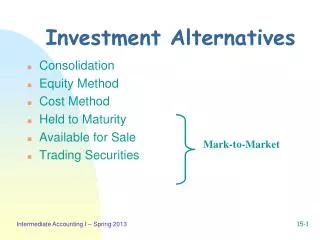
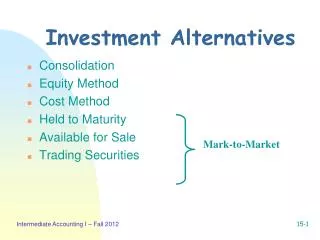
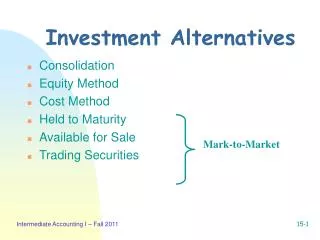
Investment Alternatives • Consolidation • Equity Method • Cost Method • Held to Maturity • Available for Sale • Trading Securities Mark-to-Market Intermediate Accounting I – Fall 2011
Investment Alternatives • Note the Tables on p. 621 and 644 • Keep significant influence in mind Intermediate Accounting I – Fall 2011
Held to Maturity • Bond accounting • Bond valuation • Investment revenue • Bond amortization table • Discounts and premiums More in Chap. 14 Intermediate Accounting I – Fall 2011
Trading Securities • Unrealized holding gains & losses: in earnings • Under SFAS 157, Fair Value Measurements, a valuation allowance is now used to revalue the investment • Note treatment of gain or loss on sale Intermediate Accounting I – Fall 2011
Available for Sale • Same as accounting for trading securities except for OCI treatment • Record at cost • Dividends & interest: in earnings • Realized gains & losses: in earnings • Unrealized holding gains & losses: in OCI • See p. 629 Intermediate Accounting I – Fall 2011
Reporting • Balance sheet • Income statement • Statement of cash flows • Trading: operating cash • Other: investing cash • Statement of shareholders’ equity Intermediate Accounting I – Fall 2011
Permanent Impairment • Adjust & include in earnings • Continue with normal accounting for HTM and AFS after the impairment Intermediate Accounting I – Fall 2011
Transfers • Mark-to-market first • To trading: include unrealized holding gains & losses in earnings • From trading: no P & L adjustment • HTM to AFS: unrealized holding gains & losses in OCI • AFS to HTM: amortize unrealized holding gains & losses Intermediate Accounting I – Fall 2011
Fair Value Options • SFAS 159 • Irrevocable • Simply treat the HTM or AFS security as a trading security • P. 637 and 653 Intermediate Accounting I – Fall 2011
Disclosure • Aggregate fair value • Gross realized & unrealized holding gains • Gross realized & unrealized holding losses • Change in net unrealized holding gains & losses • Amortized cost basis by major security type--see p. 642 Intermediate Accounting I – Fall 2011
Investor Has Significant Influence—the Equity Method • Again note the impact of significant influence • Record at cost • Reflect % of net inc. or loss in investment acct. • Zero floor concept • Decrease invest. acct. for div. rec’d. • Acquisitions in excess of BV-p.647-649 • Fair value option is also available: separately reported Intermediate Accounting I – Fall 2011
Significant Influence • Generally between 20% and 50% ownership • Exceptions: see p. 644 Intermediate Accounting I – Fall 2011
Change in Circumstances • From equity: discontinue equity • To equity: restatement & adjustment to R/E Intermediate Accounting I – Fall 2011