Entomology
Entomology Original PowerPoint by Mark Morgan Modified by Georgia Agriculture Education Curriculum Office November 2005 What is Entomology? the branch of zoology that deals with the study of insects

Entomology
E N D
Presentation Transcript
Entomology Original PowerPoint by Mark Morgan Modified by Georgia Agriculture Education Curriculum Office November 2005
What is Entomology? • the branch of zoology that deals with the study of insects
• On average there are more than 750,000 species of insects that have been identified worldwide.
There are only approximately 10,000 species of insects that are harmful to humans.
Problems • Deadly epidemics of the past have been caused by diseased organisms carried by insects. • Example: Bubonic Plague epidemic that wiped out the population of Europe in the 14 century was carried by fleas that infested rodents
Classification of insects: • Kingdom • Phyla • Class • Order • Family • Genus • Species
The highest level is the Kingdom • The most specific is the species level. • Organisms are usually classified by the genus and species. • This is called a binomial nomenclature.
Six orders of insects: • Orthoptera- which includes the grasshopper and locust • Hemiptera- which includes the true bugs such as leaf hoppers and plant bugs • Lepidoptera – moths and butterflies • Homoptera- aphids
Cont’d… • Thysanoptera- thrips • Coleoptera- which is the largest group of the insect orders this has beetles
How are insects grouped? • by the way they feed on plants • by their mouth parts
Six Mouth Parts • Sponging • Rasping- sucking • Siphoning • Chewing-lapping • Chewing • Piercing- sucking
Insects have no internal skeleton and they rely on their hard outer coating, exoskeleton, which protects their inner organs and supports their body.
Parts of an Insect • Head • Thorax • Abdomen
Head • Has a pair of compound eye and two sensory appendages called antennae
Thorax • is divided into three segments from which are attached three pairs of legs
Abdomen • is attached to the thorax • which will contain more segments
Life Cycles • Incomplete Metamorphosis • Complete Metamorphosis
Incomplete Metamorphosis • Eggs • to Early nymph (no wings) • to late nymph (wings developing) • Goes to Adult
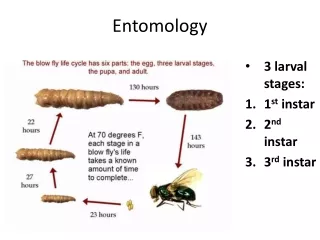
Complete Metamorphosis • Eggs to • Larva to • Pupa to • Adult
What Is a Larva? • It is when the young insect has soft tubular body and looks very much like a worm
What Is the Pupa Stage? • The larva matures and will pass through the pupa stages which is usually a relatively dormant stage.
What is DDT? • This is a chemical that was discovered by German name Othmar Zeidler in 1874. • It is a chemical used to reduce the number of insects in a given area. • Example: mosquitoes in the tropics
Integrated Pest Management • Cultural methods • Insect diseases and predators • Pheromones • Release of sterile males • Insect resistant plants varieties