Parallelization: Conway’s Game of Life
This document explores the parallelization of Conway’s Game of Life, a well-known cellular automaton with applications in various scientific fields such as biology, ecology, and cognitive science. It discusses the essential rules that govern cell states and the methods used to simulate the game's evolution through different computational paradigms including distributed and shared memory systems. Key topics include the architecture for parallel processing, load balancing strategies, message passing standards like MPI and OpenMP, and algorithmic design for effectively managing concurrent executions.

Parallelization: Conway’s Game of Life
E N D
Presentation Transcript
Cellular automata: Important for science • Biology • Mapping brain tumor growth • Ecology • Interactions of species competing for resources • Cognitive science, hydrodynamics, dermatology, chemistry, environmental science, agriculture, operational research, and many others
Cellular automaton • Has a grid of cells • Performs functions automatically • Exhibits chaotic behavior – initial set of conditions produces random result after certain number of time steps
Neighborhoods Von Neumann Moore
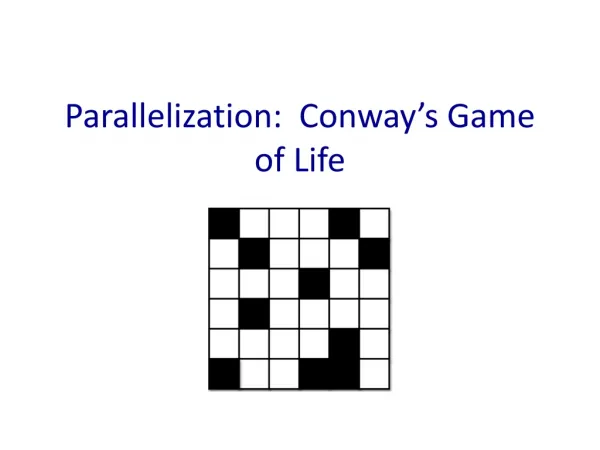
Conway’s Game of Life • 2 cell states: ALIVEand DEAD • 4 rules: • If a cell has fewer than 2 ALIVEneighbors, it will be DEADin the next time step • If an ALIVE cell has 2 or 3 ALIVEneighbors, it will be ALIVE in the next time step • If a cell has more than 3 ALIVE neighbors, it will be DEAD in the next time step • If a DEAD cell has 3 ALIVE neighbors, it will be ALIVE in the next time step
How do we simulate? • Small board: with pencil and paper • Beyond a small board: single computer • Even bigger: parallel processing • Bigger and bigger: cluster computer
Parallelism • Concurrency (doing things at the same time) • Multiple flows of execution (virtual entities that perform computations) working on the same problem • Distributed Memory • Shared Memory • Hybrid
Flows of execution • Processes • Distributed memory • Must communicate (message passing) • Threads • Shared memory • Processes with threads • Hybrid
Parallel hardware • Multiple coreson a single compute node • Shared memory • Multiple compute nodessharing a network • Distributed memory • Multiple compute nodes with multiple cores sharing a network • Hybrid
What are some standards? • Message Passing Interface (MPI)– distributed memory/message passing • OpenMP– shared memory • MPI/OpenMP- hybrid
How to approach the parallel algorithm • State clearly the goalof the algorithm • Use the goal to determine the algorithm’s data structures • Identify the datathat will be contained within the data structures and parallelized • Determine load balancing • Determine the parallel tasksthat are performed on the data – draw pictures and write descriptions • Determine message passing • Create a written representation of valuesneeded for the parallel tasks • Develop pseudo-codefor the algorithm
Considerations • Assume hybrid parallelism • Distributed memory, shared memory, or serial can be refined from hybrid • Hybrid on 1 thread per process is just distributed memory • Hybrid on 1 processis just shared memory • Hybrid on 1 thread and 1 processis just serial • The entire codeis executed by eachprocess • Threads only execute code for which they are spawned
What is the goal of the algorithm? • A grid of cells is updated at each time step for some number of time steps based on the rules of Conway’s Game of Life.
What are the algorithm’s data structures? • A grid of cells is updated at each time step for some number of time steps based on the rules of Conway’s Game of Life.
What data is parallelized? • Each process receives a certain number of rows • Each thread receives a certain number of columns