Download
1 / 21
210 likes | 327 Vues
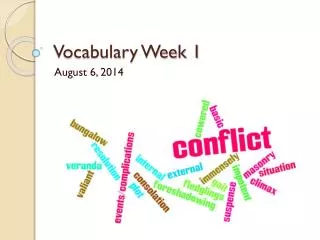
This resource introduces fundamental vocabulary and key concepts essential for understanding storytelling. Key terms such as "bungalow," "veranda," and "masonry" provide insight into descriptive language, while concepts such as "conflict," "climax," and "resolution" explain the structure of narratives. Additionally, vocabulary such as "valiant," "immensely," and "impotent" enriches language skills. Understanding terms like "foreshadowing" and "suspense" enhances a reader's ability to engage with texts meaningfully, making it an excellent tool for writers and literature enthusiasts alike.

E N D
Vocabulary Week 1 August 7, 2012
Bungalow • A type of low, one-storied house
Veranda • An open porch covered by a roof
Immensely • Enormously
Cowered • Crouched and trembled in fear
Gait • Way of walking or running
Masonry • Something built of stone or brick
Valiant • Brave and determined
Consolation • Comfort
Fledglings • Baby Birds
Impotent • Powerless
Plot • What happens in a story
Climax • The story’s most emotional or suspenseful point
Suspense • What makes you want to continue reading
Resolution • End of the story when all of the loose ends are tied up
Conflict • Struggle or clash between two or more characters or forces
Basic Situation • First thing you read; sets the stage for the action
Events/Complications • Things that make it hard for characters to solve their problems or work out their conflicts
External Conflict • Struggles between two or more outside characters or forces
Internal Conflict • Struggles that take place within a person
Foreshadowing • The use of hints or clues to suggest what will come later in the story